The new ranking

Supercomputers, Europe narrows the gap with the US. Three new Italians in the Top500

The 65th edition of the Top500 has been published. The German supercomputer Jupiter Booster takes fourth place and advances Europe in the comparison with the USA. The Italian supercomputers in the rankings rise from 14 to 17: Pitagora-Cpu (Cineca), SpaceHPC (Esa Italia) and Cresco 8 (Enea) enter the list

by Antonio Larizza

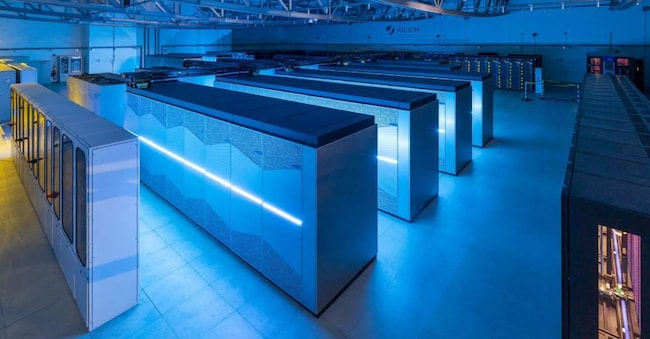
Centro di supercalcolo di Jülich, in Germania

3' min read

3' min read

With El Capitan, the United States still leads the Top500 ranking of the world's most powerful supercomputers, but Europe narrows the gap. Germany switched on the Jupiter Booster, heralded as the first exascale-class supercomputer funded by the EuroHPC project: the German machine, operated by the Jülich Supercomputing Centre, was the fourth most powerful supercomputer in the world. Italy contributes to the European run-up by placing three new supercomputers in the rankings. But in the inter-country comparison it is surpassed by Germany.

This is the picture that emerges from the 65th edition of the Top500, the ranking that has updated the list of the world's most powerful supercomputers every six months since 1993. The one we comment on here was released on 10 June 2025 and updates the previous edition of November 2024.

Loading...

VIAGGIO NELL’ITALIA DEL SUPERCALCOLO

Loading...

United States in Command

The El Capitan system retains the number one position in the rankings and confirms the US lead. El Capitan, Frontier and Aurora are now the top three exascale systems. All three are installed at Department of Energy (DOE) laboratories in the United States.

Germany breaks the mould

.

In fourth place, however, comes a European supercomputer. It is the German Jupiter Booster. It is the only new machine to enter the Top 10 and, once fully operational, it will also be the first exascale-class supercomputer made in Europe, built as part of the European Union's EuroHPC programme, which brings together private and public resources and aims to close the gap with the United States in terms of installed computing power.

Jupiter Booster is currently being commissioned and has achieved a preliminary power value of 793.4 Petaflop/s (and 930 Petaflop/s peak power) using only part of its computing infrastructure. This alone, however, was enough to take fourth place in the overall ranking. Managed by the Jülich Supercomputing Centre, it is based on Eviden's fully liquid-cooled BullSequana XH3000 architecture.

Supercomputer Leonardo, come sarà l’AI Factory di Bologna

Europe narrows the gap with the US

.

The comparison by number of active supercomputers shows some interesting dynamics. The United States added two systems to the list, bringing the total number to 173. By contrast, China reduced the number of representative machines from 63 to 46 and, as in the previous list, introduced no new machines. It would therefore appear that Beijing has, at this stage, decided not to subject its supercomputers to the preparatory tests for inclusion on the list (which remains voluntary). On the European front, Germany continues to close the gap, now with 43 machines on the list.

Looking at the number of supercomputers in the Top500 aggregated by continent, North America leads with 187 machines, followed by Europe with 163 and Asia with 135.

Looking instead at the power ratio by installed computing power, the percentage share attributable to European supercomputers in the ranking rises from 27.4% in November 2024 to 33.1% today. That of the United States, over the same period, drops from 55.6% to 48.9%. Europe thus narrows the gap with the US by 12.4 percentage points: the US-European gap drops from 28.2 to 15.8 percentage points.

Italy puts three new supercomputers in the Top500

.

An achievement to which Italy also continues to contribute. In this edition of the Top500, the number of Italian supercomputers in the rankings grows. Enter Pitagora-Cpu of Cineca in Bologna (104th in the ranking), Cresco 8, the supercomputer with which Enea aims to accelerate research into nuclear fusion (230th in the ranking) and SpaceHPC, switched on at the Italian headquarters of the European Space Agency (in 263th place).

In the comparison between countries, Italy loses third place in the world rankings - led by the United States with Japan in second place - precisely because it is overtaken by Germany. Our country is a candidate to regain positions in the next rankings, thanks to the new supercomputer that EuroHPC and Cineca are building in the Ai Factory in Bologna and that will be 40 times more powerful than Leonardo, Cineca's supercomputer that in the new ranking from ninth place drops back one position, but still remains in the Top10.

Italy's most powerful supercomputer, Eni's Hpc6, retains its top spot but falls back one place, from 5th to 6th in the world rankings.

Supercomputer: ecco Hpc6, il più potente d’Europa

AMD processors dominate the Top10

.

The 65th edition of the Top500 found that AMD and Intel processors are the preferred option for systems in the Top10. Five systems use AMD processors (El Capitan, Frontier, HPC6, LUMI and Alps), while three systems use Intel processors (Aurora, Eagle, Leonardo). Jupiter Booster is based on a Grace Hopper Superchip and Fugaku continues to use a proprietary, ARM-based Fujitsu A64FX.

Green500 unchanged

.

The 65th edition saw no changes in the Green500 ranking, which measures the energy efficiency level of supercomputers. In first place is confirmed the German supercomputer Jedi, followed by the French Romeo-2025 and Adastra 2, in second and third place respectively.

Copyright reserved ©
Loading...

Brand connect

Loading...

Newsletter

Notizie e approfondimenti sugli avvenimenti politici, economici e finanziari.

Iscriviti