
Supercomputing is accelerating the energy transition and is becoming a strategic infrastructure

Major industrial challenges are increasingly being tackled through virtual simulations rather than in actual physical facilities. This is reflected in a now well-established trend: the ability to process enormous amounts of data within tight timeframes, to develop and train artificial intelligence models, and to digitally replicate the behaviour of materials, processes and infrastructure has become one of the key drivers of competitiveness and innovation for a nation’s economy. And it is on this frontier that supercomputing is assuming the role of a strategic and essential infrastructure for the growth of industry and the research sector, as well as for energy transition objectives.
The gradual spread of AI has further accelerated this process, given that large generative models, as well as the ‘digital twins’ used to replicate the behaviour of industrial plants, networks and systems, require an unprecedented level of computational power. It is therefore no coincidence that Europe has identified the integration of High-Performance Computing and artificial intelligence as one of the pillars of its technology strategy, investing in the EuroHPC supercomputer network and in the development of new AI Factories to strengthen the Old Continent’s digital sovereignty. The trend in global investment in AI infrastructure confirms the scale of the phenomenon: according to leading market research firms, global spending in 2025 was more than double the levels recorded the previous year.
From energy to materials: where supercomputing makes the difference
According to many experts, the energy sector is one of the areas where the transformation driven by AI is most evident, given the increasingly pressing need to balance security of supply, competitiveness and decarbonisation. This transition requires an ever-deeper understanding of physical phenomena and simulation capabilities capable of reducing the time, costs and risks associated with research; supercomputing meets these needs by providing the tools to develop very high-resolution geological models, simulate the behaviour of fluids in reservoirs, optimise plant design and accelerate the development of new materials for batteries, photovoltaic cells and greenhouse gas capture systems.
At the same time, a reliable and highly scalable computational platform enables increasingly accurate atmospheric simulations to improve the output of renewable energy plants and tackle extremely complex scientific problems, such as the study of plasma in magnetic confinement fusion. The growing convergence between HPC (High-Performance Computing) technologies and artificial intelligence technologies is the other side of the same coin: the availability of vast computing resources makes it possible to develop specialised models trained on industrial data, thereby making predictive maintenance, plant monitoring, process optimisation and the analysis of complex scenarios more efficient. For businesses, the benefits are clear: being able to rely on proprietary infrastructure – integrated with the cloud yet dedicated to the most strategic applications – represents a key element of technological autonomy and safeguards the assets of data and expertise that can make all the difference in an increasingly global competitive landscape.
HPC7: Eni’s latest technological leap
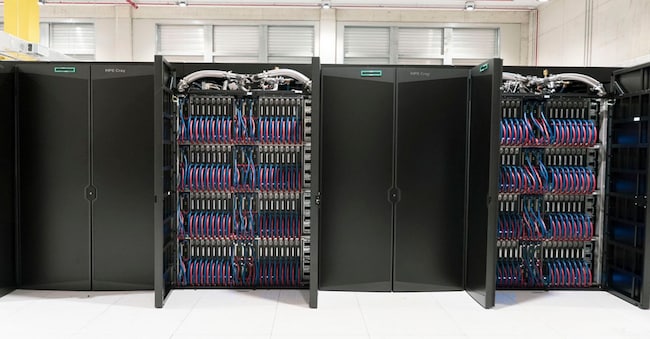
HPC7, Eni’s new supercomputer, which came online in recent weeks with a sustained capacity of over 571 Pflop/s and a peak capacity of 861 Pflop/s, ranks sixth in the global TOP500 list and second in Europe, once again proving to be the world’s most powerful supercomputer for industrial use. Performance aside, however, the system’s distinctive and truly valuable feature lies in its ability to operate in synergy with HPC6, the supercomputer due to come online in 2024: the combination of the two machines in fact exceeds the exascale threshold, achieving over one exaflop per second of computational capacity (more than a billion billion complex mathematical operations every second). Computing power on this scale significantly expands research and development opportunities across the entire value chain, from subsurface characterisation to geological and fluid dynamics studies dedicated to CO₂ storage, right through to the development of new materials and biofuels. A computing platform such as the one developed by Eni also constitutes an infrastructure supporting the development of specialised artificial intelligence models for the energy sector, enabling the integration of numerical simulation and AI models into internally developed applications to support various business activities.
Another distinctive feature of the project is the speed with which HPC7 was implemented; it was designed and commissioned by leveraging the specialist expertise developed within the company through a process that began as early as the 1970s and has been consolidated, since 2013, with successive generations of HPC infrastructure. Thanks to a ‘fast-track’ approach, the system was in fact made operational in around ten days, drastically reducing timescales which, for systems of this complexity, are normally measured in months. HPC7 is housed, alongside HPC6, in Ferrera Erbognone’s own Green Data Centre in the province of Pavia, one of the European centres best equipped to meet the challenge of combining high performance with energy efficiency. The direct liquid-cooling system used in HPC6 and HPC7 dissipates around 96 per cent of the heat generated, whilst a dedicated photovoltaic system also helps to power the entire site. This focus on sustainability is further confirmed by HPC7’s inclusion in the Green500, the international ranking that measures the energy performance of supercomputers, where this supercomputer ranks among the top in its category.
This technological ecosystem also represents a distinctive asset for Eni, as it is able to attract new initiatives and talent from outside the company, as has already been the case with HPC6 through the Call4Innovators initiative. Eni has, in fact, opened up its supercomputing infrastructure to businesses, start-ups and research centres, providing computational capacity, specialist expertise and advanced tools to develop artificial intelligence solutions and digital innovation. Among the first organisations to show interest in the initiative are Domyn, Mercuria, Dompé, Almawave, Reply and the Bruno Kessler Foundation. Access to Eni’s supercomputing capabilities will be provided via AI services, with the aim of utilising infrastructure, data and models securely and competitively, in line with Italian and European industrial and institutional interests and in support of digital sovereignty.
For Eni, the completion of this exascale computing project represents a dual strategic milestone upon which to build industrial competitiveness for the coming decade: on the one hand, leveraging state-of-the-art technological infrastructure to support both traditional business activities and those linked to the energy transition, and on the other, having a platform open to innovation, capable of fostering new collaborations with the research community and attracting further specialist expertise to accelerate the development of next-generation digital solutions.

