Saving Recipes
How does Eurospin establish itself as the most money-saving retailer? According to Altroconsumo, a family of four, with an average annual expenditure of EUR 9,276 according to ISTAT, can save up to EUR 3,700 over twelve months by opting for the cheapest products on the shelves. Even by opting for a trolley made up exclusively of the brand's products, the savings remain substantial. In this case, it is Carrefour that guarantees the greatest economic advantage, with a reduction of up to EUR 3,308 per year. For households adopting a more flexible approach, buying a mix of branded products, private labels and economy items - the so-called mixed shopping basket - the savings depend strongly on the distribution channel chosen. Doing a mixed shopping at a discount store can result in annual savings of EUR 2,838 by choosing In's Mercato, the cheapest chain in this category. However, the advantage is considerably reduced if you buy the same products in a hypermarket or traditional supermarket: even in the best case scenario, with Famila, the savings stop at 208 euro per year. Finally, those who prefer branded products can achieve savings of up to 506 euro per year, once again by turning to Famila. However, this is a modest result compared to the price variability found during the survey: the articles of the best-known brands show the widest price fluctuations, with differences in some cases exceeding 100 per cent between one shop and another. In other words, the same product can cost twice as much depending on the supermarket chosen.
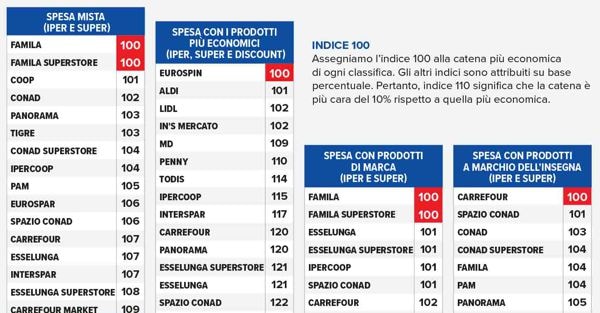
the scenario most representative of real behaviour is that of mixed shopping. Among hypermarkets and supermarkets, the leader in convenience is Famila (together with Famila Superstore), which again this year comes out on top (index 100). They are followed at a very short distance by Coop (index 101) and Conad (102). As far as mixed shopping in discount stores is concerned, the first position is occupied by In's Mercato (index 100), which stands out for its highly competitive prices. In the absence of an In's shop nearby, Eurospin (index 102) and Lidl (index 106) are good alternatives.
Discounters are the stable leaders in terms of convenience. Leading this year in the category of cheapest products is Eurospin, which is back on top after losing ground in the last two editions of the Altroconsumo survey. The second step of the podium is occupied by Aldi (index 101), while in third place are In's Mercato and Lidl (ex aequo, index 102). The comparison between discounters and traditional retail chains shows the widest price gap in this category: a significant distance that reflects the different commercial strategy and strong savings orientation of discounters. To find a non-discount chain one has to scroll down to the seventh position, occupied by Ipercoop (index 115), reflecting the gap that still persists between different distribution models.
Towns that go save that you find
The shopping receipt is also affected by the territory and Altroconsumo measured the sales prices of 67 cities. The best ranking (index 100) is the Iper Rossetto in Marcon, in the province of Venice. The Rossetto chain has steadily dominated the ranking for years: five of its shops are in the top ten positions. Among the cities in the Veneto region, it is Verona that stands out for the high concentration of competitive shops, with numerous shops in the top 30. In second place is Iperal in Como, followed by three Mega shops in Pordenone, Udine and Treviso. For Central and Southern Italy, Coop.fi in Sesto Fiorentino and a Dok Supermercati outlet in Taranto respectively stand out. At the bottom of the ranking, the outlets with the highest prices are a Despar in Cagliari (index 131) and a Sigma in Bologna (index 132).
The cities of Northern Italy are confirmed as the most dynamic from a competition point of view. In Como, for example, one can save up to EUR 1,386 per year by choosing the cheapest outlet. Significant margins are recorded in Rome and Bologna, where the difference between the cheapest and the most expensive store is over EUR 1,300 per year; in Milan the gap is slightly smaller, but still significant. The opposite scenario in the South, where competition between chains is much more contained. In Naples and Caserta, the maximum savings obtainable in one year by choosing the best outlet even stops below EUR 50. As far as Central Italy is concerned, in Florence, potential savings can be as high as 970 euro, while in other cities such as Perugia, Arezzo, Pisa, Pescara, Latina and Prato, the price range fluctuates between around 400 and 700 euro per year. Surprisingly, the record for savings goes to Venice, where a careful family can keep its annual expenditure within 6,260 euros. Como (6,282 euros) and Verona (6,386 euros) are also doing well. On the opposite front, Sassari ranks as the least economical city, with a minimum expenditure that does not fall below 7,410 euros per year.