
Superyachts, go for sustainable moorings that safeguard the seabed
Seares has created a system that can generate green electricity from wave motion and protect posidonia meadows

Key points
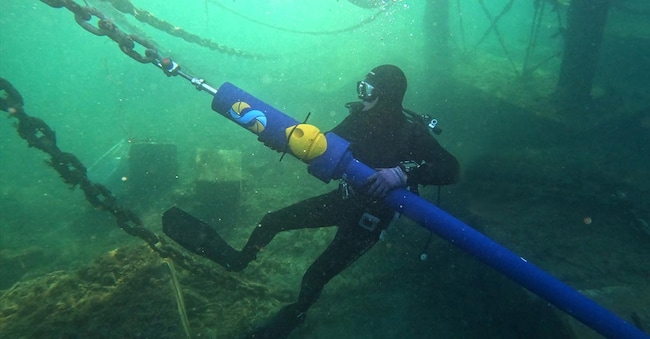
Transforming yacht moorings into systems capable of performing a dual function: adapting to the increasingly large size of boats mooring in ports, reducing peak loads on the quays, and offering a technology capable of recovering energy from wave motion, allowing part of that generated by the boat's movements to be converted into electricity that can be used to power quay services. The project was realised by Seares, a small Tuscan company, founded in 2018 by a team of engineers specialised in mechanics and mechatronics. Thanks to a system called Seadamp, it succeeds in dampening the direct and indirect effects of moorings on quays and seabeds and, as far as the latter are concerned, it is contributing, in particular, to the preservation of posidonia oceanica, one of the main bio-indicators of seabed health.
Currently, explains Giorgio Cucè, CEO of Seares, "Seadamp technology is covered by 13 international patents, protecting the operating principle and applications in intelligent mooring and energy recovery systems, and has been installed on over 1.200 mooring lines, in contexts that include marinas, marinas, yachts, and operational and demonstration installations (including Yacht Club de Monaco, Marina di Pisa, Marina Cala dei Sardi, Agroittica, Snam, North Tyrrhenian Sea Port System Authority, ndr)'. The idea to create the project arose from two distinct factors that coexist in Italian ports, but not only: a lack of mooring infrastructure suitable for large yachts and the general desire of ports to participate in the ecological transition.
Italy's first superyacht builder but inadequate docks
Italia, Cucè recalls, "is the world's leading builder of superyachts: there are 568 units under construction in Italian shipyards, with average boat sizes constantly growing. In contrast to this, the infrastructures designed to accommodate them, in many Mediterranean marinas, have mooring systems with technologies that are not suitable for large yachts, often remaining those of 30 years ago. And an inadequately sized mooring can generate structural stress on bollards and docks, accelerated wear and tear, hull damage, and open the way to extraordinary maintenance work on port infrastructures. The issue, therefore, does not only concern the safety of the individual vessel but also the economic and structural sustainability of marinas'.
Seadamp, says the CEO, "is able to reduce peak loads and movements on mooring lines by up to 90 per cent. Unlike traditional elastic solutions, the hydraulic system guarantees constant performance over time and progressively absorbs stresses, distributing them in a controlled manner between the boat and the infrastructure". The system, moreover - and this is where the green element comes into play - is equipped, he continues, with 'wave energy recovery technology that allows part of the energy generated by the movements of the boat to be converted into electricity that can be used to power quay services'.
Green energy from docking system
The berth, says Cucè, "has always been seen as a mere cost centre, a passive element that wears out over time; our goal is to transform it into a centre for the production of green energy, using the power that the sea exerts on port infrastructure every day". This is a process that comes at a time when, increasingly, ports are aiming to become, in addition to simple places of transit for goods and people, hubs capable of producing, storing and distributing clean energy. Moreover, according to the Espo environmental report 2025, 80% of European ports have already set concrete targets to reduce their emissions, despite obstacles related to the impact of climate change and the lack of physical space.


