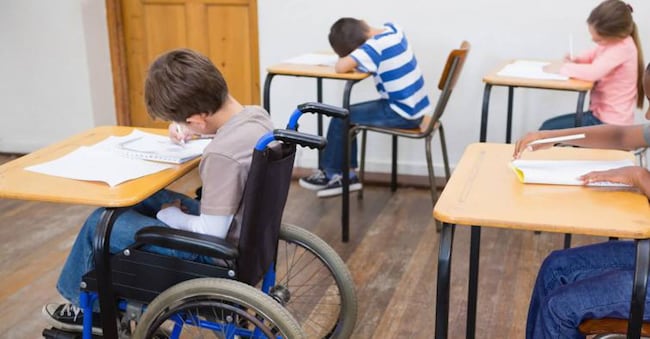
Students with disabilities

Classroom support, 27% of teachers are not specialised

Pupils with special needs account for 5% of the total, but there is still a shortage of specially trained teachers

by Eugenio Bruno and Claudio Tucci (Il Sole 24 Ore), Lena Kyriakidi (EfSyn, Greece) and Ana Somavilla (El Confidencial, Spain)

5' min read

Translated by AI
Versione italiana

5' min read

Translated by AI
Versione italiana

Pupils with disabilities attending Italian schools number around 360,000; a number that grows steadily every year. Compared to the total number of pupils enrolled in school, we are around 5 per cent. There are 246,000 support teachers, over 235,000 in state schools and about 11,000 in non-state schools. They too are growing, but at a slower rate, and are not always trained.

On a national level, the pupil-teacher ratio in Italia is 1.4 (1.7 in non-state schools), better than the ratio set by Law 244 of 2007, which recommends a ratio of two pupils for every teacher. This is the general picture of disability at school, taken from the latest MIM and Istat reports.

Loading...

The needs to be compensated

The pupils with disabilities are predominantly male, 228 for every 100 females. The most widespread problem is intellectual disability, which affects 40% of pupils with disabilities, a proportion that increases in secondary schools, standing at 46% and 52% respectively; it is followed by psychological development disorders (35% of pupils), the latter being more frequent in primary school (39%) and pre-school (63%). Learning and attention disorders affect almost a fifth of pupils with disabilities.

No to special classes

In Italia, and we add fortunately, there are no special or differential classes. This means that pupils with disabilities are fully integrated into the class group, but flanked by support teachers and support figures. The main problem is that the teaching staff cannot keep up with the speed at which disability certifications are growing. So much so that, from one minister to another, temporary solutions are being sought that allow the emergency to be plugged, but do not solve the root of the problem.

Few specialised prof

A serious critical issue is that almost one third of support teachers (27%) today do not have a specialisation. This phenomenon, although decreasing, is still very common in the northern regions, where the share of curricular teachers carrying out support activities stands at 38%, compared to 13% in southern schools. Not only that. Accomplicated by the cumbersome mechanisms of teacher induction, there is often a delay in appointments: one month before the start of lessons, around 11% of support teachers had not yet been assigned.

And then there is the issue of 'educational continuity', which is fundamental for these students. According to ISTAT, more than one student out of two (57% of pupils with disabilities) has changed teacher for support compared to the previous year, a quota that rises to 61% in secondary schools and reaches 69% in nursery schools. The phenomenon is rather stable throughout the territory and with no differences compared to the past. 8.4% of students even change support teachers during the same school year, this happens because the person concerned takes up a post in a subject (and not on support).

The measures deployed

Countermeasures have been taken by a little bit of all governments, starting with the increase of support positions. On training also. In a dozen or so Tfa cycles, universities have specialised around 200,000 teachers. But in eight years, the number of people working with fixed-term contracts has doubled, while every year thousands of posts remain vacant in the permanent staff and the same number in the de facto staff, more than 100,000 of which are in support only. Over the years, moreover, there has been little planning focused on the needs of the territories and also of the schools.

The current government wanted to tackle the situation head on: with the new specialisation courses (managed by Indire or the universities) more than 18 thousand teachers have specialised. In order to guarantee teaching continuity, there is also a rule in force that provides for the confirmation of annual substitute teachers or those appointed until 30 June at the request of families. According to the first MIM data, by September 2025 almost 58 thousand teachers have had their posts confirmed.

A look across the border: Greece and Spain

The picture in Italia, although with clear criticalities concerning staffing, specialisation and educational continuity, is part of a very varied European context. Difficulties are not lacking elsewhere, but organisational models and institutional responses differ significantly.

In Greece, associations of people with disabilities speak of one of the worst school years in recent times for special education. Many parents denounce the refusal of school managers to enrol their children with disabilities in public special primary and secondary schools.

The Federation of Private Education Workers also reported cases of refusal of enrolment in some public schools, formally motivated by priority criteria but, in fact, interpreted as a closure towards inclusion. According to the trade unions, the government has not followed up on the creation of new institutions, which have remained only on paper for years, including several special primary schools and a secondary vocational training workshop in Athens.

The Coordination for the Struggle of People with Disabilities also denounced the lack of health personnel and life-saving devices in some special schools. The death of a 13-year-old student in a special school in Piraeus last November from suffocation during a meal reignited the controversy over safety conditions. Previously, special schools in Thessaloniki and Crete had been closed due to the unsafe condition of the buildings, forcing students to undergo forced relocation or, in some cases, to stay at home due to the financial impossibility of families to resort to private solutions.

Available data indicate more than 16,000 students enrolled in schools for children with disabilities, of whom about 15,600 actually attend, distributed among middle schools, primary schools, special vocational schools, high schools and kindergartens. The organisations call for stable recruitment and the relocation of the schools to safe buildings.

In Spain, education is compulsory from the age of 6 to 16 and attendance rates are very high even among students with disabilities. There is no significant number of children excluded from the school system, but criticism remains from organisations about the conditions and resources available.

The Spanish model combines inclusion in ordinary schools and the presence of special education centres. In recent years, legislation has strengthened the inclusive approach: the Organic Law Modifying the LOE (LOMLOE) aims to strengthen the resources of ordinary schools to accommodate pupils with disabilities.

In the school year 2023-2024, 1,131,816 students received some kind of educational support (14% of the total, +17% over the previous year). Among them, pupils with disabilities represent 3.6% of those enrolled in non-university schools: 85.2% attend ordinary schools, 14.8% special institutions. The most widespread disabilities are autism spectrum disorders (31.4%), intellectual disabilities (24.7%) and severe communication and language disorders (13.9%).

In addition to these, over 838,000 students receive support for educational needs not classified as disabilities (socio-educational vulnerability, learning disabilities, attention disorders, high cognitive potential). The public network receives the largest share: students with special educational needs represent 4% of those enrolled in state schools, 3.6% in subsidised parish schools and 0.8% in public schools.

The system provides for psycho-pedagogical assessments and personalised measures - curricular adaptations, methodological modifications, support in the classroom - while the most complex cases can be referred to special centres with multidisciplinary teams (specialised teachers, guidance counsellors, physiotherapists, speech therapists and, in some cases, health personnel).

*This article is part of the European collaborative journalism project "Pulse"

Copyright reserved ©
Loading...

Brand connect

Loading...

Newsletter Scuola+

La newsletter premium dedicata al mondo della scuola con approfondimenti normativi, analisi e guide operative

Abbonati