
US Supreme Court, who are the justices who voted against Trump's tariffs
The Supreme Court overturned President Donald Trump's far-reaching global tariffs by a vote of 6 to 3
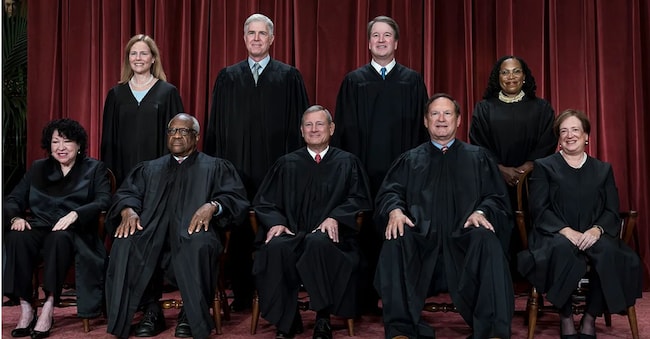
In its ruling which annulled the global tariffs imposed by Donald Trump, the US Supreme Court drew a clear line: the power to impose tariffs belongs to Congress and cannot be exercised unilaterally by the president by invoking emergency powers. With a majority of six out of nine justices, the highest US court thus significantly curtailed the scope of executive authority in trade matters.
Leading the Court is John G. Roberts Jr., appointed in 2005 by George W. Bush. Roberts, considered an institutional conservative who is concerned about the Court's stability, signed the majority opinion. In his reasoning, he emphasised that the International Emergency Economic Powers Act of 1977 cannot be interpreted as an implicit and unlimited delegation to the president to redefine national tariff policy, a matter that the Constitution expressly attributes to the legislature.
Voting with Roberts were two judges nominated by Trump himself, Amy Coney Barrett and Neil M. Gorsuch. Barrett, who joined the Court in 2020 after experience on the federal Seventh Circuit Court of Appeals, is known for her originalist approach and textual interpretation of the rules, but also for a focus on institutional balances. Gorsuch, who has been in office since 2017, is often associated with a strict, historically anchored reading of the Constitution; in this case, he held that the expansion of presidential powers in the commercial sphere exceeded the will of Congress.
The majority also includes the three judges from the progressive area: Sonia Sotomayor, appointed in 2009 by Barack Obama, the first Hispanic to sit on the Court; Elena Kagan, former US solicitor general before her appointment in 2010; and Ketanji Brown Jackson, appointed in 2022 by Joe Biden and the first African-American woman in the Court's history. For them, the decision is also a reaffirmation of the principle of separation of powers and the need for broad economic choices to go through the legislative process.
In dissent were Clarence Thomas, the longest-serving judge, appointed in 1991 by George H. W. Bush, Samuel A. Alito Jr. who joined in 2006 on the recommendation of George W. Bush, and Brett M. Kavanaugh, appointed by Trump in 2018 after a long career between the White House and the federal judiciary. The three judges argued for a broader reading of the powers given to the president in economic emergencies, highlighting the risk that an overly narrow interpretation could weaken the executive's ability to respond promptly to trade imbalances or international shocks.

