Products

Surfing the web with artificial intelligence? Now you can

by Alessandro Longo

4' min read

4' min read

A browser with AI at its core. Or perhaps, just: an artificial intelligence in the form of a browser as a universal, smart bridge to the web. Dia, the new creature from The Browser, is doing something different with AI. This new browser incorporates it into various aspects of the web browsing experience. Yes, the trend is clear, many companies want to simplify navigation and, with it, access to internet information. Among them is OpenAI, which, according to Reuters, is ready to launch a web browser based on its generative artificial intelligence. The strategy is to challenge Alphabet's Google Chrome, which dominates the browser market with percentages of over 90%.

Microsoft already put the AI assistant in the Edge browser some time ago, and there are other notable examples, such as the Opera browser. Google, OpenAI and Perplexity for their part are revolutionising web browsing through AI. And more is promised by the first two, with AI agents interfacing with the web to find data, take actions for us.

Loading...

Dia appeared, however, to many experts as something different. A kind of AI-flavoured Chrome, well integrated into the user experience. Where convenience and usability is not sacrificed to innovation pursued at all costs. The Browser had already tried this with the innovative but niche Arc product. Now it supplants it in favour of Dia.

The general idea is to have an assistant capable of performing any task, from searching the web to browsing social media, within a browser.

This leads to a semi-autonomous browsing experience, for now only on Macs, where Dia is available in beta on invitation.

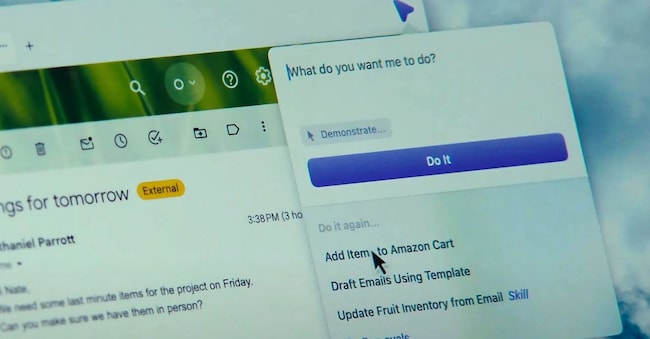
Dia thus presents itself as a web browser with an AI agent embedded in the sidebar. It is based on Chromium, the same engine that powers Chrome and Edge. This is an advantage: all the browsing data and extensions present in the other browsers will be transferred here.

AI assists us in various ways on the web. For example, we want to search for the most beautiful beaches to visit in southern Sardinia. Often in such cases we have to compare several guidebooks, which we open in various tabs to consult. Or we can ask a chatbot for the finished answer and trust our eyes closed. Uncomfortable in the first case; risky, in the second.

Dia is a compromise between the two worlds. With the 'tabs' command in Dia's AI chat, we have him create a table to compare the information present. In the same way it can summarise reviews of a product, of a restaurant.

We read a news story and do not understand its context, its assumptions? We select the first sentence of the article and ask "what happened" in the field of AI.

Then there are other functions, even sophisticated and user-programmable ones (like 'macros' or routines, e.g. to copy links from tabs on Amazon products and insert them in emails or documents or add them to the shopping cart); but basically the beauty of Dia is that it knows what is happening on the screen and in the different browser tabs. We save time but keep control over the navigation. We choose the sources of the AI and it is our commands that set it off.

Even Dia, like all generative AI, is not immune to errors, of course; but it is a basic price to pay for these conveniences.

If we like the idea, an alternative already available to everyone can be Opera and its free AI assistant Aria. It can synthesise web pages (with 'Page Context' mode), translate highlighted texts and explain concepts taken out of context. Aria also manages tabs: on voice or text command it can group, close or save them. Opera specified that Aria is powered by its own Composer AI engine, which uses OpenAI and Google technologies, enabling it to generate text (articles, emails), images from textual prompts and even analyse inserted photos (e.g. to recognise places or transcribe slides).

The giants are not standing idly by.

Microsoft Copilot integrated in Edge can summarise articles, translate texts, help with writing (e.g. generate emails or summaries). Since June, American Copilot Pro users have been able to perform online tasks such as booking flights or filling out forms via the Copilot Actions function. Agents, notes. Google, on the other hand, recently announced that it will bring its Gemini AI inside Chrome (after launching it inside the search engine). OpenAI's Operator (only available to Pro users in the US) is an agent that navigates for us with the integrated browser.

In the future, perhaps the choice for users is what level of control to maintain and how much autonomy to grant these tools.

There are also privacy implications. The Browser Company states that Dia stores chat, history, bookmarks, browsing context and files on the user's device, even in encrypted form. The company also guarantees users data anonymisation, secure deletion within 30 days from its servers, and a strict policy prohibiting partners from misusing user data.

The topic is divisive, and there are in fact companies that focus on it to differentiate themselves. In particular Brave, a privacy-conscious browser and also equipped with AI, Leo. It guarantees that conversations with Leo are anonymous: the AI models used (such as Mixtral by Mistral, Anthropic Claude, Meta Llama) are hosted by Brave and do not store any identifiable user information.

Basically, using AI (even more than other digital services) is a matter of trust. It is up to us to assess how much we can trust it and in which cases. It is therefore good that products such as Dia and Brave are being created that allow us to modulate this faculty.

Copyright reserved ©
Loading...

Brand connect

Loading...

Newsletter

Notizie e approfondimenti sugli avvenimenti politici, economici e finanziari.

Iscriviti