
Sustainable fabrics on the altar: from cotton waste the new sacred vestments
With cupro, a fibre derived from cotton processing waste, an ecclesiastical clothing collection is born, a tribute to the sustainability promoted by Pope Francis in his encyclical 'Laudato Sì' ten years ago

3' min read
3' min read
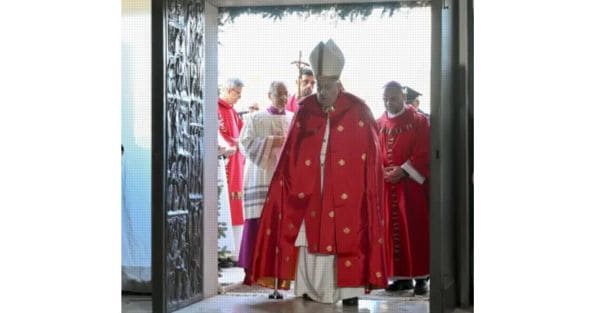
Even in a shop window overlooking Largo Brancaccio, a few steps away from the Roman basilica of Santa Maria Maggiore where pilgrims flock to pay homage to the tomb of Pope Francis, one can find a trace of the pontiff: the chasuble in red fabric, embroidered with the motif of the shell of St James, the pilgrims' emblem, the same with which he had crossed the Holy Door of the Rebibbia prison on 26 December last. However, it is not an heirloom; on the contrary, it is a creation that carries with it a profound charge of innovation, since it is part of a Bemberg cupro 'capsule' that the Sisters Disciples of the Divine Master, whose mission is to lead to prayer through the beauty of liturgical elements - from the architecture of churches to the aesthetics of vestments - have developed together with the Japanese textile giant Asahi Kasei.
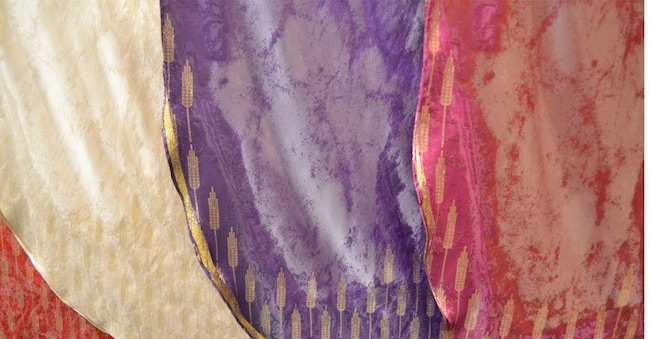
The group has held the patent for the production of this sustainable, natural, biodegradable and circular fibre since 1931, as it is derived from the closed-loop processing of cottonseed oil. The fabric, on the other hand, was produced by the Italian Brunello, a company founded in the town of the same name in the province of Varese in 1927 and today Europe's largest cellulosic fibre processing mill, with 300 looms and sales worldwide.
"We conduct a lot of research into liturgical elements, and we wanted to create something that expressed the call to protect the planet launched by Pope Francis with the encyclical 'Laudato Si' in 2015," explains Sister Mariella Mascitelli. An architect, her most recent projects include the Guardian Angels Church in Francavilla a Mare, signed together with her sister Sister Josefina Saladdino, an engineer. The home of their congregation, on the Via Portuense, houses workshops, studios and ateliers full of technique and craftsmanship, where they produce precisely that which serves to guide the elevation to the divine through beauty and which is also offered in the shops of the Liturgical Apostolate Centre in Italy.
%20-%20Copia-U34435025810ico-600x313@IlSole24Ore-Web.jpg)
It was in their home that the sisters got the idea to visit Milano Unica, the largest textile fair, to look for a sustainable textile. Preparing themselves, they then presented themselves at Brunello's stand, where they were welcomed with a certain curiosity, listened to and finally satisfied with their goals. "Cupro is perfect, because it tells a story of circularity," says Sister Mascitelli, "It is also a very light and breathable fibre, often vestments are made of polyester, which especially in summer is very problematic to wear. The chasubles were made in different variants, in a plain colour with a pattern designed by a sister, which Brunello made, or in a mix of cupro and silk with the pilgrims' shell embroidered on it.
The priests have received them with great interest and favour - the Master of Papal Liturgical Celebrations, Monsignor Diego Giovanni Ravelli, who also looks after the vestments of the popes, also spoke at the presentation of the chasubles - and there are already plans to extend the collection to other items such as stoles, dalmatics and copes. Brunello's managers are also enthusiastic: 'A completely new and very interesting channel has opened up for us,' they explain, 'after all, this too is clothing, and in a certain sense also fashion.


