
eVitara: Suzuki’s take on the compact electric SUV
Available in two electric versions: single-motor and dual-motor, both powered by a 61 kWh LFP battery that promises a range of 426 kilometres for the front-wheel-drive version and 395 kilometres for the all-wheel-drive version

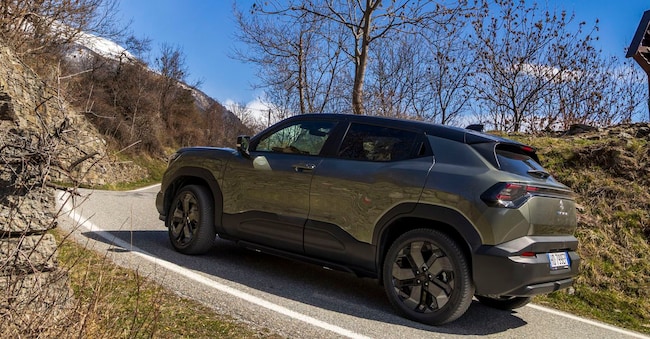
Don’t be misled by the name. In fact, the Vitara and the eVitara have nothing in common, apart from the fact that Suzuki is offering all-wheel drive on its first electric model. A unique case, at present, in the world of compact battery-powered SUVs. Developed jointly with Toyota, which, for its part, has produced the Urban Cruiser, it introduces new technologies and unprecedented design standards.
Based on the Heartect-e architecture for electric models, the eVitara is available in two versions. The single-motor, front-wheel-drive version with 174 horsepower and 197 Nm of torque is priced from €37,000, whilst the dual-motor version with 184 horsepower and 300 Nm, featuring electric all-wheel drive, is available from €39,000. Both are powered by a 61 kWh LFP battery, promising a range of 426 kilometres for the front-wheel-drive version and 395 kilometres for the all-wheel-drive version. The 11 kW on-board charger allows AC charging from 10% to 80% in five and a half hours, whilst the same charge takes 45 minutes using direct current, which the car accepts up to 70 kW – unlike some rivals that can handle even higher peaks and therefore recharge faster.
The system that propels the eVitara Dual Motor up to 150 km/h and from 0 to 100 km/h in 7.4 seconds proves to be responsive and, when needed, capable of displaying a rather lively character even without switching to Sport mode. The handling is intuitive both on tarmac and off-road thanks to the suitably tuned suspension, although it is a little stiff over the more pronounced bumps, which affects the overall comfort – otherwise good, thanks also to the soundproofing of the cabin. As for fuel consumption, at the end of the 110-kilometre test—mainly on steep mountain roads with brief off-road and motorway sections—the on-board computer recorded an average consumption of 21.7 kWh/100 km rather than the 16.6 kWh/100 km stated by the manufacturer.
Although it shares many design elements with its distinct twin, the Toyota, the Suzuki electric SUV bears a resemblance to the petrol-powered Vitara in the styling of its front and rear ends and their distinctive lighting signatures, the muscular wheel arches, the balance between the bodywork and glass surfaces and, finally, the typical SUV ground clearance: 18 centimetres.
Measuring 4.28 metres long, 1.80 metres wide and 1.64 metres high, with a wheelbase of 2.70 metres, it offers plenty of space in the rear where, among other things, the sliding bench seat allows you to adjust the space to favour either the passenger area or the boot, which isn’t very spacious to begin with. Thus, the standard capacity of 238 litres can be increased to 310 litres, whilst the maximum capacity remains at 1,052 litres. The linear dashboard features a panel that connects the 12.5-inch configurable cockpit display with the 10.1-inch screen of the always-connected infotainment system, which is quite responsive but has a graphical interface that is not particularly attractive, although it is fairly intuitive.

