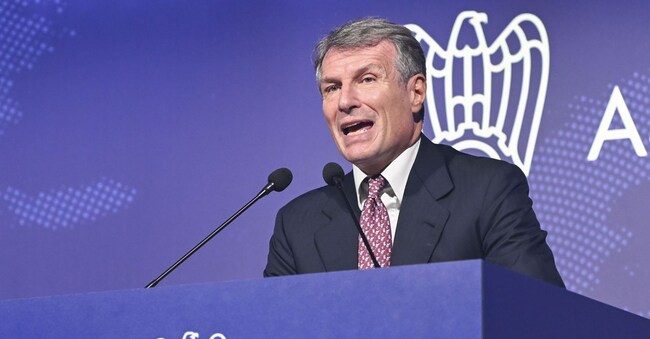
The President of Assolombarda

Spada: 'Support those who invest with premium IRES and Transition 5.0'

'Aware of budget constraints, but as the world slows down we need signs of focus on business'

5' min read

5' min read

"Now that the economy is slowing down, it is time to invest, to look ahead, to prepare for future growth. That is why the government should give a signal of attention in this regard'.

Protecting industry, making it competitive, supporting it in this difficult phase. For Alessandro Spada, president of Assolombarda, Confindustria's first territorial association with over 7,000 member companies, the priorities are clear. Even clearer in light of the numbers. Because the latest industry data for the first nine months of 2024, includingindustrial production (-3.4%), export (-0.7%) and turnover (-4.2%), leave little room for doubt about the "bad" moment in manufacturing, which also sees a double-digit growth in requests for the Cassa Integrazione (Wage Guarantee Fund).

Loading...

'After years of strong growth, in which Italy did better than Europe,' Spada explains, 'now the picture is complex, with global trade surrendering 4.2% in the first six months of the year, Lombardy's exports dropping by over a billion, and a drop towards the United States as well as with Europe. It is not surprising to see that for one out of every four companies in the North West, the greatest critical issue is insufficient demand. And now, also looking at the weakness of Germany, there is concern among companies.

Assuming that we are a structured and solid territory, which in recent years has always recorded double-digit growth among companies, growth today is modest, at 0.4%, in line with national growth.

Limited development that is mainly explained by the growing difficulties in the economy of Germany, with which we are strongly connected'.

Strong international business projection is both an asset but also a risk, in slowdown phases such as the current one. And although there is confidence in a possible recovery in 2025, it is in the current phase that action must be taken with countercyclical support and recovery measures.

'At this time when the market is not responding,' Spada explains, 'we need interventions that give the right stimulus to growth and in particular that act on investments. This is the right lever to use today in order to prepare for future growth and boost competitiveness: it would be important for the government to send companies concrete signals of attention in this regard'.

Premium IRES for those who leave resources in the company and invest

It is in this direction that Confindustria's proposal to provide for a rate of IRES, corporate income tax, to fall by five points, from 24% to 19%, in favour of those who keep at least 70% of their profits in the company, using part of it, 30%, for qualified investments, goes.

"We have already seen and appreciated the stabilisation of the tax wedge cut, and we are aware of the budgetary limits,'' Spada added, "so we are certainly not asking the government for follies. But while we wait for the two-rate tax system to be fully introduced, finding room for the premium IRES would be crucial, a driver of development and growth, five points of reduction that would give an important signal of attention to those who look to the future and invest. I am thinking, for example, of hiring or investments that lead to increases in productivity, innovation, or environmental sustainability, or that ensure improvements in workers' health and safety. It would be a regulation capable of supporting both corporate capitalisation and competitiveness. It would also be able to compensate for the cancellation of ACE (Economic Growth Assistance), which has been in place since 2011 and will stop in 2024'.

Transition 5.0 still at the pole

Another knot to be unravelled concerns the rules of engagement of Transition 5.0, a measure combining digitisation and energy saving, which has so far seen only marginal use (EUR 136 million) of the EUR 6.237 billion available in tax credits and for which robust regulatory maintenance is now awaited.

"The anticipations of the corrections made by the Ministry of Enterprise and Made in Italy go in the right direction, to simplify a measure that is strategic but so complex that it fails to take off, almost a year after its announcement. Changes that reflect part of the requests we have made as companies. Which, I remind you, are the real end-users of the measure'.

Therefore, the hypothesis of extending the time limits for installation to April 2026 is appreciated, as is the creation of an automatic calculation of energy consumption for depreciated assets. And of course, the raising of rates and surcharges for the purchase of EU photovoltaic panels, so that they are competitive with Asian ones, are also welcomed.

Announcements that the government is now being asked to translate into firm rules.

"Time is running out and as of today Transition 5.0 is not taking off, while anticipations are still just words: the Ministry has said it will present an amendment to the Ddl Budget and we are urgently waiting to see the requested changes in writing. For us, in any case, the best proposal put forward so far is to use part of the earmarked resources to refinance Industry 4.0, which has proven to be a measure that works and had the enormous advantage of simplicity.

MEF controllers

.

While changes in the required direction are desirable, what is now called for is swift action, taking into account the many uncertainties that have characterised the rule's progress. "Every announced change, even if it is retroactive, to a certain extent engages the market by creating second thoughts, doubts and uncertainties among companies and operators: this is why announcements must be followed immediately by facts. Together with the bonus IRES, a slimmed-down 5.0 scheme would represent a countercyclical action, which comes at the right time to relaunch growth, and which can give a strong impulse to the entire machinery and automation supply chain, sectors that would regain vigour by relaunching in turn a vast related industry".

Simplification is also expected on the front of internal controls, with the request for a complete reversal of the provision, contained in the Manoeuvre, that introduces for companies, bodies, organisations and foundations that receive contributions from the State exceeding 100,000 euro per year, the obligation to integrate the composition of the board of auditors or statutory auditors with a representative of the Ministry of Economy and Finance.

"It must be cancelled," Spada points out, "because the imposition of a ministerial-appointed auditor or auditor within companies would be a bad sign, the benefits of which we cannot see, but only the drawbacks. First of all, it is a completely disproportionate measure, which denotes a strong distrust of companies. Moreover, it disregards the fact that the main incentive regulations are already subject to forms of monitoring, which often entail very significant burdens on the companies themselves. And everything is needed at this stage except more bureaucracy'.

Copyright reserved ©
Loading...

Brand connect

Loading...

Newsletter

Notizie e approfondimenti sugli avvenimenti politici, economici e finanziari.

Iscriviti