Middle East

Syria, regime fallen, rebels in Damascus. Bashar al-Assad on the run. Premier al-Jalali arrested

After a very rapid advance, the rebels took control of Damascus. The president could be in a Russian base ready to leave for Moscow

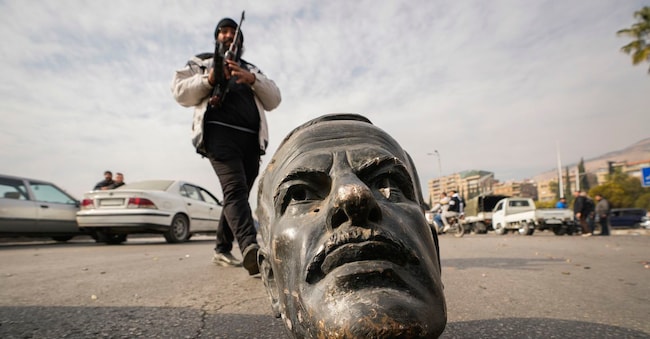
Un combattente dell’opposizione cammina accanto a un busto rotto del defunto presidente siriano Hafez Assad a Damasco, in Siria, domenica 8 dicembre 2024. (Foto AP/Hussein Malla)

4' min read

4' min read

From our correspondent

NEW DELHI - The Syrian regime has fallen. On the night between Saturday and Sunday, President Bashar al-Assad hastily left Damascus on board a flight to an unknown location that took off from the capital's international airport. The decision to flee was made when, in a new sudden acceleration, rebel forces entered the city. According to Israeli sources, Assad may be hiding in a Russian military base in Syria before continuing on to Moscow.

Loading...

Overnight the Syrian prime minister, Mohammed Ghazi Jalali, said in a video that the government is ready to "extend its hand" to the opposition. "I am at home and have not left the country, and this is because of my attachment to this nation," Jalali said. Speaking to Al Arabiya TV, Jalali also said Syria should organise free elections.

LA MAPPA

Loading...

In the morning, the rebel leader Abu Mohammed al-Golani issued a communiqué in which he charged Jalali himself with the supervision of state institutions until the handover, prohibited the Armed Forces from approaching government buildings, and banned machine-gun fire in the air that accompanied the celebrations. Shortly afterwards, however, a video was released showing the arrest of Prime Minister Mohammed Ghazi al-Jalali by rebel forces at a hotel in Damascus.

al -Jalali also reportedly said he did not know the whereabouts of former President Bashar Al-Assad and his Defence Minister.

The flight of Bashar al-Assad not only marks the end of one of the most long-lasting, oppressive and bloody regimes in the entire Middle East, but is also a blow to Russia and Iran, who lose a key ally in the region.

The celebrations in town

.

As soon as word of the fall of the regime spread, thousands of people, in cars and on foot, gathered in a central square in Damascus, waving flags and chanting 'Freedom'. Eyewitnesses report seeing armed groups lining the streets in the capital's suburbs. At dawn, the city's police headquarters was empty. An Associated Press journalist filmed an abandoned army checkpoint, with uniforms lying on the ground under a poster with Assad's face. Residents of the capital's suburbs reported gunfire and explosions.

Images broadcast by opposition-linked media showed a group of protesters celebrating Assad's escape after climbing on top of an abandoned tank in the middle of one of the capital's central squares. Shouts of 'Allahu Akbar': 'God is great' could be heard from the minarets. The pro-government radio station Sham FM reported that after Assad's departure, the airport of Damascus was evacuated and all flights suspended. Insurgents announced that they had entered the notorious Saydnaya military prison, north of the capital, and freed the detainees.

Siria: i ribelli conquistano anche Daraa, città chiave del Sud

A regime shattered in a few days

.

The seizure of Damascus comes just hours after the fall of Homs, where the regular army effectively gave the rebel forces a free rein and retreated, paving the way towards the capital. The group that launched the surprise offensive against President Assad's regime on 27 November is called Hayat Tahrir al-Sham (Hts) and collaborates with an umbrella group of Turkish-backed Syrian militias known as the Syrian National Army.

The Hts is a splinter faction of al-Qaeda and is considered a terrorist organisation by the United States and the United Nations. However, in recent years, the group has claimed to have cut ties with al-Qaeda. Some analysts pointed out that the Hts had recently tried to redefine its image, focusing on promoting civilian rule in the areas of territory under its control.

Siria, ecco l’arrivo dei ribelli alla periferia di Damasco

The leader of the Hts is called Abu Mohammed al-Golani. It was he who, in 2016, distanced himself from al-Qaeda and redefined his group's identity. "Golani was more astute than Assad. He has remade his image, forged new alliances and launched a charm offensive" towards minorities, explains Joshua Landis, a Syria expert and director of the Centre for Middle East Studies at the University of Oklahoma.

An accidental (and ruthless)

leader.

Runaway President Bashar al-Assad has ruled Syria for 24 years, succeeding the 30-year regime of his father Hafez. Bashar was an accidental leader, elevated to the role of successor only after his older brother Basil, the heir designate, died in a car accident in 1994.

Faced with the need to give continuity to the absolute domination exercised by his family over the country, Bashar was forced to suddenly and radically change his life, returning to Syria, abandoning his medical career (he is an ophthalmologist) and embarking on a military training that quickly led him to the rank of colonel, so as to enhance his credentials at the time of succession. At the time of his father Hafez's death in 2000, Bashar was only 34 years old and the Syrian parliament wasted no time in lowering the minimum age to serve as president.

The young Assad's first months in power were characterised by openings both to the outside world and at home. Nothing sensational, but enough to mark a change of climate from his father's regime, which had gone down in history as one of the most violent and repressive in the entire Middle East.

Then in 2001 there was an initial clampdown in response to a petition signed by a thousand intellectuals calling for Syria to become a multi-party democracy. But it was the extremely violent reaction to the Arab Spring of 2011 that showed the world the true face of the Syrian dictator, who, in order to suppress the uprising and fight the civil war that immediately followed, did not hesitate to use all the firepower of his army and air force, including that of his Russian ally, against his own population.

Copyright reserved ©

Brand connect

Loading...

Newsletter

Notizie e approfondimenti sugli avvenimenti politici, economici e finanziari.

Iscriviti