After Beijing

Taiwan, chips and rare earths: the Xi-Trump summit did not change the balance

Markets disappointed after summit close: Boeing brings home modest results, Tesla none. And even Nvidia and AMD stand by and watch
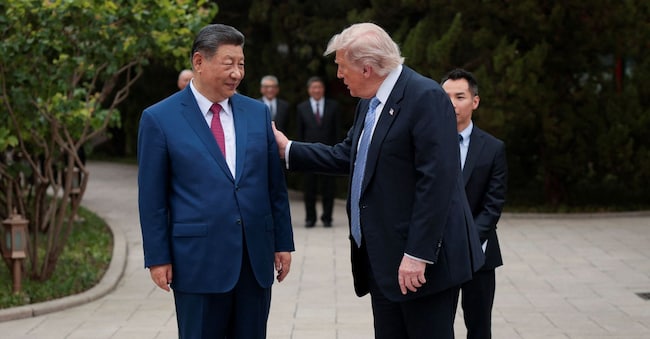
by Biagio Simonetta

 REUTERS

3' min read

Translated by AI
Versione italiana

3' min read

Translated by AI
Versione italiana

For two days, in Beijing, the scene looked like the one that Donald Trump wanted to build. Air Force One landed in China with the big American ceos on board, ready to sit at the tables of Chinese power. Jensen Huang of Nvidia, the top brass of Boeing, Apple's Tim Cook, Elon Musk and other well-known names from Silicon Valley. The giants of US finance and technology, in short, alongside the White House. The idea was simple: to show that the United States remains the economic centre of the world even within the most difficult relationship on the planet.

But when diplomacy replaced the ritual images, there remained above all a sensation of coldness. The Chinese posture appeared immediately clear. Clear in showing itself available on the symbolic and protocol level, but also very rigid on strategic dossiers. Like Taiwan, defined without half-measures the most delicate point in relations between Washington and Beijing. And the fact that Xi Jinping openly evoked the "Thucydides' trap" during the summit appeared as a very heavy political signal. A concept that the Chinese leadership rarely uses so directly in high-level face-to-face meetings.

Loading...

According to several analysts, Trump leaves Beijing with many diplomatic smiles and few concrete victories. And it is no coincidence that after the summit was over, the markets reacted by turning negative.

Trump a Xi Jinping: Abbiamo un ottimo rapporto, risolviamo i problemi velocemente

Chip & Tech

One of the most obvious signals concerns Nvidia. Jensen Huang was part of the US delegation, not least because Washington hoped to unblock at least part of the exports of advanced semiconductors to China by seeking loopholes on rare earths. But in the last few hours US Trade Representative Jamieson Greer admitted that export controls on chips were not a central theme of the talks. Translated: no real opening.

For Nvidia and AMD, the knot remains huge. China continues to be a crucial market for artificial intelligence and data centres, but US restrictions remain in place and Beijing is accelerating in parallel on the development of increasingly competitive domestic industries, so much so that US technological leadership could be challenged within a few years.

The markets, somehow (and also in light of the American delegation on board the presidential plane) expected at least a political signal of détente on the AI front. But that signal did not come, also demonstrating that Chinese autonomy on the technology front now gives Beijing new room for manoeuvre.

The Tesla Dossier

But the signal did not come for Tesla either. The presence of Musk, who has gone viral on social media for Mr Elon's usual over-the-top attitudes (above all, the posture he assumed during a selfie with Lei Jun, CEO of Xiaomi), did not help to unlock one of the most important dossiers for Tesla: the Chinese green light for Full Self-Driving. During the summit, there were no official announcements or public openings from Beijing. Perhaps it should not be forgotten that in China, Musk continues to have an ambiguous image. On the one hand, it is seen as the symbol of Western innovation and modern electrics. While on the other, Beijing views with increasing suspicion its ties with Washington and especially with Starlink and SpaceX, which are considered sensitive issues for Chinese national security.

Few results for Boeing

Another open chapter was that of Boeing, but here too the results brought home by the US did not seem satisfactory. For days the Trump administration had let the possibility of a maxi Chinese order filter through, with numbers circulating for weeks around 500 aircraft. In the end Trump spoke of around 200 jets, but without concrete details on the models, timing or structure of the agreement. And above all without an official signature. And in fact the Arlington (Virginia) company's stock slipped in the alt-market.

The Taiwan Rock

In short, the main outcome of the Beijing summit seems to be the maintenance of the fragile trade truce reached at the last meeting between the two leaders last October, when Trump had suspended the heaviest tariffs on Chinese goods and Xi Jinping had avoided further hardening the rare earths front. Otherwise, smiles aside, many issues remained essentially unresolved. And it was not enough for Trump to bring the world's most powerful CEOs to China to bend Beijing on strategic dossiers. Xi Jinping has chosen the line of caution and rigidity. Especially on the Taiwan issue, where the Chinese warning seemed truly severe for the first time. The island remains the most critical point in relations between the two powers. The Sarajevo gun of the 21st century, as it has already been called. And Trump's non-response to a Reuters question about Taiwan seemed to tell the true climate of the summit, more than many official statements.

Copyright reserved ©
Loading...

Brand connect

Loading...

Newsletter

Notizie e approfondimenti sugli avvenimenti politici, economici e finanziari.

Iscriviti