Safety

Taiwan is testing its defences in preparation for a possible attack by China

The exercises will simulate an invasion, a naval blockade and disruptions to communications. For the first time, civilians will also be involved in the urban resilience exercises

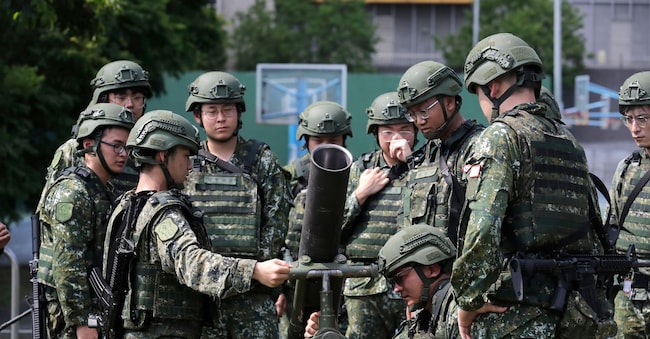
Mercoledì 5 agosto 2026, a Taipei, Taiwan, alcuni soldati svolgono un addestramento di squadra con un mortaio durante le esercitazioni militari annuali Han Kuang. (Foto AP/Chiang Ying-ying) APN

3' min read

Translated by AI
Versione italiana

3' min read

Translated by AI
Versione italiana

Taiwan launched its annual “Han Kuang” military exercises today, the most important training exercise for its armed forces, organised to prepare for a possible invasion by China, which regards the island as a rebellious province and does not rule out the use of force to bring it back under its control. The manoeuvres will last ten days, until 14 August.

This year’s exercise aims to test the ability of the armed forces to continue operating even under conditions of severe disruption to communications and the chain of command. For this reason, one of the central aspects of the training concerns the decentralisation of operational decision-making: field commanders will be required to react independently, without waiting for instructions from higher levels. The exercises will also introduce command procedures modelled on those used by the US armed forces, including so-called ‘backbriefs’, through which subordinates explain to their superiors how they intend to carry out the mission they have been assigned.

Loading...

Operations began before dawn, when an underground command centre in Taipei issued the order to commence the exercises. Over the coming days, prolonged defensive operations will be simulated, including live-fire exercises, naval blockade scenarios and responses to so-called ‘grey-zone tactics’, that is, military pressure tactics that fall short of the threshold of open conflict.

Come difendersi dalla Cina: la grande esercitazionei militare a Taiwan

The exercises are taking place across the whole island. Along a beach overlooking the Taiwan Strait, dozens of reservists have been training with domestically manufactured assault rifles, whilst in the courtyard of a secondary school in Taipei, other soldiers simulated the loading of mortars and the use of M4 carbines. In the south of the island, naval units and a submarine were deployed, whilst tanks and other armoured vehicles carried out manoeuvres before dawn on the streets of Taichung. Among the vehicles deployed were the new US M1A2T Abrams tanks, part of the 108 units purchased by Taipei in 2019 and delivered in stages over recent months.

The exercises also include a simulation of a Chinese naval blockade. Navy and Coastguard vessels will escort convoys carrying supplies to the island through the eastern waters, whilst the capacity of the mobilised factories to sustain wartime production and the relocation of military and civilian facilities will be tested.

For the first time, the Han Kuang exercises are also significantly involving the civilian population. In Taipei, Taichung and Kaohsiung, urban resilience exercises will be organised, featuring simulated air raid alerts and a temporary slowdown of the mobile network, designed to replicate potential telecommunications disruptions during a crisis. The aim is to test the ability of institutions and citizens to continue functioning even in the face of severe disruptions to communications.

The manoeuvres involve over 20,000 reservists. Part of the training involves more than 5,000 military personnel from two brigades, compared with just one brigade involved in the previous edition. The training will also serve to test how quickly the reserve forces can transition from normal peacetime activities to full operational readiness.

“Training can always be improved,” said Defence Minister Wellington Koo, assuring that Taiwan will continue to train intensively to ensure it is prepared both in peacetime and in the event of war.

On the eve of the start of the exercises, President Lai Ching-te reiterated his commitment to strengthening the island’s defences and the resilience of society, condemning the expansion of the Chinese Communist Party’s authoritarianism and asserting that Taiwan will continue to invest in its own security.

In recent years Taipei has stepped up the process of strengthening its military capabilities, partly under pressure from the United States, the island’s main arms supplier and its greatest international supporter. The strategy is increasingly focused on mobile and easily deployable systems, such as drones and other platforms suited to asymmetric defence against a militarily superior adversary.

Loading...

On the political front, President Lai has pledged to raise military spending to 5 per cent of gross domestic product by 2030, but the opposition-controlled Parliament recently approved a $24.8 billion emergency plan for new purchases of US arms, which is less than the approximately $40 billion requested by the government.

Taipei is also awaiting Washington’s approval for a further package of military supplies worth up to 14 billion dollars. Following his visit to China last May, President Donald Trump described arms sales to Taiwan as a “good bargaining chip” in relations with Beijing. Meanwhile, the previous military aid package worth around 11 billion dollars remains in place; this is the largest such package authorised by the United States to date.

Copyright reserved ©
Loading...

Brand connect

Loading...

Newsletter

Notizie e approfondimenti sugli avvenimenti politici, economici e finanziari.

Iscriviti