
AI, Nvidia designs the processors of the future in Taiwan
Leading tech company focuses on perfecting artificial intelligence technology. Objective: to reduce costs and consumption by more than 90 per cent

2' min read
2' min read
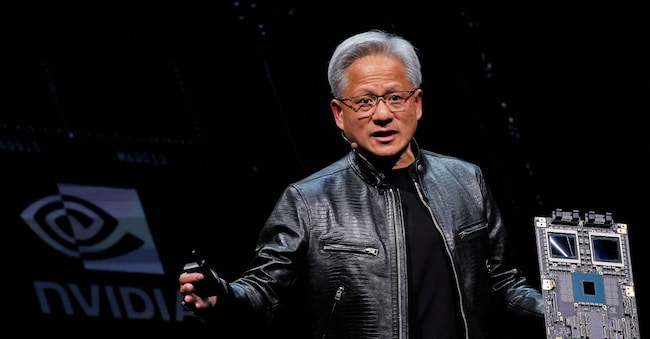
All in on artificial intelligence. At the Computex conference in Taipei, Jensen Huang, CEO of Nvidia Corp. , outlined the company's vision for the future of AI-related processors. It not only revealed plans for the annual release of new accelerators, but also two future products: the Blackwell Ultra chip for 2025 and the Rubin platform for 2026. The latter, in particular, promises significant improvements in energy efficiency, addressing growing concerns about the energy impact of AI data centres.
The Strategy
.The strategy of Nvidia, a leading company in the field of data centre systems for artificial intelligence, extends far beyond hardware production. During his keynote at the National Taiwan University, Huang outlined how artificial intelligence is triggering a new industrial revolution. The expectation is that the technology will also spread to personal computers. Nvidia, already the main beneficiary of the huge wave of investment in AI, now seeks to expand its customer base beyond the cloud computing giants, embracing a broader range of industries and government agencies.
The promise: less costs, less energy consumption
Huang, who has described his approach as 'CEO maths', argues that growing 'computational inflation' requires accelerated methods to handle huge volumes of data, promising98% cost savings and a 97% reduction in power consumption thanks to Nvidia technologies. In addition to these chip innovations, the company is introducingnew models and software tools, primarily geared towards implementing AI capabilities in PCs. Collaboration with Microsoft and hardware partners at Computex showed new laptops with AI enhancements under the Copilot+ brand. However, the presence of an Nvidia graphics card greatly enhances the performance of these devices, expanding the capabilities of popular software such as games.
New Horizons
.In parallel, Nvidia is working on a new design for servers, the programme MGX, which will enable partners such as Hewlett Packard Enterprise and Dell Technologies to accelerate the marketing of products based on its chips. Rivals such as Advanced Micro Devices and Intel are also adapting to this new configuration, integrating their processors with Nvidia chips. And that is not all. Nvidia's commitment to innovation is also reflected in the introduction of services such as Nvidia Inference Microservices, or NIM, which Huang described as'AI in a box', now available to the public. These services, offered free of charge, are designed to accelerate the implementation of AI solutions, but require a licence for use.

