
Tajani: Iran has crossed the red line, now working on de-escalation
The Foreign Minister underlines Israel's reasons: Tehran can in no way acquire a nuclear weapon. Critical opposition: either defend Netanyahu or work on de-escalation

3' min read
Key points
3' min read
"As far as Iran's nuclear programme is concerned, we have the UN agency's report that Iran has violated the rules and gone beyond the red line in terms of building the atomic weapon. So the Israeli remarks are absolutely grounded on the basis of an independent report that comes from the UN agency'.
Tajani underlines Israel's reasons: 'Iran has crossed the red line'
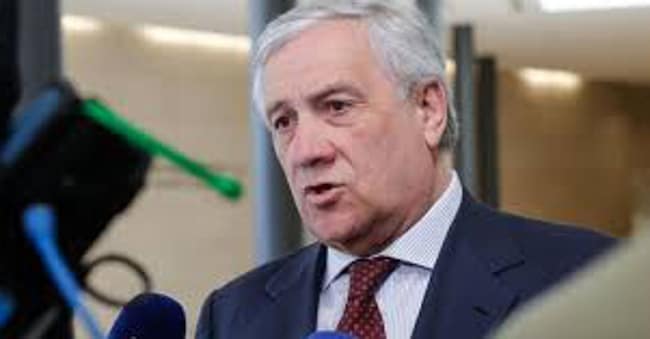
.Even before going to Parliament for his hearing before the Foreign Affairs Committees of the House and Senate, Deputy Prime Minister and Foreign Minister Antonio Tajani reinforced the government's line after Prime Minister Giorgia Meloni, in her telephone conversation with Israeli Prime Minister Benjamin Netanyahu, had emphasised the need for "Iran under no circumstances to acquire a nuclear weapon", while hoping that "the efforts led by the United States to reach an agreement can still be successful". The red line, Tajani reiterated in Parliament, has in fact already been crossed. "Faced with a nuclear threat, there can be no ambiguity. Iran cannot equip itself with the atomic bomb. I also wanted to convey this message to the President of the Israeli Republic, Isaac Herzog, to whom I reiterated Israel's right to ensure its survival by protecting itself from a possible nuclear attack'. And again: 'The decision to launch the operation stemmed from intelligence information about Tehran, such that it poses an existential threat to Israel, the region, and the international community'.
"Italy is at the forefront of de-escalation"
.Substantial support for Israel's action, therefore, in tune with the position taken by US President Donald Trump ("Iran make the agreement before there is nothing left of it"). The Italian government's path remains that of the resumption of denuclearisation talks and, on Italy's side, diplomatic work for a de-escalation of the conflict ("we are in the front line on this front"). The consequences of which, in the event of a prolonged military clash, would also be enormous from an economic point of view, Tajani emphasises: freedom of navigation on a route that is crucial for Italy and for global trade is at risk, and there would be consequences on the energy, humanitarian and migratory fronts.
"So far, no critical situation for the 50,000 Italians in the area"
.Finally, information on the Italians - military and civilian - present in the area. "There are currently about 50,000 Italians throughout the Middle East region. The most significant presence is in Israel, with about 20,000 compatriots, while there are about 500 in Iran. At the moment, no critical situations have been reported to us,' Tajani said. 'In addition to these are our military personnel present in the area, from Iraq to Lebanon, from the Gulf to Sinai, which we follow together with the Ministry of Defence. Our embassies are in contact with all the compatriots who have asked for information to return to Italy. They are all well and are receiving - one by one - every possible assistance, taking into account the disruption of air traffic in the region,' he added. "In particular, a group of 36 pilgrims from the Italian Bishops' Conference, present in Jerusalem, was assisted by our Consulate General and managed to reach Jordan".
Critical objections: either support Israel or work for de-escalation
Tajani's statement did not convince the opposition, which found it contradictory to say the least. Can one support Israel's action in substance and at the same time assure that he wants to work for de-escalation, wonders Francesco Silvestri of the M5s: "We would have expected clearer political positions. Despite his firm tone, the contents appear contradictory. What sense does it make to come here and say everything and the opposite of everything? To say that he supports de-escalation but also the action that Netanyahu took? These things are contradictory. He did not make it clear whether he is in favour of what just happened, in the timing versus the efforts being made for real de-escalation'. More nuanced was the position of Pd secretary Elly Schlein, who wished to emphasise that 'no one more than us is hostile to the Iranian regime that oppresses women and no one more than us supports the women's freedom movement, yet this sudden and unilateral action by Israel can only weaken negotiations in the designated places'. Of two things, Schlein says, asking the government not to crush the country on Trump's 'mood swings': 'Either you think that Israel's is a legitimate attack, and some of the majority statements go in this direction, and then you have to have the courage to say: he did the right thing. Or one thinks that one must stop the escalation, and then one must tell Netanyahu to stop and Iran to curb its reactions. Unilateral attack on Iran is not the way. We would like clarity, we ask the government and the EU'.


