
Tajani: ‘We are considering a Trieste–Koper port system’
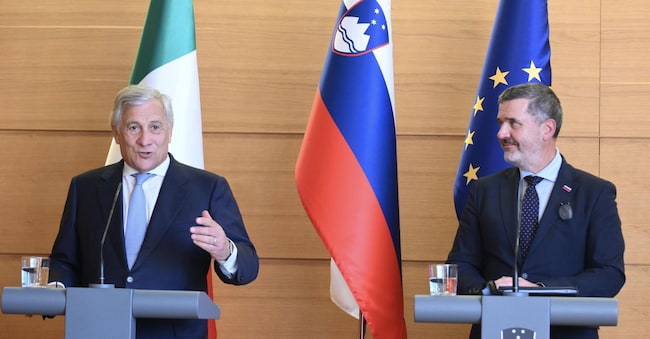
The Foreign Secretary met his Slovenian counterpart, Tone Kajzer, in Nova Gorica (Slovenia)

Key points
‘A port system comprising Trieste and Koper (Capodistria, Slovenia) that would boost handling capacity and promote exports. Trieste is the hub; Koper could be its twin port, reinforcing the system.” This solution was outlined by the Minister for Foreign Affairs, Antonio Tajani, during a press conference with his Slovenian counterpart, Tone Kajzer, in Nova Gorica (Slovenia). Minister Kajzar echoed this, confirming Tajani’s remarks: ‘Our aim,’ said the Slovenian minister, ‘is to ensure seamless cooperation between our ports.’
In the background is the Imec, the infrastructure project officially unveiled in September 2023 during the G20 summit in New Delhi. The aim is to link three of the world’s most dynamic economic regions — India, the Middle East and Europe — to promote trade, energy and digital integration. The northern corridor would link the Middle East to Europe via a combination of railways, road networks and ports, passing through countries on the Arabian Peninsula (such as Saudi Arabia and the United Arab Emirates) before reaching the Mediterranean. The port of Trieste is well-placed to play a significant role.
Tajani: ‘I am considering alternative measures to a Schengen suspension for Slovenia’
Another key focus of the meeting was the situation on the border between Italia and Slovenia, where fixed police checkpoints remain in place, as a temporary derogation from the free movement provisions of the Schengen Agreement. “Italia,” said Tajani, “is taking a positive view of the possibility of replacing, once the extension expires, the suspension of the Schengen Agreement” at the border between Italy and Slovenia “with agreed alternative measures that guarantee security and the fight against irregular immigration”. “I have already discussed this with Piantedosi,” added the Foreign Ministry official. A joint operation is being considered, similar to “that on the border with France, involving Italian and French police officers”. Kajzer described the border as “a space for cooperation and new opportunities”. The extension expires on 18 December.
This morning, Tajani spoke in Trieste at the Annual Forum of the South-East Europe Observatory, established by the Einaudi Foundation. “I welcomed the proposals put forward by the South-East Europe Observatory regarding a less bureaucratic model for the accession process of the Western Balkan (Albania, Bosnia and Herzegovina, Kosovo, Montenegro, North Macedonia and Serbia, ed.) to the European Union,” he said. “A valuable suggestion that I agree with.” In general, the minister reiterated that the countries of the Western Balkans “are European” and “we must admit them to the European Union as soon as possible, as is their right”. In this regard, however, “Europe must not adopt a hostile attitude: we must be rigorous in the accession procedures but not obstructive. If we delay through bureaucratic red tape, we risk losing the Balkans politically because there are competing interests between Russia, China and Arab countries. For Italia,” Tajani emphasised, “this is a political priority.”
Minister: ‘The swift accession of the Western Balkans must be a priority’
Speaking on the sidelines of the meeting in response to a question about Ratko Mladic’s state funeral, the Foreign Ministry spokesperson clarified: ‘We remain convinced that Serbia should be a future member of the European Union, even though there have been mistakes and decisions with which we do not agree; however, these certainly do not constitute insurmountable obstacles to accession to the European Union.’ On Mladic’s funeral, he continued, “we have said nothing”; however, “the Serbian authorities did not attend – that was a choice that was made. I do not find it particularly encouraging; perhaps it could have been avoided, but we are focusing on the progress Serbia must make” in order to join the EU.


