
Tancredi Bianchi and the value of masters

3' min read
3' min read
Thoughtful essays and articles with flowing prose, in recent years, have been full of laments by their authors (us, alas, included) on the crisis of intermediate bodies, the principle of authority and the consequent bewilderment of more than one generation, deprived of solid points of reference.
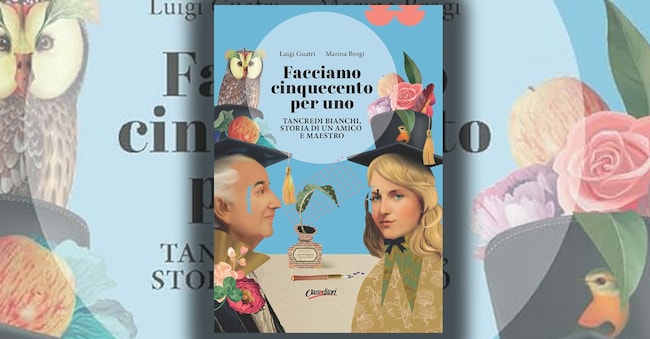
A book like Facciamo cinquecento per uno, in which Luigi Guatri and Marina Brogi recall Tancredi Bianchi - three names that for the readers of this journal need no introduction - can be a reservoir from which to draw in times of despair. The book is meant to remember the 'friend of a lifetime' for the former and the master of life, as well as of academia, for the latter, but it is in truth something much richer and more multifaceted. The text, in fact, restores the biography, not of just one, but of three illustrious personalities, from whom, first and foremost, examples can be drawn.
Of course, when one reads in the first pages that Guatri and Bianchi, who were substantially the same age (the former was born in 1927, the latter a year younger), in the summer of 1950, in the post-war period after the Second World War that was savouring life anew, were in Cattolica, instead of dancing around the streets of the Adriatic city discussing business economics, one would be tempted to think what boring and depressing lives awaited these two young virgins. And yet, to be serious again, this book presents, vividly, the figures of three intellectuals who, born in the academy, not only did not disdain, but actually considered it fundamental to drop their science into the world. 'For corporatists, professional activity is our experiment', so warned Luigi Guatri.
Let us be clear: we are out of the mould of cloying hagiography, which, it is well understood, was not to the liking of the person whose figure is primarily intended to be recounted, as much as it is not in the authors' chords. As for the tale, it proceeds not only through Guatri and Brogi's recollections, which retrace the stages of Tancredi Bianchi's existence, but also by offering the reader many documents, both public and private, that are not usually accessible. They range from personal letters to speeches on anniversaries, from the presentation of studies in honour to farewell lectures on teaching, from the remembrance of friends to speeches given at award ceremonies. Private thoughts or thoughts that cannot be found, because they are unpublished or in any case not easy to find, which always have, together with considerations linked to the circumstance to which they refer, broader references, demonstrating the author's stature.
This pastiche of sources has a twofold (and pleasant) effect on the reader: the feeling, on the one hand, of living together with the protagonists decisive moments, not only of their lives, but of the country, and on the other, of being admitted into an intimacy of feelings and intentions that bound all three.


