
Taranto: the urban transformation brought about by the Mediterranean Games – infrastructure and investment beyond Ilva
With over 95 million euros in public funding from the Government and the Organising Committee, new sports facilities and urban regeneration projects are reshaping the city’s landscape

Key points
Taranto beyond Ilva. Countdown to the 20th Mediterranean Games. With just three weeks to go, there is a flurry of activity on the building sites. On 21 August, the Apulian city will host the opening ceremony at the Iacovone Stadium, kicking off a packed programme of events running until 3 September, with over 4,000 athletes taking part. Whilst the city finalises the programme of events that will take place across its various neighbourhoods from 15 August, the decisive phase is now underway in the areas undergoing redevelopment. This marks the final push of a masterplan which, according to the special commissioner and chairman of the Organising Committee, Massimo Ferrarese, has been realised in just 30 months. ‘We are now handing over the final facilities,’ said the commissioner, highlighting the support received from local authorities and citizens, and the change brought about in the perception of Taranto at local, national and international levels.
The Swimming Stadium, the iconic landmark
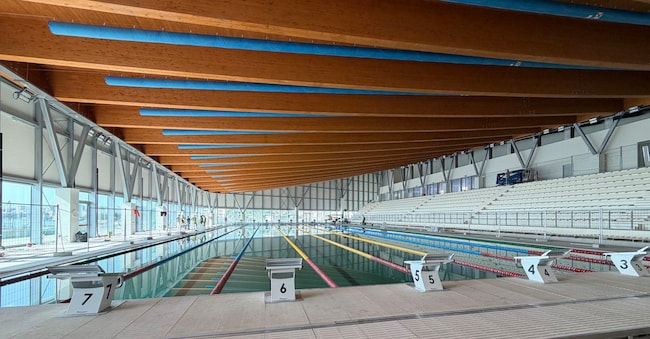
The clearest example of this race against time comes from the Swimming Stadium, where 180 workers are currently working in two shifts. The construction site is managed by Ferraro, the company responsible for the detailed design and construction of the project after being awarded the contract 15 months ago. The timeframe is particularly tight, with just 12 months to transform the concept that emerged from a design competition into a functioning facility and to complete the handover in time for the opening of the Games. One of the most challenging stages in this project was the construction of the laminated timber roof, built by Rubner, which began at the end of January and was completed in April despite strong winds, heavy rain and complex logistics, characterised by overlapping work processes and the handling of large structural elements. The roof spans approximately 3,800 square metres and comprises 860 cubic metres of glulam, 342 cubic metres of X-Lam and 11,500 kilograms of steel. The swimming centre comprises two 50-metre Olympic-sized pools, one indoor and one outdoor overlooking the sea.
Taranto’s new sporting landscape
Alongside the installation of the pools – manufactured by an industry leader such as Fluidra – work is also underway on the stands, the technical installations, the finishing touches and the functional furnishings, all designed in line with minimum environmental requirements and the objectives of the 2030 Agenda. Alongside the Swimming Stadium, the PalaRicciardi is also ready – another project on which Ferraro worked. This facility places Taranto amongst the select few locations in Italia for indoor athletics: it is the third arena of its kind after those in Ancona and Brescia, and the first in Southern Italia. The structure, covered by a spectacular metal-framed canopy comprising over 322,000 kg of steel and reaching a height of up to 25 metres at its ridge, can accommodate around 1,500 spectators in its stands, which have already been fitted with blue and white seats, and is designed to host cultural and entertainment events as well. Outside, photovoltaic canopies and extensive green spaces complete a project focused on sustainability and urban regeneration.
The challenge after the Games
These two facilities represent just two of the many elements of the transformation currently taking place in the city of Taranto and the development of a sports programme capable of operating all year round, combining indoor and outdoor activities. “Taranto is about to face the most important moment in its sporting history, but also one of the most significant in general,” Deputy Mayor Mattia Giorno told Il Sole 24 Ore. In what is a difficult period for the city, the Games represent, according to Giorno, “an incredible opportunity, made possible by investments of hundreds of millions of euros that have created building sites, jobs, new projects and infrastructure”. The physical transformation, however, is only the first part of the challenge. “Taranto is a city that needs to rediscover itself, to draw strength and to find a way forward,” emphasises Giorno. The value of the event will therefore depend on the ability to ensure the facilities remain in use after the competitions have ended, transforming this extraordinary investment into an ongoing policy for sport, urban quality and economic development.
The Minister for Sport and Youth, Andrea Abodi, also focuses on the transition from the event itself to its legacy. The facilities built in Taranto are “facilities of the highest sporting quality”. The minister explains that the coming days will be spent “fine-tuning and personalising” the facilities and finalising preparations for the ceremony: ‘We have achieved a great deal, but we must continue our efforts.’ Abodi also highlights the work carried out in financial and organisational terms: ‘We have ensured that there are no additional costs and that the Organising Committee’s budget remains balanced.’

Brand connect


Newsletter RealEstate+
La newsletter premium dedicata al mondo del mercato immobiliare con inchieste esclusive, notizie, analisi ed approfondimenti
Abbonati