Enlargement

Goal 2030 for Albania, first Muslim EU candidate country

Erdogan's Turkey financed the new mosque in Tirana, and some were doubtful about joining. But Albanian Islam appears strongly secularisedv and perhaps even a model for the continent

by our correspondent Beda Romano
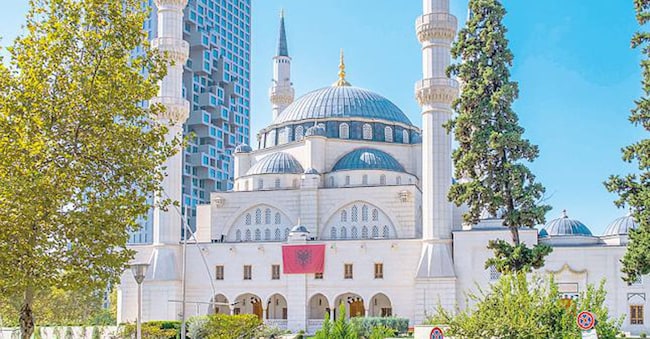
La nuova moschea finanziata dalla Turchia a Tirana

5' min read

5' min read

TIRANA - Albania's desire to join the Union is palpable. The capital hosts a branch of the College of Europe, the government has just organised a summit of the European Political Community, the country has set itself the goal of accession in 2030. Is the Union ready to welcome the first candidate country with a Muslim majority? Doubts are rife, even though Albanian Islam appears incredibly secularised, and perhaps even a model for the rest of the continent.

Actually, the premises do not seem to be the best. In October, President Recep Tayyip Erdoğan packed his bags and came to Tirana to inaugurate a new mosque, the construction of which was financed by the Turkish government. A total of €30 million, on the banks of the Lana stream that runs through the city. The place of worship, marked by four minarets 50 metres high, can accommodate up to eight thousand worshippers. Made of light-coloured stone, the elegant building towers in the centre of the capital.

Loading...

According to the latest official census, Muslims in Albania make up 45.9% of the population, plus 8.4% Catholics, 7.2% Orthodox, and 4.8% Bektashi, the particularly liberal Islamic community. Thirty per cent of the inhabitants preferred not to answer the question, so much so that many observers are convinced that Muslims would actually be 65% of the total population, making Albania a country with a clear Islamic majority.

The Albanian Muslim community has four high schools and a university, with 800 students, and every six months organises an academic interreligious dialogue with other religious communities to discuss current affairs. In the past, the fundamentalist Wahhabi movement attempted to take root in the country, but was soon isolated by the local community, its exponents arrested and expelled. A few dozen Albanians, about a hundred apparently, were recruited by the Islamic State in Syria.

In this context, the recent construction of the Namazgja Mosque, with the help of Turkey, may lead to suspicion. Is Albania, like other countries in the region, the battleground of yet another political and religious tug-of-war between East and West? Is Ankara surreptitiously shifting the Albanian centre of gravity towards the East, to the point of making the country the fifth column of a retrogressive and conservative Islam? In reality, the situation appears less worrying.

Former ambassador to Paris (1992-1997) and former foreign minister (2005-2007), the 66-year-old novelist Besnik Mustafaj meets us in a café in the city centre: 'The communist regime had destroyed practically all places of worship. When democracy arrived, many were rebuilt. The Vatican and Greece financed the construction of a Catholic and an Orthodox cathedral. Missing from the list was a Grand Mosque. The choice fell on Turkey, also to avoid donations from the Gulf countries'.

Exponents of the Muslim community confirm this interpretation. Elton Karaj is 39 years old and is the imam of the only mosque that survived Enver Hoxha's dictatorship, that of Et'hem Bey on the famous Scanderbeg Square: 'We also accepted the Turkish donation because we share the same legal system with the Turks. Islam has four legal schools, which differ in the way they approach the interpretation of the Koran.

With Ankara, the Muslim community has insisted on maintaining control over religious appointments. On the other hand, the level of secularisation in this country of 2.7 million inhabitants is high. Veiled women are rare, at least in the cities; and Imam Karaj himself admits that only 5-10% of Albanian Muslims are practising. Interfaith marriages are frequent, at least among less observant people (they do not bother 79% of Albanians surveyed by the Konrad Adenauer Stiftung in a recent study).

History has made Albania an extraordinary crossroads of religions. The Line of Theodosius (395 A.D.) crosses the country, but instead of irretrievably splitting society in two, it has created a melting pot in which Muslims, Catholics and Orthodox have coexisted for centuries. In few other cities besides Tirana, perhaps only in Jerusalem or Sarajevo, is the singing of the muezzin from the top of a minaret overlaid by the ringing of the bells of the nearby Orthodox church.

The factors of undeniable religious tolerance are rooted in history. Albania is the only country in the Balkans where nationality is not associated with a religion (unlike Catholic Croats, Orthodox Serbs or Muslim Bosnians). In 1912, all religious communities associated themselves with the country's declaration of independence from the Ottoman Empire, sanctioned by the Vlora Assembly and drafted mainly by the Muslim Ismail Qemali.

Before the communist dictatorship, Albania had 600 mosques, today there are almost 900. Yet, there seem to be no fears of Islamic extremism. Analyses the imam of the Et'hem Bey Mosque: 'I know that in some Western European countries the risk exists. Muslims often originate from the Middle East, and have difficulty separating religion and culture (...) We here are influenced by other religions and European values - human rights, freedom of speech, gender equality'.

On the economic front, membership of the European Union still seems to be an uphill struggle, despite the efforts of the government of Edi Rama, who has just been re-elected to lead the country. The black economy, corruption, and mass emigration remain old worms. Some uncertainties also remain on the political side. Commenting on the recent legislative elections, the European Commission denounced 'electoral negligence'. The 2030 target will depend very much on the goodwill of the Twenty-Seven.

Former diplomat Mustafaj, whose latest novel has been translated into Italian by Castelvecchi Editore (In the Name of the Mother and Child), is close to the current opposition to the socialist government. He does not hesitate to criticise the premier, who in his opinion does not do enough to ensure the equal presence of the different religious communities in the executive, as was the case in the past. On Albania's accession to the EU, however, he is optimistic, despite the doubts of some because of the Muslim majority in the country.

'When I was based in Paris,' he recounts, 'I went to President Mitterrand to ask him if our joining the Organisation for Islamic Cooperation (OIC) would hinder our accession to the EU. He asked me under what conditions we would join the organisation. I told him that the only condition would be respect for our constitution, which, by the way, does not provide for a state religion. After a moment's reflection, he replied that a European presence in the OIC would be a good thing',


Copyright reserved ©
Loading...

Brand connect

Loading...

Newsletter

Notizie e approfondimenti sugli avvenimenti politici, economici e finanziari.

Iscriviti