
The fear of tariffs on consensus: Meloni, Tajani and Salvini's cross match
Each leader of the centre-right is taking a big risk. Here is what is at stake for Fratelli d'Italia, Forza d'Italia and Lega
4' min read
Key points
4' min read
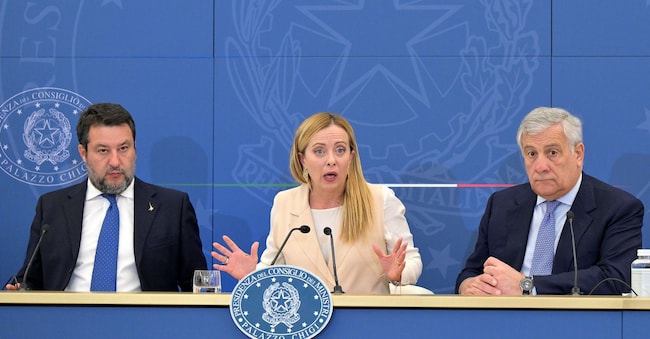
While waiting to know the 'details' of the 15% basic tariffs agreement signed on Sunday in Turnberry, Scotland, the premier Giorgia Meloni and her deputies, Antonio Tajani and Matteo Salvini, are also wondering about the possible impact of the new framework of trade relations with the United States in terms of consensus and popularity. Different parties, different electorates, those of Fratelli d'Italia, Lega and Forza Italia. But each in the centre-right majority is taking a big risk and preparing its strategy to resist the blows and not lose ground.
Meloni and the defence of dialogue: will he pay?
The boomerang danger for the Prime Minister is evident: the much trumpeted 'very special relationship' with Donald Trump and the role of bridge-builder and facilitator in relations between the two sides of the Atlantic repeatedly claimed by Meloni could backfire on her if the price to be paid on the altar of the new US protectionism proves too high for the Italians. What the oppositions call 'acquiescence' and 'unconditional surrender' to Trumpism, however, is called realism, if not pragmatism. The strategy of dialogue advocated against those who, like the France of Emmanuel Macron, had called for threats of harsh countermeasures, gave birth to 15% against the dreaded 30% that would have been triggered from 1 August in the absence of an agreement.
In the joint note with the deputies, the PM wanted to make it clear right away that she had helped to avert a trade war and save 'the unity of the West'. On this key she will continue to beat in front of her electorate, which so far has remained sensitive to the cry "Make the West Great Again" with which Meloni in the White House has revisited the Trumpian Maga and tried to accredit herself as the 'presentable' and moderate face of the world right (the one honoured on the cover of Time). But tomorrow, if the burden on the pockets of businesses and citizens proves to be less bearable than assured, also in view of the very short blanket of our public accounts, will the honeymoon with the Italians continue? A key question, in light of the already announced re-election to the next political elections.
Tajani and the challenge of the government's pro-European column
To characterise itself as the pro-European pillar of the government has been the identitarian flagship so far waved by Forza Italia and its leader, Antonio Tajani, whose arduous task in the post-Berlusconi era has been to not dissipate the founder's consensus and to protect the party from sovereignist stragglers. The Italian soul of European popularism has been defended to the bitter end, even at the cost of bitter clashes with the other deputy prime minister, the Lega Nord's Matteo Salvini.
But, precisely for these reasons, the attacks on Europe and its weakness that have been raining down from various quarters in the last few hours after the agreement between Ursula von der Leyen and Trump are likely to hurt the Azzurri more. Tajani's difficulty is all here: he cannot afford to fire on Brussels, but must worry about protecting the party's traditional constituency. Moreover, in a phase of transition towards greater internal democracy, sanctified by the last National Council, and towards the 'openness' urged by Pier Silvio and Marina Berlusconi. How will the announced new Manifesto per la libertà coming after the summer be received by businesses suffering from tariffs?


