
Tax, Leo: on Irpef we aim for the second rate up to 60,000 euro
The Deputy Minister for the Economy at the Trento Festival also highlights the work done on the global minimum tax. From Trentino Alto Adige comes a virtuous example on complementary pensions and financial education

Key points
The aim is to make one more step on the Irpef reduction, raising the second Irpef rate bracket (the one now at 33%) from 50 thousand to 60 thousand euro of income. Of course, if the resources available for the next manoeuvre allow it. But not only because the path to the completion of the fiscal reform now sees the finishing line: the Omnibus corrective decree and the Tax Code are missing, but in the meantime 28 delegated decrees have already been passed, 24 of which are in the 'Official Gazette'.
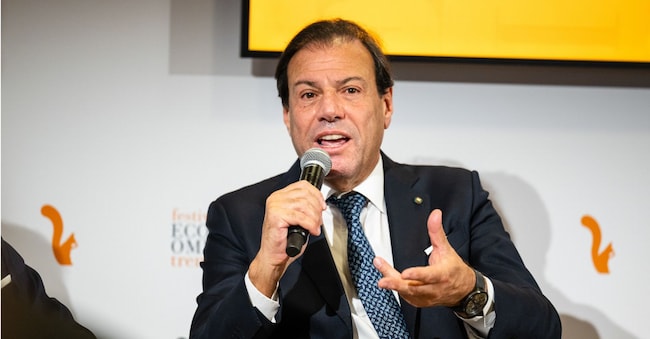
Changes remain on the agenda that can only be made if the resources are available. The reference is to the adjustments on the financial income side where there are hot topics such as the unification of the treatment of real estate and securities funds and the reduction from 26% to 20% of the taxation on the returns of investments of professional funds. These are some of the topics that Deputy Minister of the Economy Maurizio Leo addressed on the sidelines and during the work of the panel "Opportunities, protections and prospects: a multidimensional approach" during the Economy Festival in Trento.
The global minimum tax and the search for simplifications
The panel addressed tax justice, financial education and organisational leadership. The discussion started from the new posts on international taxation from Pillar 1 (on taxation of the digital economy) and Pillar 2 (on global minimum taxation). On Pillar 2 and the Italian application effects. The effort made - claimed by Deputy Minister Leo - is to find formulas to simplify the implementation of a discipline that presents several complicating factors precisely because of the need to seek harmonisation on different tax systems. So much so that even the director of the Inland Revenue Vincenzo Carbone stressed that it will not be easy to carry out controls on Pillar 2 and that a working group has already been set up in the Agency for four years to understand the rules and arrive ready with clarifications provided in advance.
The culture of complementary pension provision
The conference was an opportunity to address what the Regione Trentino Alto Adige is already doing to spread the culture of the supplementary pension. The regional councillor Carlo Daldoss took stock of the fund project for newborns. A project that concerns the zero-to-five age bracket with an initial contribution of 300 euro at birth and then annual payments of 200 euro: in practice, economic support can reach 1,100 euro for each new birth or each new baby. The numbers speak of great interest in the initiative, because months after its launch there are 17,500 members. This means 40 per cent of the applications from potentially interested families out of an estimated 40,000.
The leverage of financial education
Matteo Migazzi, managing director of Pensplan Centrum (the complementary welfare services company of the Trentino Alto Adige Region), placed the topic of financial education at the centre of the debate, starting from two key figures: there are about 1,800 billion bank deposits and about one million Italians have suffered financial fraud. "Our goal is to put citizens in a position to have tools to better plan their future," Migazzi explained. 'We are trying to intervene,' Migazzi explained, 'with projects in schools. We are in more than 150 schools. We start here, because we manage to eliminate social class differences because the children are on the same level'.


