
Tec raises $450 million in a record-breaking funding round for a European space company
Bessemer, Atomico and EQT’s Scaleup Europe Fund are leading the round. Total funding rises to 680 million; the funds will finance the Nyx capsule’s mission to the ISS and the reusable Storm engine

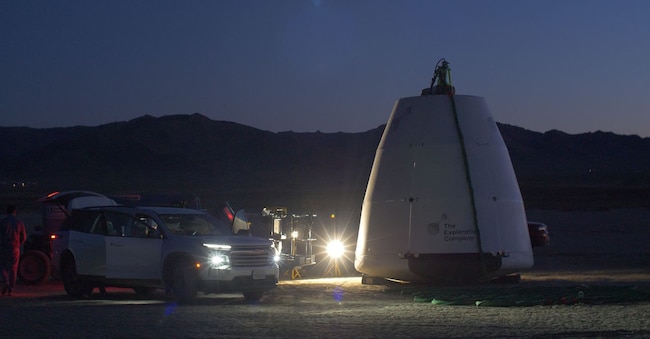
$450 million in a single funding round: this is the figure that The Exploration Company (Tec), a European space company founded in 2021 by Hélène Huby, announced today, Tuesday 8 September, that it had raised in a Series C funding round. According to the company, this is the largest ever announced by a European space firm and, as Tec emphasises, ‘the largest ever secured by an EU-based company led by a female founder and CEO’.
The round is being led by the US firm Bessemer Venture Partners, the European firm Atomico, and the Scaleup Europe Fund managed by EQT – the vehicle that brings together public and private capital with a stated target of 5 billion euros. Existing investors are also taking part, including Balderton, Plural, Cherry and Red River West. Whilst Alex Ferrara of Bessemer will join the board of directors, this funding round brings the total capital raised by Tec to around $680 million. The funding remains subject to the necessary regulatory approvals.
The figures accompanying the announcement say a great deal about the current phase the company is going through: over 2 billion dollars in contracts and commitments worldwide, divided equally — according to Tec — between public programmes, starting with the European Space Agency, and private clients for cargo logistics to space stations. Tec currently employs more than 550 people across Europe (with its headquarters in Munich and operations in Bordeaux and Turin), the United States and the United Arab Emirates, and has signed a Space Act Agreement with NASA for technical qualification, safety and certification activities for future missions to the International Space Station and commercial space stations.
The funds raised will finance two objectives: the first, identified as a short-term priority, is Nyx, the reusable capsule designed to deliver cargo to current and future space stations and return it to Earth, with the prospect of eventually transporting crews as well. Tec confirms that its first full-scale orbital demonstration will be the docking with the ISS, followed by re-entry into Earth’s atmosphere.

The second objective is Storm, a high-thrust reusable rocket engine fuelled by liquid oxygen and biomethane, which the company claims is “the first in Europe to use a full-flow staged combustion cycle”. Technically more complex, its architecture should enable the propellants to be utilised to their full potential. Storm is designed to serve as the propulsion core for a future European reusable launch vehicle for super-heavy payloads, capable of placing up to 40 tonnes into low Earth orbit, i.e. within 2,000 kilometres of Earth.

