
Technique, research and preciousness: how Bulgari renews its Tubogas
The Roman maison, which celebrated 140 years in 2024, presented the 16 new references of one of its best-loved collections in New York

3' min read
3' min read
Dazzled by the reflections of a Burmese ruby, a Colombian emerald or a Paraiba tourmaline, it may seem hard to believe that it is actually the profound rationality of an engineering design that enhances their beauty. Yet, in a jewellery creation, the structure, the skeleton is as important, if not sometimes more so, than the magnificence of a gemstone. It is the cages that create dreams, as revealed by the work of the master goldsmiths in Bulgari's high jewellery atelier in Rome, capable of filing imperceptible layers of metal to give maximum prominence to a stone and assemble dozens of tiny components into an impeccable jigsaw puzzle for a single earring.
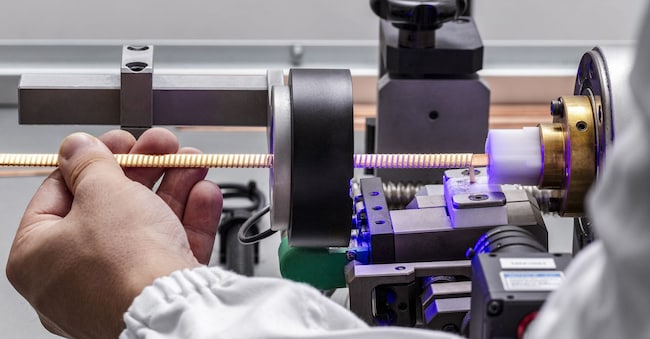
Famous and loved for the colourful and exuberant style of its jewellery, as well as its passion for research and experimentation, in its long history (which just in 2024 celebrated 140 years) Bulgari has signed a collection that has made craftsmanship and technical innovation its aesthetic hallmark. Tubogas is a solderless construction technique that softens gold, exploiting its ductility. It originates from two strips of metal with a U-shaped cross-section wrapped around a copper core, which are then rolled and fired again, and then the inner part is melted in acid. A process with alchemic and futuristic traits, son of the industrial revolution (and aesthetics) of the mid-nineteenth century, when the Tubogas, named after the tube used to transport pressurised gas in the 1920s, began to be experimented by other maisons as well. However, it was only at Bulgari that it became a protagonist. It all began in 1948: Rome was slowly rising from the rubble of war to transform itself little by little into the capital of the forthcoming Dolce Vita, and Bulgari applied Tubogas to the soft, enveloping bracelet of its first Serpenti jewellery-watch. But it wasn't until the 1970s, when functionality merged with design and lifestyles became more versatile, that Bulgari's Tubogas multiplied and diversified, meeting the maison's other motifs. Then, in the early 1980s, Bulgari innovated again by launching the Tubogas in steel, an alloy lighter than gold but more complex to work with, and which effectively responded to a new taste for motifs that were still industrial but intrigued by new technologies.
Today Tubogas is made at the Bulgari factory in Valenza, which was set up in 2017 and is set to become the largest in the world with the forthcoming inauguration of its expansion, which will bring its total surface area to 32,000 square metres and the number of people working there to 1,700. And it is there, among the hills of Monferrato, that 16 new references from the Tubogas collection originated, presented by Bulgari last September in New York with a special Bulgari Studio event (a creative platform where various contemporary creators interpret the icons of the maison): there are bracelets that meet other collections, such as Parentesi; a necklace that echoes Bulgari's taste for coloured gemstones with a tanzanite, a rubellite and a green tourmaline framed by geometric inserts in semi-precious stones and pavé diamonds, set in the centre of a Tubogas link with a distinctive triangular shape. Standing out, with its almost steampunk tones, an extreme extension of the collection's industrial aesthetic, is the Tubogas Black Eagle necklace, in steel, white gold and diamonds. Among the novelties, which at the same time evoke the origins of Tubogas, is a watch whose bracelet is not composed of the classic sequence of segments, but of three small ropes of yellow, white and pink gold. In addition, four rose gold variants in the new collection will be launched exclusively in Greater China and Japan.
In the Domus space in the historic Bulgari boutique at Via Condotti 10 in Rome, on the other hand, an exhibition dedicated precisely to Tubogas has just been inaugurated, offering for the first time to visitors a Tubogas Monete necklace with four Greek silver coins, circa 1974, which recently became part of the Bulgari Heritage Collection and of which only two examples in the world are known to exist, together with one of the maison's first Tubogas jewellery-watches, dated 1948.


