
'Technological plurality to cut emissions from heavy transport'
Anfia, Anita, Assogasliquidi and Unem: the solution indicated by the European regulation is not the right way. Italy relaunches biofuels

4' min read
4' min read
Old and polluting. This is the merciless picture of the goods transport fleet (trucks) circulating in Italy. In total there are about 4.9 million vehicles, according to the most up-to-date data from the Motorizzazione. Of this total fleet, only 29% has a Euro VI engine. 57.8 per cent of heavy goods vehicles run with engines between Euro zero and Euro IV. There is one figure in particular that gives one pause for thought: in Italy, 12.3 per cent of the total HGV fleet has a Euro zero engine. Moreover, 96.8% of the trucks registered in our country are powered by diesel. Electrically powered trucks make up just 0.3% of the total. To understand the environmental impact of heavy transport, it should be borne in mind that in our country, over 80% of goods travel by road and that the average age of trucks is 19.1 years, among the highest in Europe.
The new regulation
.It was against this backdrop that the new European regulation on the reduction of emissions from heavy-duty vehicles came down last spring: the one that outlaws all fuels except electric and hydrogen starting in 2040. This regulation imposes drastic and progressive cuts in HGV emissions as of now: -15% in 2025 compared to 2019 values; -45% between 2030 and 2034; -65% between 2035 and 2039; -90% from 2040 onwards. It is clear that the Italian road haulage industry is completely unprepared for such a roadmap. Moreover, the green transition of road transport requires huge investments and many road haulage companies are too small to cope with such an economic effort on their own without adequate support from the state.
The technology issue
.However, before financial, the issue is first and foremost technological. According to a confidential document by Anita, Anfia, Assogasliquidi-Federchimica and Unem, the approach adopted in the European regulation, in outlining the decarbonisation path for heavy transport, is not inclusive of all available technologies, but enables and emphasises a single solution (zero-emission vehicles: electric/fuel cell-hydrogen), whose technological developments are not yet mature for the sector, the associations claim. This makes the European decarbonisation targets for commercial vehicles difficult to achieve. The four associations write: 'Electric and hydrogen fuelling is not immediately implementable for all heavy goods road transport missions, especially long haul ones. The ecosystem for zero-emission mobility is still being defined'. The first Bev (100% electric) battery-powered heavy goods vehicles have recently appeared on the market, but they are suitable for medium-haul transport. They still present limitations in terms of autonomy (up to 500 kilometres), charging time (up to 90 minutes), and payload (up to 22 tonnes). Electric power has so far mainly taken hold in urban freight distribution, among light and medium commercial vehicles. Similarly, hydrogen vehicles today have limitations for use in long-haul heavy transport missions in terms of range (up to 650 kilometres with a 50-kilogram tank), refuelling times and payload, while their market offering is still confined to a few European countries (France, Germany, Switzerland).
The Italian position
.Italy has been fighting for some time, in the European forum, to affirm the principle of technological plurality to reduce emissions from heavy goods road transport. According to the government and the Italian road haulage industry, there are other technologies, currently available, that can usefully contribute to the decarbonisation of the sector and the creation of a pathway to zero emissions. First and foremost: the use of biofuels, where Italy is at the forefront in the world thanks to the extraordinary efforts of Eni. Rome has waged a tough battle within the EU institutions to obtain an initial green light for biofuels, which has not yet matured. The government is aiming for 2027, when the EU regulation on cutting emissions from trucks will be reviewed by all member states in order to assess its effectiveness. Certain aspects, explains the document drafted by the four associations, will be central to the review, including: the number of zero-emission heavy-duty vehicles registered in the member states; and progress in the development of charging and refuelling infrastructure (public and private) for alternative fuels for heavy-duty vehicles.
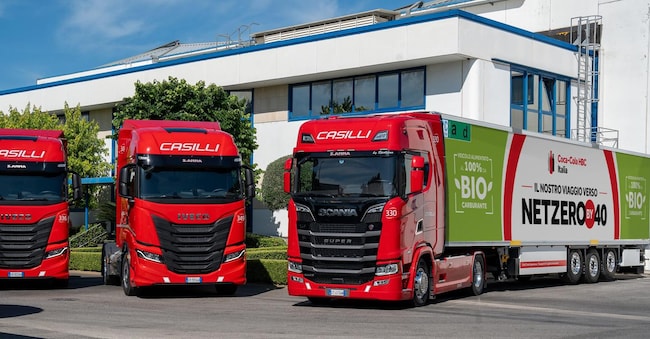
Eni, for its part, is already producing and distributing in 600 stations throughout Italy a renewable liquid biofuel (Hvo) made from vegetable or animal waste, agro-food industry residues and a residual part of vegetable oils, which reduces carbon emissions by up to 90 per cent and can be used in the latest generation Euro VI engines. Furthermore, there is not only biodiesel. In the gas chain (LNG, CNG, LPG and their bio declinations), our country is an excellence, enjoying a competitive advantage. Aiming at bio-Lng is in line with the EU's declared carbon neutrality objectives. If methane of fossil origin already reduces CO2 emissions by 20%, the bio version, produced from organic waste and agricultural biomass waste, fully achieves carbon neutrality. And so the environmental interest coincides and merges with that of the national economy.


