Innovation

Tecnopolo set to make a comeback in advanced computing

The new infrastructure enhancing the Leonardo supercomputer was unveiled in Bologna. The investment totals €86 million, with more than half funded by the NRRP

by Luca Orlando

3' min read

Translated by AI
Versione italiana

3' min read

Translated by AI
Versione italiana

A new engine for Artificial Intelligence. An infrastructure for managing large volumes of data, and new applications in quantum systems.

The Bologna Technology Park is introducing further technologies, with a total investment of €86 million, the majority of which (€49 million) is funded by the PNERR, bringing in new tools that strengthen the technology hub’s position in the fields of high-performance computing and artificial intelligence applications.

Loading...

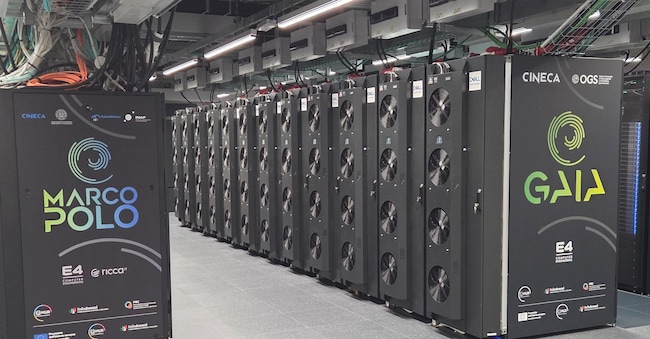
The systems presented – LISA, MARCO POLO, GAIA, NOX and SOL – are the latest additions to the ICSC ecosystem (National Research Centre for High-Performance Computing, Big Data and Quantum Computing) and will help to enhance the capabilities of an infrastructure designed to integrate high-performance computing, cloud computing and quantum computing, enabling the country to achieve autonomy and independence in the control and management of data.

“The NRRP,” explained Anna Maria Bernini, Minister for Universities and Research, during the inauguration, “has enabled the creation of a state-of-the-art infrastructure that already allows Italia to play a leading role in strategic sectors such as supercomputing and quantum computing. The technologies inaugurated today consolidate our country’s position within the most advanced research and innovation sectors and represent a decisive investment in the scientific, technological and industrial future of Italia and Europe.”

“This inauguration,” adds Michele de Pascale, President of the Emilia-Romagna Region, “confirms our region’s status as a true European capital of big data and supercomputing, but above all demonstrates our extraordinary ability to put the resources of the PNRR to good use, transforming them into permanent infrastructure.”

“In this way,” comments Antonio Zoccoli, President of the ICSC National Centre and the National Institute of Nuclear Physics (INFN), “a fundamental building block is being added to the ICSC’s national infrastructure. Thanks to the strategic vision of the Ministry of University and Research (MUR) and the investments from the National Recovery and Resilience Plan (PNRR), Italia has in fact equipped itself with the first permanent integrated platform combining HPC, cloud and quantum computing, capable of strengthening digital sovereignty and supporting the competitiveness of the entire national economy. A resource which, particularly in light of today’s geopolitical and energy instability, takes on fundamental importance in preventing further ground from being lost in the international race for data control, enabling autonomy to be achieved through the creation of a viable and sustainable Italian and European alternative to the US technological model.”

“With the addition of SOL and LISA,” explains Francesco Ubertini, Vice-President of the ICSC National Centre and President of CINECA – we are creating an integrated ecosystem centred on Leonardo, designed to support a wide range of workloads: from advanced artificial intelligence applications to traditional HPC, right through to emerging quantum computing. This milestone is the result of a strong national commitment by Italia – through the Ministry of Universities and Research, CINECA and the ICSC – together with EuroHPC, which has aligned investments and capabilities to strengthen Europe’s technological sovereignty and enable the creation of a new generation of cutting-edge resources for research and innovation.”

For the Bologna Technology Park, this marks another step in an ongoing development process. Once the buildings currently under construction are completed, the site is set to welcome other research-related organisations such as Enea, the Chips-It Foundation, and Cineca itself, with its supercomputing division. And then there is the UN University and numerous companies such as Nvidia, STM and Cisco, global giants that have already expressed an interest in setting up here, where one of the ten most powerful computing systems in the world is located.

And if we also take into account Eni’s supercomputer in the Pavia area, Italia is the only country in the world – apart from the US (which has four) – to boast two of these advanced facilities in the global top ten for computing power.

Copyright reserved ©
Loading...

Brand connect

Loading...

Newsletter

Notizie e approfondimenti sugli avvenimenti politici, economici e finanziari.

Iscriviti