
Ten Unmissable Looks from the Gulbenkian Museum in Lisbon
Ca' Rezzonico houses masterpieces from the collection of the Armenian philanthropist Francesco Guardi, who blurred Vedutism into intimism
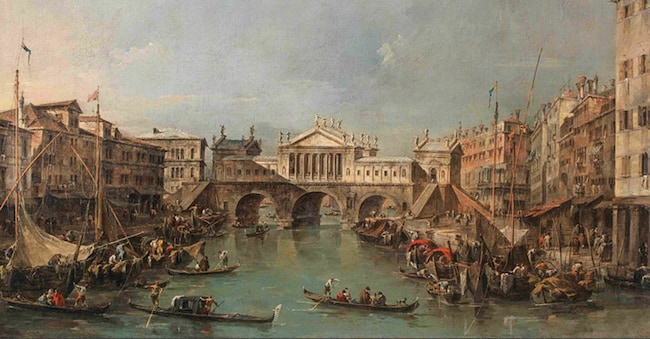
The Rialto Bridge closes the daily routine on the Grand Canal, with curtains flapping in the wind, gondolas bustling and squires crowding. This is the Venice of Francesco Guardi (1712-1793), who reworked Canaletto's models and animated the banks of the Grand Canal with his unmistakable macchiettes, even putting his signature - a very rare occurrence - on a shop sign: The Grand Canal at the Rialto Bridge is one of the ten paintings by the Venetian artist from the Calouste Sarkis Gulbenkian Collection on show until 8 June at Ca' Rezzonico.
The entrepreneur and philanthropist of Armenian origin (Scutari, 1869-Lisbon, 1955) is an oil magnate and invests in beauty, from classical art to the Italian and Flemish Renaissance and the Dutch seventeenth century: he escapes Ottoman persecution first in Cairo, then in London and Paris, where, in Avenue d'Iéna, he brings together a large part of his collections, to finally move to Lisbon at the outbreak of the Second World War. And the museum that bears his name houses 19 canvases by Guardi, purchased between 1907 and 1921 and considered to be among the author's most famous: 'I have enough Guardi paintings, but I always like to see other interesting ones,' he often repeated as a reminder of his passion for Venetian light.
To be able to admire ten of them in the portego on the first floor of Ca' Rezzonico is a precious opportunity for a plunge into Venetian life, in a city laid bare in Guardi's flickering painting. The light smudges the buildings, the speckles liven up St. Mark's Square at the Festa della Sensa and it is very interesting to compare it with about fifty drawings, kept at the Gabinetto dei disegni e delle stampe of the Fondazione Musei Civici di Venezia, where the largest nucleus of Guardi's sheets - 410 in all, including those of his son Giacomo - is to be found, valued at 30 Austrian lire, a pittance, when it passed into the hands of Teodoro Correr, the founder of the museum of the same name.
The artist loves the glory of Venice when he portrays The Departure of the Bucintoro, the Doge's galley, or The Regatta on the Grand Canal, but he finds humanity in the popular and lesser-known corners of the city: in the Veduta del canale della Giudecca e la punta di Santa Marta, he almost dissolves vedutismo into intimism. He frequents the mainland and the clarity of the Veduta delle chiuse di Dolo recounts the Venetian nobility who had their holiday residences on the banks of the Brenta. Finally, starting from Canaletto's etchings, he turns his attention to the Capricci and the Rialto Bridge according to Palladio's design - a project that was never realised - mixes classicism with the frenzy of merchants and boatmen in those infinite nuances that are life.
I Guardi di Calouste Gulbenkian, curated by Alberto Craievich, Venice, Ca' Rezzonico, until 8 June 2026 - Catalogo Antiga, pp. 136, € 30


