
Tennis stops Italy: ratings boom for Davis and 'public service' challenge
With the third Davis Cup in a row, Italian tennis also conquers the TV: share over 31%, peaks of 6.2 million and the Tg1 slipping. The exploit of the Azzurri fuels Fitp president Binaghi's battle for increasingly free-to-air tennis

Key points
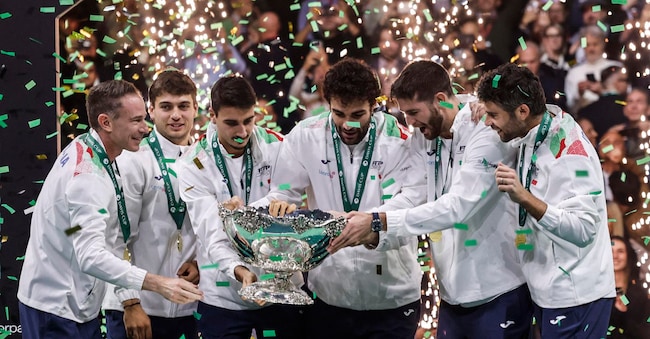
It used to be only for football. Now, for the moments when Italy stops you can (also) look to tennis. Yesterday, Sunday 23 November, with the third consecutive Davis Cup lifted to the sky - the fourth, counting the 1976 trophy - that ritual found its definitive consecration. And television, once again, found itself a faithful mirror of the country's mood.
Nothing like tennis, at this stage in history, seems to be able to channel collective attention (and enthusiasm). Not the struggling Italian national football team, certainly. Ever since Italian tennis players began to really impose themselves on the global scene, with Jannik Sinner arriving on the roof of the world, at number 1 in the Atp ranking now surrendered (and who knows, maybe it's not a small thing) to the Spaniard Carlos Alcaraz, the television ratings draw a curve that resembles an Alpine ascent: steep, continuous, almost heroic. And the numbers of the Davis final confirm this with punctuality.
Up to 31% share
The opening match of the final against Spain, the one between Berrettini and Carreno Busta, according to Studio Frasi's elaborations on Auditel data, garnered 3.6 million viewers and a 28% share between Raiuno and SuperTennis, the federal channel that holds the full rights. An event audience, in a Sunday family schedule. But it was with Flavio Cobolli's comeback feat that Italian tennis turned into pure television epic. His match against Munar was watched on average by 5.1 million people, with a share that exceeded 31%. One in three Italians, in front of the television set, measured their pulse to the rhythm of the Roman's strokes.
And then the last set, the perfect narrative fragment, which took place between 7.15 p.m. and 8.01 p.m. There the Auditel numbers indicate 6.2 million average viewers and almost 9.6 million contacts. Numbers of a European Championship final, numbers of Italy mirroring itself. So much so that the party afterwards, in its explosions of hugs and raised mobile phones, even caused Tg1 to slip: the racket that stops the country, replacing the main liturgy of information for a moment.
The popularity of tennis
That of tennis on TV is the story of a movement that sees its standard bearers winning far and wide. The new Italian generation has provided a cast worthy of a national saga, with different but complementary protagonists, capable of aggregating transversal audiences. The networks have noticed: post-match debates, behind-the-scenes documentaries, a narrative ecosystem that only a short time ago would have seemed a gamble. Now, however, it is an investment that pays off: event share, high ratings, tennis entering barroom talk like Var or the last missed penalty.


