
Terna focuses on new skills and talent search
Human resource development is at the heart of the industrial plan. The role of the Tyrrhenian Lab

3' min read
3' min read
Terna's 2024-2028 business plan, signed by the company's CEO Giuseppina Di Foggia, has set the course. In reaffirming the group's central role in supporting the transformation process affecting the country, it has placed people, the company's main asset, at the centre of the strategy, through their distinctive skills. The objective is, on the one hand, to strengthen Terna's workforce - which currently numbers about 6,200 employees - thanks to a considerable increase in recruitment and in the search for talent to support the group's activities, as well as a strengthening of skills (the plan envisages a growth of 1,400 people between now and 2028), and, on the other hand, to develop a different leadership model within the company that makes people feel like the protagonists of an ecosystem capable of enhancing specificities and paths and enabling more efficient ways of working.
Fair and Inclusive Transition
."The energy and digital transition process that Terna is leading offers great opportunities for growth for the country, also from a professional point of view - explains Managing Director Giuseppina Di Foggia - Terna, in fact, invests in people through the continuous training of new skills, with the aim of enabling our resources to effectively use innovative technologies and develop flexibility, creativity and resourcefulness. These are the characteristics, both individual and group, that allow us to enable a fair and inclusive transition, as envisaged in the 2024 - 2028 business plan".
In short, a change of pace in the valorisation of what Terna considers its main 'asset', as is also shown by the figures provided by the Human Resources Director, Daniele Amati. "In the last 18 months we have hired one thousand people and another thousand will be hired soon. These numbers, so significant, exemplify the importance and complexity of the moment we are living. People represent the group's main asset, and it is precisely to initiate the necessary changes that we have strengthened our people strategy by acting on all the levers available in the HR function (human resources, ed.), i.e. performance management, compensation and benefits, training, and also those relating to development and growth plans, with the aim of personalising them according to the characteristics of each individual person'.
Investments and Projects
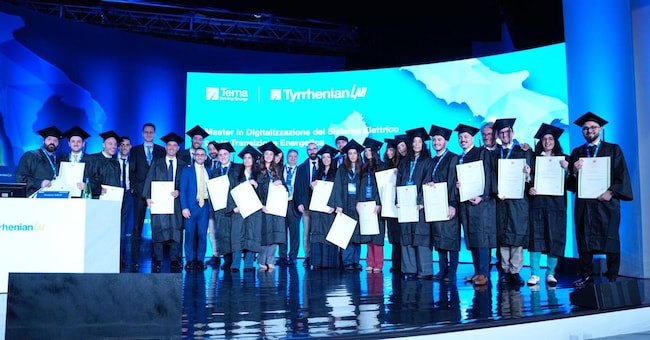
Terna has therefore decided to put in place, on this front, important new investments and projects that revolve around several tracks, from the Terna Academy, the "engine" of the spread of a culture of continuous learning - also thanks to the Terna Faculty, the network of in-house teachers that offers highly specialised courses -, to the Talent Management system, capable of attracting, motivating and developing people, so as to bring out their distinctive skills. Not to mention the Tyrrhenian Lab project, under which the third edition of the master's degree programme "Digitisation of the electricity system for the energy transition" was inaugurated in November, promoted by Terna in cooperation with the universities of Cagliari, Palermo, and Salerno, and which aims to establish a training centre of excellence distributed in the locations of the three respective cities where the cables of the Tyrrhenian Link, Terna's submarine power line called to connect Campania, Sicily, and Sardinia, will land. "The Tyrrhenian Lab project, realised in collaboration with universities and centres of excellence, confirms itself as a high-level academic training opportunity for the new generations of professionals in the electricity system," explains CEO Di Foggia, who points out that the third edition of the master's course, aimed at candidates from Stem studies, "registered over 350 applications: this confirms that we have created an effective training model that we intend to spread not only in Italy but also abroad.
A very articulated strategy, therefore, that also includes welfare policies and actions aimed at favouring work-life balance, personal wellbeing, the protection of parenthood, the sharing of family and essential responsibilities, and the removal of potential obstacles to equal pay. In the sign of that path of change that, as Amati emphasises, is based on certain founding values, such as respect, the uniqueness of individuals, and responsibility, understood as a tool for people's growth and development'.


