
Tesla blacklisted in Sweden but breakthrough on autonomous driving in the US and China
The AP7 pension fund has decided to sell its entire stake, amounting to USD 1.4 billion. But for Musk there is good news about regulation in two key markets

4' min read
Key points
4' min read
Two geographically distant but crucial developments for Tesla's future crossed paths on Friday 13 June. On the one hand, the United States and China - the two most important markets for Elon Musk's company - seem ready to remove regulatory obstacles to autonomous driving. On the other, in Europe, there is growing discontent on the labour rights front: the Swedish public pension fund AP7 has decided to put Tesla on its blacklist and sell its entire stake, amounting to USD 1.4 billion.
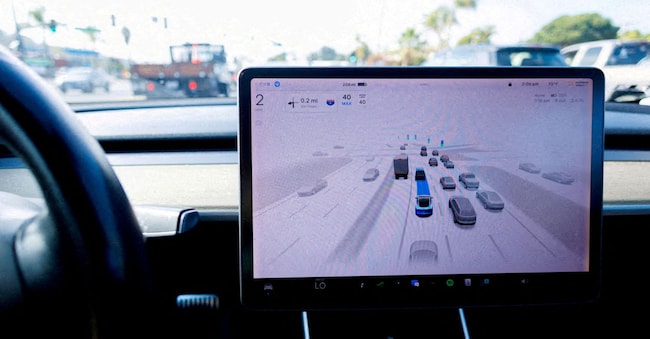
In the United States, the National Highway Traffic Safety Administration (Nhtsa) - whose top management had been swiftly shaken down by Musk during his leadership of the Doge, the car wanted by President Trump to cut federal spending - has announced its intention to simplify the process of exemption from the rules imposing manual controls in vehicles. A change that could speed up the approval of the Cybercab, Tesla's robotaxi without a steering wheel or pedals expected on 22 June, in view of the imminent launch of autonomous transport services. Regulatory decisions can now come 'in months, not years', said Nhtsa lawyer Peter Simshauser.
Is the Trump administration still close to Musk?
The reform comes at a time of apparent rapprochement between Musk and Trump. The president publicly stated that Elon Musk knew at the beginning of his election campaign that his policy would not be in favour of electric cars. Potus pointed out that Musk chose to support him anyway, despite the fact that his programme included cutting incentives and abolishing obligations on electric cars. In particular, Trump recalled asking Musk why he supported him despite these positions, to which Musk allegedly replied: 'Well, if it affects everybody, I'll compete.
This clarification by Trump came just as he was announcing the blocking of the Californian electric car law and as Musk was expressing regret for the excessive tone of the controversy between the two.
However, the Trump administration's decision to simplify and accelerate the process of exemption from federal regulations for cars without traditional controls (such as steering wheel and pedals) is a potential direct benefit for Tesla. The Austin-based company bases its expected future growth precisely on the prospect of accelerating the business of autonomous driving. The signal was immediately picked up by the markets: Tesla's share price jumped during the intraday session, up as much as 4% to USD 331, only to retrace to +1.94% (and USD 325) on a negative day for stock exchanges. On 5 June - during the most heated phase of the confrontation between Tesla's CEO and Donald Trump - a low of $284 had been reached. In the week, the increase was even more pronounced, 10.2%.


