
Tesla dismantles Dojo: how does Musk's chip and AI strategy change?
Morgan Stanley estimated Dojo's potential value at $500 billion just twelve months ago. It was to be the centrepiece of Tesla's technological vision

3' min read
3' min read
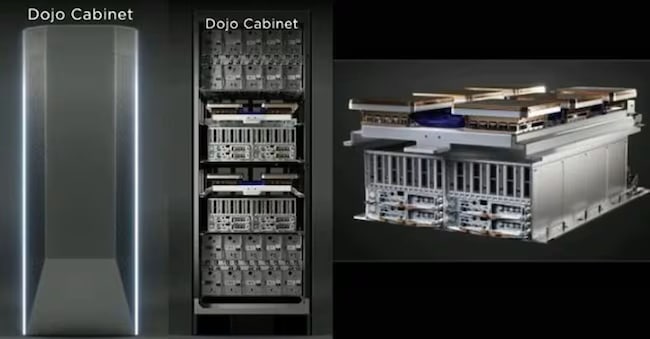
Elon Musk has decided to dismantle the team that developed Dojo, the supercomputer designed to train proprietary models of autonomous driving without depending on external suppliers such as Nvidia. Pete Bannon, who led the project, has left the company. Bannon was vice president for engineering and hardware design, arriving from Apple in 2016. The remaining engineers will be assigned to other projects related to data centres and computing infrastructure.
The decision marks the divestment of what until recently was considered one of the group's most strategic 'weapons'. Morgan Stanley had estimated Dojo's potential value at $500 billion just twelve months ago. On the social network X, the tycoon justified the choice by explaining that 'it doesn't make sense to split resources across two such different chip architectures'. The company will now focus on the AI5 and AI6 chips, which according to the CEO will be 'excellent for inference and good enough for training'.
The stock market reaction
.The markets appreciated: Tesla's share price gained up to more than 3.5 per cent. The end of the Dojo adventure should be interpreted not so much as a surrender, but more as a choice of efficiency and pragmatism. Why? Reducing risks and costs, leveraging established external suppliers (Nvidia, AMD, Samsung), reviewing corporate priorities with appropriate reallocation of resources and personnel to objectives closer to the business.
An unprecedented brain drain
.The Dojo project, which even last year the CEO described as 'a gamble with a very high potential payback', was born out of Tesla's ambition to hire top-level processor designers to develop higher-performance AI accelerators. But the initiative suffered delays and setbacks for years, marked by a continuous haemorrhaging of top talent. In 2018, Jim Keller, the renowned chip designer initially recruited to lead the production efforts, left. He was succeeded by Ganesh Venkataramanan, who, however, left Tesla in 2023 and founded DensityAI, where some 20 members of the Dojo team have now moved. A true talent exodus. Peter Bannon, who had worked with Keller for years and had taken the reins of the chip programmes, now followed the same path. He was preceded by other key figures who left the scene, such as Milan Kovac (robotics), David Lau (software) and Omead Afshar (operations).
Strategy and Evaluation of Tesla
The eclipse of Dojo is accompanied by a broader rethinking of chip strategy. Tesla has strengthened its alliance with Samsung, signing a ten-year, $16.5 billion contract for the supply of semiconductors. Production of the AI6 chip will take place in Texas, reducing dependence on TSMC. But the stop comes at a time when the robotics strategy is showing both technical and financial cracks. At the moment, the Full Self-Driving technology does not seem to be able to compete with the competition, Waymo (Alphabet/Google's company operational from 2018) above all.


