Cars of the future

Tesla Robocab and Robovan, what are Elon Musk's two self-driving vehicles

It is a two-seater coupe only and an Mpv with up to ten seats. It has no steering wheel and no pedals with a giant screen in the centre of the dashboard. The robot taxi will cost just under $30,000

by Corrado Canali

4' min read

4' min read

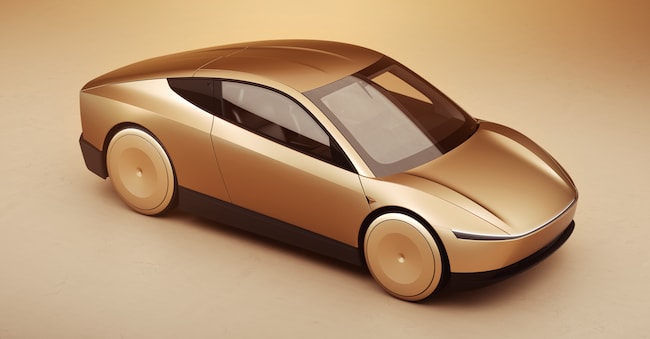
Tesla has just shown the first glimpses of its fully self-driving Robotaxi. The car is a two-door wing-opening coupe dubbed Cybercab, the name referring to the front end derived from the much larger Cybertruck to which it adds a more aerodynamic shape, with only two seats on board. There is no steering wheel or pedals, just a giant screen in the centre of the dashboard.

The Cybercab will be on sale for just under $30,000

.

CEO Elon Musk did not reveal any estimates of the Cybercab's performance or range, but said that it will be available for purchase by the public at a price below $30,000. It will also have inductive charging, which means there is no physical outlet to charge the battery. Musk also showed a kind of electric minivan dubbed Robovan, designed to move large amounts of people autonomously.

Loading...

Also a kind of 10-seater minivan

.

There are no specifications for this minivan either, at least at the moment, although from what we can tell, it should accommodate more than 10 people. It is unclear whether the van will also be available for purchase by the private public. Tesla says it plans to launch fully autonomous operations in California and Texas next year with the Model 3 and Model Y. It will not, however, be on the road before 2026 with the Cybercab.

No information on delivery times

.

Musk has always underestimated the delivery time of Tesla products, and one can imagine that the same will happen with the Cybercab. He himself has admitted that he has been optimistic in the past with the timing. After the debut, Tesla allowed those present at the event to take a tour of the 50 or so Cybercabs, albeit in the closed environment of a film set. No doubt videos from inside the car will start to spread online throughout the night. But knowing Tesla, it will probably be a long time before we see these cars on the road.Not one, but well two self-driving vehicles: the long-awaited Robotaxi and a mini-van, not so imaginatively named Robovan.

Tesla Robotaxi, tutte le foto

Photogallery26 foto

Tesla Robocab, le foto del monovolume a guida autonoma

Photogallery30 foto

Autorobots, Tesla's concept cars

Not one, but two self-driving vehicles: the long-awaited Robotaxi and a mini van, not so imaginatively named Robovan.

It must be said right away that these are things that other manufacturers call concept cars or show cars, and we have seen them in dozens of car shows. And never on the road. Will this be the time? With Elon Musk, never say never: he has accustomed us to making announcements well in advance, presenting cars without saying that they were a prototype, with non-existent or immature technologies, and then, after some time, perhaps not with the promised roadmaps, the vehicle arrived on the market. A case in point: Model 3, but also Cybertruck, while the Roadster2 has not been heard from since.

But back to the announcements and reveals at the Hollywood studios, where Elon Musk lifted the veil on Tesla's Robocab. The Texan company's CEO showed off the long-promised vehicle in the Italian night, featuring two doors and no steering wheel or pedals, paving the way for what he says will drive the electric vehicle manufacturer's long-term growth. The fact that it has no controls means that it is a vehicle with autonomous driving level 4 or even 5 on the scale established by the Sae, Society of Automobile Engineers. And it is a technology that is currently difficult if not impossible to realise and engineer into a production vehicle. It should also be remembered that Tesla already offers a level 3 system (on the motorway) but for legal reasons it is reduced to level 2. The same applies to competitors such as Mercedes.

Musk, who arrived on stage at the Warner Bros Studios near Los Angeles, California, aboard one of the robotaxis - called the Cybercab - said that 'production will begin in 2026' and that the vehicles can be purchased by customers 'for less than $30,000'. Their operation will cost 20 cents per mile.

"Most of the time, cars do nothing," Musk said, speaking on stage. "But if they are autonomous, they could be used five times more, maybe ten times more."

A statement that says nothing new, it has been heard dozens of times for the past 15 years when car company CEOs promised fully automatic driving, only to have their dreams dashed on level 2 and level 3 as they had to divert economic and human resources to electric cars. Now Elon Musk is catching them off guard again: the electric car faces a (not unexpected) crisis, sales are at a standstill, and he is relaunching on the new (so to speak) source of the self-driving car. Tesla has to reckon with a growth rate that is slowing down not only because of competition that has now reached Musk's brand levels, especially that of the increasingly aggressive Chinese manufacturers, but also because the market seems to be moving towards different solutions thanks to artificial intelligence and even greener than battery-powered cars. Hence Musk's decision to focus on new prospects where other car manufacturers are more vulnerable and where Tesla can exploit a competitive advantage as in the past with electric cars.

In view of the objective technological difficulties and despite the enthusiasm unleashed on social media, however, investors and analysts underlined the difficulties of technology and downgraded expectations.

Musk's plan is to operate a fleet of self-driving Tesla taxis, also called cybercabs, which passengers will be able to hail via an app. Individual Tesla owners will also be able to use the app by offering their vehicles as robotic taxis.

Copyright reserved ©
Loading...

Brand connect

Loading...

Newsletter

Notizie e approfondimenti sugli avvenimenti politici, economici e finanziari.

Iscriviti