
The textbook endures: first tool used in the classroom and at home. 74% prof already with AI
Survey 'The value of textbooks in classroom teaching and home study, when AI enters the classroom', presented at the Chamber of Deputies at the conference organised by the Italian Publishers' Association
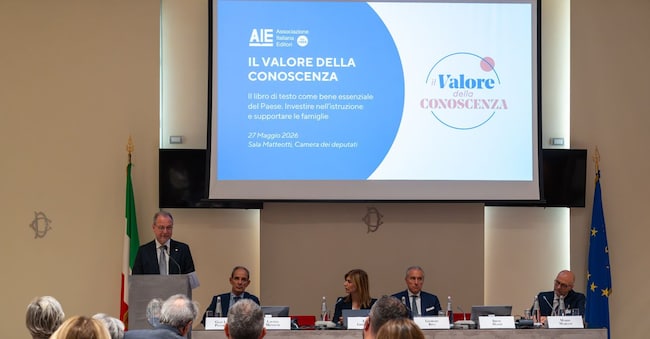
The textbook remains at the heart of school learning processes, even in the days of Artificial Intelligence. All the more so in a complex scenario where - say two out of three teachers - the ways and times of student learning have deteriorated over the past five years. This is what emerges from the survey 'The value of the textbook in classroom teaching and home study, when AI enters the classroom', presented today at the Chamber of Deputies during the conference organised by the Italian Publishers Association (Aie) 'The Value of Knowledge. The textbook as an essential asset of the country. Investing in education and supporting families'.
The search
A survey based on the responses of 3,399 primary and secondary school teachers in Italy (the original responses of 5,274 teachers were reduced to 3,399 to ensure a representative sample at Italian level), with the aim of examining the value that teachers attribute to the textbook (and to the digital materials linked to it) in classroom teaching and student home study.
Involving over 2,100 teachers
The event promoted by Aie at the Chamber of Deputies, on the initiative of the President of Commission VII (Culture, Science and Education) Federico Mollicone and under the patronage of the Ministry of Education and Merit, also involved more than 2,100 teachers connected via streaming from all over Italia. The textbook, with all the other didactic materials that accompany and supplement it, thus obtains a rating of 8.5 points, playing an even more important role in home study, where (with 8.7 points of appreciation) it is considered by teachers to be the essential point of reference for students' study and learning. Textbooks, say Italian teachers, are the first tool used for classroom development (99%).
Integration
In this scenario, 74% say they also use AI tools to prepare teaching materials. And, again on the subject of AI, tools made by publishers are considered useful by teachers, especially those that enable the development of tests and exercises (80%). The textbook is also the first tool used for home study (81%). For almost 70% of the teachers, students' learning times and modes have deteriorated over the past five years. The reasons given are first and foremost the reduction in time devoted to individual study (72%), the increasing difficulty in tackling complex texts (58%), but also the use of AI tools to do homework (36%). In the face of this transformation, 90% of teachers affirm that the organisation of content in textbooks and related materials is functional to current student learning patterns.
The active catalogue
According to a second study presented at the Chamber, the Aie Observatory on the world of school and publishing supply, the active catalogue (at least one adoption linked) today consists of 22,386 titles (ISBN codes for textbooks in Modes A, B and C) corresponding to over 5 million (5,042,541) digital content offered (it was 3.6 million last year). In 2025/2026, almost all adopted school books, 95.7 per cent, are in the so-called Mode B, which combines the printed book - central to learning processes - with the digital format (e-book) and digital learning content offered at no increase in cost. The e-book is used to a limited extent by students, but the use of digital learning content is growing. For almost all adopted books (according to publisher responses covering 90% of school adoptions) publishers have released or are releasing AI tools for the school year 2026/27.

Brand connect


Newsletter Scuola+
La newsletter premium dedicata al mondo della scuola con approfondimenti normativi, analisi e guide operative
Abbonati