The centre

Textiles, in the Biella CNR laboratory hunting for fakes

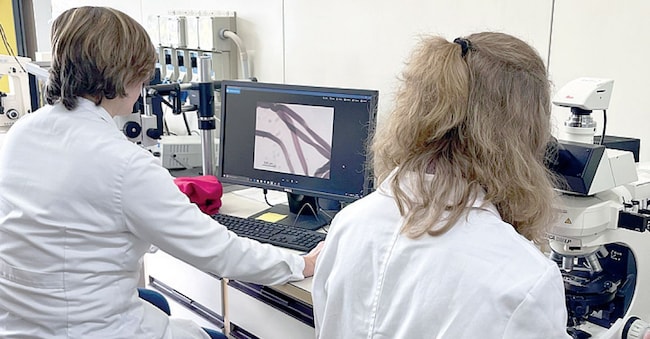
Here, prosecutors from all over Italy and chambers of commerce send samples of the seized materials to be analysed by researchers and technicians

by Carlotta Rocci

4' min read

4' min read

The value of a pure cashmere yarn can be up to ten times higher than that of a mixed yarn, which is much less valuable. Different fibres have very different prices in a market, the textile market, where the composition of materials largely determines the price. The expert eye of the entrepreneurs in the sector is sometimes not enough to distinguish fabrics to check whether or not they correspond to what is declared on the label.

You need well-equipped laboratories, electron microscopes and chromatographs, like those at the Stiima-Cnr centre in Biella, located in the heart of the wool and textile industrial hub in Piedmont and specialised in the analysis of fibres and yarns, so much so that it has become the national anti-counterfeiting reference centre. Here, prosecutors' offices throughout Italy and chambers of commerce send samples of seized materials to be analysed by researchers and technicians.

Loading...

One of the last batches arrived between December and January: samples of cashmere, silk and wool, to discover the composition of thousands of pieces that had ended up under seizure during a Guardia di Finanza operation. The chemical analysis of the products unmasked the fake: the 'silk' scarves were actually banal polyester: they would have ended up on the market for a few euros a piece, but still with a price well above their real value.

"The counterfeiting phenomenon is there, and it is constantly increasing," confirms the head of the research centre, engineer Riccardo Carletto. Samples such as those sent in December arrive all the time, and the evaluations carried out by the centre's experts number in the hundreds every year.

Often it is a millimetre analysis, because Italian regulations set a tolerance of 3% on the components indicated on the label, other countries have even stricter rules: technology is needed to provide precise answers on the quantity and quality of the fibres that make up a fabric.

"The first step under the microscope allows us to distinguish, on the basis of morphology and reaction on contact with the reagents, the type of fibre - animal, natural or synthetic," explains Cinzia Tonetti, head of the electron microscopy laboratory. "The second step, on the other hand, is chemical, with the use of solvents that dissolve the fibre.

An electron microscope is needed to distinguish animal fibres such as wool, alpaca or cashmere, but at the Stiima-Cnr centre an innovative technique called Proteomics, based on the analysis of the keratin contained in animal fibres, has also been developed in a project started in collaboration with the department of food and drug sciences at the University of Parma, which allows the type of material analysed to be identified without any margin of error.

Analyses to support investigations coordinated by the public prosecutor's office represent only part of the work of this research and analysis centre, which is also known abroad. Entrepreneurs, interested in protecting themselves and verifying the quality of a purchased product or the conformity of batches to be sent to a foreign country (with different standards from those in Italy), rely on these specialists to check samples of goods. Requests have arrived from European countries and even from the United States to analyse samples of goods.

"Every country has its own rules: for example, in China, if you declare that the product is pure cashmere, it must be 100% pure cashmere, with no margin of tolerance. The risk is that the cargo is seized and destroyed. That is why producers working with this country protect themselves by making preventive checks,' explains Carletto.

The other major strand of counterfeiting concerns the marketing of branded products, made, however, with materials that do not have the same characteristics as the original. It is a complex analysis involving the yarns, the dyeing and finishing process, and the properties that a fabric acquires with different treatments such as, for example, the ability to be water-repellent. "The counterfeit garment has a number of elements that can make it more or less recognisable than the one certified by the company that produces it," the experts explain. Other analyses study the antibacterial properties of the processing carried out on the fabrics, for an overall assessment of what is then manufactured, labelled and sold to the public.

Between test tubes, slides and machines that chemically and mechanically stress the tissues, some twenty people work: researchers, technicians and administrative staff, mostly women. Founded in 1969 as the Oreste Rivetti Research Institute, today the centre is part of the CNR and invests a large part of its resources in research, "which remains our mission," confirms Carletto. "Here we develop, for example, new materials unrelated to more traditional textiles, such as keratin nanofibres used in the biomedical sector for cell growth and tissue regeneration, or materials for filtering water and air. Fake cashmere, therefore, is only part of the workload that the centre deals with every year, but it represents a growing share, as does the phenomenon of counterfeiting in many sectors, including textiles.

Copyright reserved ©
Loading...

Brand connect

Loading...

Newsletter

Notizie e approfondimenti sugli avvenimenti politici, economici e finanziari.

Iscriviti