
Meccanotessile: India becomes the leading market
Output for 2025 is slowing; all eyes are on the ITMA exhibition. Salvadé: “An opportunity to reaffirm our leadership role. Politicians must take stable measures.”

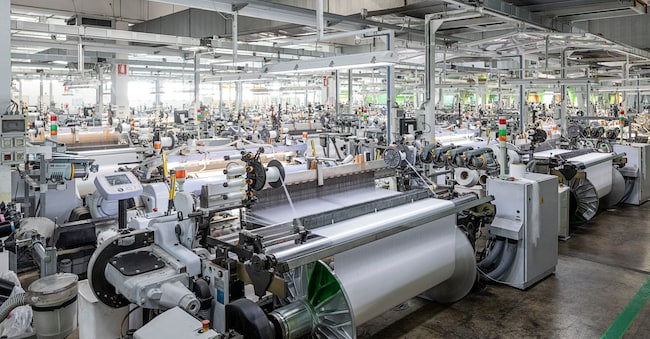
“India? It’s now our leading market, accounting for almost 80 per cent of our revenue.” The case of Sandro Salmoiraghi, an entrepreneur in the textile machinery sector, is an exception – but not entirely so – and in fact reflects a wider trend affecting the entire sector. As a result, India has now become the leading overseas market, overtaking China by a wide margin.
Despite the many difficulties of the period, the sector continues to hold an important position globally, ranking fourth amongst the world’s leading exporters of plant and machinery. Whilst China’s lead is out of reach (8.3 billion in exports, almost a third of the total) and Germany, with 2.7 billion, is not too far behind, Japan and Italia are separated by just a few points.
This is the result of a trend which, in recent years, has in fact seen a downward spiral in our international sales, against a global industry backdrop of moderate growth driven by the Asian economies. In 2025, global trade in textile machinery reached €26.5 billion, marking a recovery of 3.4 per cent following two years of decline. Over the five-year period 2021–2025, global trade in the sector showed slight growth, at an average annual rate of 0.6 per cent. This contrasts with a 5 per cent decline in Italia, a figure in line with that of Germany but better than that of South Korea, which remains well behind us in the rankings. Despite numerous difficulties, Italian manufacturers are thus continuing to hold their own and remain among the world’s leaders.
“Leadership,” explains Acimit President Marco Salvadè during the association’s annual general meeting, “is built not on cost, but on quality, the ability to innovate, the customisation of solutions, technological efficiency and industrial expertise. To support this drive, we remind the institutions of the need for coherent industrial policies, with incentives for innovation and digitalisation that are stable over time and easily accessible.”
Although the United States is the leading importer, global machinery exports, when broken down by major regions, are in fact directed primarily towards Asia, which continues to be the world’s manufacturing hub in the textile sector as well, accounting for over 50 per cent of total machinery imports.


