
Thanda island, swimming with the turtle sheikh
Emirati Fahim Al Qasimi dedicates his life to safeguarding the most endangered and fragile marine species

Key points
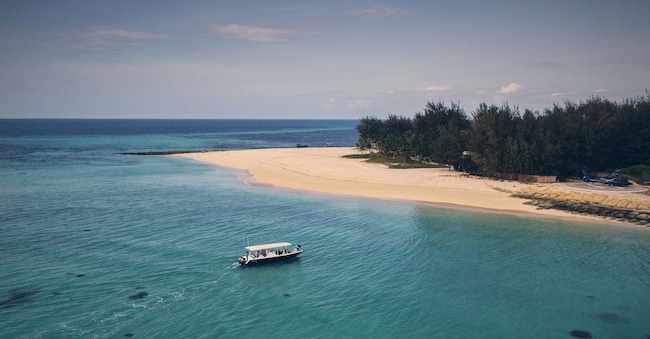
If you think Zanzibar has lost its old charm, a little further south, off the coast of Tanzania, there are other wilder islands to discover. Such as the archipelago of Mafia Island Marine Park and tiny Thanda Island in the Shungimbili Marine Reserve, a kingdom of diving. Thanda is a private eight-hectare tropical islet with an elegant colonial-style villa with five rooms and two bungalows on the coral beach full of shells, palms, flowers and birds, where we were based to explore some conservation projects with Sheikh Fahim Al Qasimi, who has been involved in protecting and caring for sea turtles for years.
A Life for the Sea
Besides his family, the emirate of Sharjah for which he works as executive chairman of the Government Relations Department, Fahim lives for the sea. As a child he was afraid of it. Then one day he discovered free diving and hasn't stopped: 'It's the freest way to be in the ocean,' he explains. "You put on a mask and fins, and you feel like a fish." A few years ago, during one of his dives he came across a turtle trapped in plastic, released it and she disappeared happily into the depths. A few months later it happened again.
Fahim was on a patrol in his sea when he spotted a turtle moving strangely at a depth of seven metres. "I was taught not to touch sea creatures, so I went on," he says. "But something didn't convince me and I went back. After half an hour, she was exactly where I had left her. I picked it up to bring it afloat, but when we were almost at the surface, I realised it was blocked by a fishing line. She hadn't breathed for over an hour and was missing a fin. It was not enough to free her, she needed treatment'. So the Sheikh sought shelter at the Dubai Turtle Rehabilitation Project (DTRP), inside the Burj al Arab, Jumeirah's famous sail-shaped hotel, the upscale hospitality group with 29 hotels across the Middle East, Europe and Asia. Since it was founded in 2004, the DTRP has rescued some 2,300 turtles and of these 96 have been tagged to track their routes once back at sea. Some have stopped in the waters of the Gulf, others have gone far, like Dibba who swam nine months and 8,300 kilometres to Thailand.
An outpost of marine life
Today, Fahim is the ambassador of DTRP, has created the 800turtles hotline (800 887853) that anyone can call to report an injured or endangered animal, and has earned the title 'Sheikh of the Turtles'. But his love for the sea is boundless, he knows it, explores it as soon as he can and tries to put himself in the shoes of the creatures that inhabit it, as he learnt from the map 'The World According to a Fish', which re-imagines land and oceans as a single body of water. Despite being a speck in the Indian Ocean, Thanda Island is an extraordinary outpost for monitoring marine life, thanks to its diversity and the initiatives led by Rianne Laan, the island's biologist, who in her book The Marine Life of the Shungimbili Island Marine Reserve tells of the 338 types of fish, 34 corals, 105 invertebrates and more than a hundred shells.
For Fahim and Jumeirah, the Shungimbili Marine Park and Reserve is an observatory for other important sustainability projects of the group such as coral cultivation in collaboration with Ocean Revive and the Dubai Reef programme to develop a coral reef from scratch in the waters of the Arabian Gulf. For four days, together with the Sheikh, we explored the amazing seabed and coral reefs around Thanda and, near Mafia Island, we encountered a whale shark. It is one of the rare places in the world where, from October to April, it is very likely to spot these harmless polka-dotted fish, the largest in the sea, floating silently in the water. Mafia is not yet on the radar of international tourism. There are no luxuries, no worldliness, just a few bungalows on the beach, often without electricity (such as the Chole Minji Treehouses lodge) and a population of fishermen and farmers who get by to improve the quality of life with dignity and with the help of some NGOs, such as Star for Life, which since 2005 has had a self-esteem and health programme that starts in primary schools and supports young people in the development of creative projects and small businesses. The secret of this island is its distance from everything.

