
That brilliant but stingy genius, Titian
With the arrival of one of the master’s masterpieces, the Poldi Pezzoli Museum explores the artist’s travels, commissions, fame and his attention to payments...

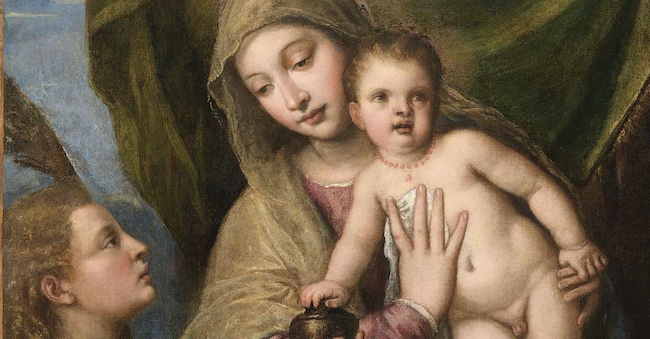
The 18th- and 19th-century guidebooks to Milan recommended three unmissable sites to nobles and foreigners, men of the church and soldiers passing through the city: the Duomo, Leonardo’s Last Supper and the Pinacoteca Ambrosiana, founded in 1618 by Cardinal Federico Borromeo and home to several masterpieces by Titian, including the Adoration of the Magi, the Penitent Mary Magdalene and the Deposition of Christ. For the master from Cadore, who was in Milan in the 1540s, had brought with him twenty new works, characterised by heroic drapery and free brushstrokes, capturing the imagination of lovers of beauty and the desires of the most discerning collectors. Today, that wonder is being revived thanks to the special exhibition currently running at the Poldi Pezzoli Museum, ‘A Titian for Milan’. The museum’s collections now include the Madonna and Child with Mary Magdalene, a painting by Titian dating from the 1540s: ‘This project stems from a significant gesture: a collector’s decision to entrust the Museum with a work that has never before been exhibited to the public, thereby turning it into an opportunity for study,’ says director Alessandra Quarto. ‘It is a concrete example of how private generosity can be transformed into a shared heritage, and this work has inspired the idea of exploring the intense and still partly undiscovered relationship between Titian and Milan.’
The artist, a master of self-promotion and of seeking proximity to those in power, became associated with the imperial court as early as 1533, when he painted one of his first portraits for Charles V. He then arrived in Milan in 1540 at the invitation of Lope de Soria, an adviser to the Governor of Milan, Alfonso d’Avalos, and secured an annuity for his son Pomponio as well as a commission from the Confraternity of Santa Corona for the Crowning with Thorns (now in the Louvre), a seminal work by Titian. His fame preceded him, and the artist fuelled it with masterpieces such as the‘Address by Alfonso d’Avalos’ (now in the Prado), delivered in 1541 when he was back in the city for the triumphal entry of Charles V, who granted him an annual pension of 100 scudi paid from the treasury of Milan. It is most likely during these years that the Madonna and Child with Mary Magdalene was painted, a room painting whose composition occupied Titian’s imagination for several decades. The Madonna holds the Child and gently tilts her head towards Mary Magdalene, whose long hair flows freely. The colour palette is vibrant, the brushstrokes are full-bodied, and certain details – such as the pronounced shadow beneath the Virgin’s nose – reveal the artist’s personality; he was undoubtedly assisted in the final execution of the work. X-rays have confirmed that the painting was executed in two stages, and the most striking change is that of the figure of the saint, who was not originally depicted as a saint but as a male figure in profile: traces of his large nostrils, thick beard and pronounced receding hairline are still visible. ‘One is led to believe,’ explains curator Lavinia Galli, ‘that the painting may have been conceived – and at least largely executed – for a person who had since died, or who did not collect it. At that point, it would have remained in the master’s studio until – a few years later – he decided to transform it into a Mary Magdalene, delegating the reworking to an assistant, almost certainly identifiable as Girolamo Dente, who had been his most trusted collaborator for years.” Perhaps that male figure was the patron? Who knows; what is certain is that the work arrived in Milan on a date yet to be determined, given that in 1746 the English Grand Tourist Sir Thomas Saunders Sebright (1723–1761), an English Grand Tourist, purchased it for his estate at Beechwood Park, which is now a school and where the archive still exists, offering a place to dig for clues: the work is described as ‘Titian, Virgin & Child &c., From [blank] Palace Milan’, and in that space—which is barely legible to English eyes—there may well be a clue to help us speculate on the palace and the Milanese patron.
Even setting aside these missing pieces of the collecting history puzzle, there remains no doubt that Titian’s fame was widespread in sixteenth-century Milan, as demonstrated by the other works on display. The Portrait of Gian Giacomo Medici, known as ‘il Medeghino’ (Biblioteca Ambrosiana, 1540–41) radiates a powerful light, born of the encounter between Titian and ‘il Medeghino’, a general in the service of Charles V. The Madonna Mazenta (Galleria dell’Accademia, Venice, 1560–65), documented in the collections of the Milanese Marquis Guido Mazenta, is imbued with artistic maturity, featuring overlapping brushstrokes and contemplative shadows. Finally, the copy from the Ospedale Maggiore of the Crowning with Thorns, the first version of which Titian painted for the Chapel of Santa Corona in the church of Santa Maria delle Grazie.
The master undertook his third and final journey to Milan in 1548, to paint a portrait of Prince Philip, the future Philip II. There was no shortage of prestigious commissions; emperors and nobles vied for his services. He was wholly absorbed by his art, but also faced issues with non-payment and delays. So much so that in 1559 he sent his son Orazio to Milan to collect the pension granted to him by Charles V, and the chronicles – without explaining the reasons – recount that the sculptor Leone Leoni stabbed Orazio in his home, the Casa degli Omenoni. Titian, so immense and yet so human, on the hunt for a few coins.


