
May you not get a krampus
With St Nicholas and the terrible devils of Tarvisio, Celtic festivals were inaugurated and closed with the Mass of the Sword in Cividale

Key points
The aluminium sink on fire was the formal start of the Christmas celebrations. We found the flames licking at the dish rack and my father laughing beside it. Of course it was St Nicholas who, for us lucky children from Cividale del Friuli, was worth as much and more than Father Christmas. He was the Triestine saint par excellence, even though we sang: 'San Nicolò di Bari, la festa dei scolari' (St Nicholas of Bari, the schoolchildren's feast day), pocketing our holiday without asking too many questions about that singing geographical anomaly. While in exotic Trieste, the Greek community, devoted to St Nikolaus, forerunner of St Klaus, celebrated mass in the Orthodox church of the same name on the banks, we went to the mountains in the Tarvisio area, Sella Nevea, where we climbed one of the ski slopes on foot, laying down tangerines, oranges and milk to refresh Father Christmas.
The Krampus in the Tarvisio area
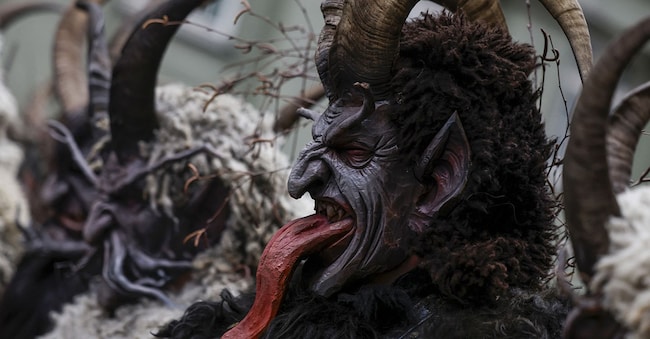
The night before, in Tarvisio, there were the Krampus, human devils entirely covered in furs and equipped with a pair of long horns on their heads and cowbells on their backs: when they passed, it seemed as if they were being swept away by a Mephistophelean herd. They wore wooden masks on which was carved the grimace of a mouth that wanted to bite or a devilish tongue. In their hands they held a long, mighty torch and, tucked into their belts, was a bundle of sorghum ready to scourge the naughty children. They preceded and followed the float with the bearded and snow-white St Nicholas, who, instead, standing there with a stick and bishop's robes, distributed sweets to the good children in a Lombrosian manner. I would see other Krampus again years later, those of Ortisei, sunnier and more mischievous. Here, their faces bare, dyed black, they good-naturedly chase the patrons, smearing them with soot. Only their backs and heads are covered in fur that ends in horns. They do not provoke childish disturbances, at most a necessary trip to the dry cleaners.
Propitiatory rites
St Nicholas was the day on which the Christmas tree was made, a real pine tree with its roots cut off, to the horror, quite rightly, of ecologists. The nativity scene was also made, so moss was collected on the banks of the Natisone, but it was Father Christmas and not the baby Jesus who brought the gifts. First, however, came Saint Lucy, a rather important saint, on whose grandguignolesco manner of martyrdom one glossed over, and for whom candles were lit on a wreath made of pine boughs. This opened the season of divinations for the New Year, more or less secretly from parents, because it involved the use of lighters. Lead was melted, as well as one could, and then released into the water with finger burns of varying intensity. From the form in which the metal solidified, we tried to predict the future. Only after decades, studying the life of Bobi Bazlen, did I discover that it was an Austrian custom, realising that I had been unknowingly immersed in a sacred-profane mash typical of the eastern Alpine arc, with a pagan-Spinozian matrix reinforced by the passage of the Celts and the Habsburgs, stretched towards the light and with the Lutheran nuance of Pasolini's 'terra romanza'.
Tripe after Mass
On Christmas Eve, people waited until midnight to go to Mass. The cathedral was full of people who then ended up in the taverns drinking a taj (glass) of wine, some grappa (contemplated even in the morning at breakfast) and eating tripe, seasoned with unfailing intercalary profanity. Lunch was an Italian-Habsburg mélange: there were tortellini, which came straight from Bologna from two emigrant aunts, brovade e musèt (sour turnips and skinny cotechino), while gubana was betrayed for panettone Motta, brought 'fresh' from a Milanese uncle, and, finally, there was the Christmas log of chocolate and butter, an element that pervaded the length and breadth of our recipe book, bequeathed by a grandmother named Jela, in honour of the Queen of Montenegro. In a little red notebook, Jela, known as Jella, passed on how to cook the basics: gulash, gugelhupf, strudel and sacher.
The Mass of the Sword and the Pignarûl
After New Year's Eve, we could smell the end of the festivities, which coincided, in Cividale, on 6 January, with the Mass of the Sword, in which the deacon wears the plumed helmet and wields the sword that once belonged to the Patriarch of Aquileia Marquard of Randecke, administering the blessing with three blows. We were left with the consolation of going to Tarcento to see the Pignarûl, the great epiphanic bonfire, on which the old things and sorrows of the year ended are burnt. It is an ancient rite linked to Celtic cults, thanks to which, by looking at the direction of the smoke rising from the bonfire, one can tell how the year will go: if towards the sea (south/levant) it will be lucky, if towards the mountains better to arm oneself with patience and tenacity. Those who had postprandial strength arrived in Carnia, where there was and is the Tîr des cidulis, which is also mentioned in a novella by Caterina Percoto. From the hills the local boys (cidulârs) would throw, flaming wooden wheels with a rhyme (raganizza), revealing the name of the beloved girl. Then began the blackest cold that came from the Balkans. Leaving home for school could touch minus 10. Only Candlemas, 2 February, would let us know when the grip would loosen. If during mass, touched on the neck by two crossed candles to keep away the sore throat, there was sunshine or bora from winter, we were finally 'fora'...


