
The challenge of 2025 will be to use words like 'challenge' well
The wish for the New Year is that we rediscover the meaning of words. And we are not referring to the words in the wild that crowd the social uttered by the many who in the pre-internet era had no wide audience.

4' min read
4' min read
The wish for the New Year is that we rediscover the meaning of words. And we are not referring to the words in freedom that crowd the social spoken by the many who in the pre-internet era did not have a large audience. We are referring to those uttered by those with high responsibilities, either through direct power or media influence. We have, for example, a NATO secretary general, who fortunately like the previous one has limited powers because the real ones are in the hands of American military personnel who for the overwhelming majority use words as well as weapons, who speaks of the need to enter into 'a mentality of war', without us understanding what he means.
But the word that is most in use today, even among the most thoughtful and balanced commentators, is 'challenge'. But the challenge being talked about is not the virtuous one that we should all set ourselves in order to achieve personal and collective goals and achievements for the individual and collective good, but 'the challenge' against the enemy, 'the challenge' as a drive to conflict, 'the challenge' as a form of exorcising a future that frightens us and an obsessive anxiety about losing what we have. But the real 'challenge' is how we will discuss a security system based on mutual benefit, on cooperation, and not on deterrence between increasingly armed blocs that are described as irreconcilable by a Europe that compensates for the absence of a war capacity with bellicose words.
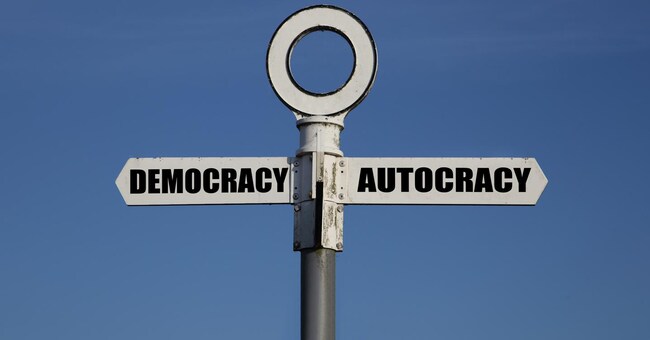
But the meaning of the words is especially lost when faced with a statement that is nowadays uttered in an 'axiomatic' manner, meaning without the need for demonstration. The statement is as follows: 'the challenge we face is that between democracies and autocracies'. It sounds like a good sentence, in a West that oscillates between blaming itself for all the nefariousness of the past and claiming to represent the good of humanity. What does the word 'challenge' in the quoted sentence mean? Does it mean that liberal democracies, because that is what we are talking about, which represent a minority in the world, must challenge countries whose systems of government deviate from this model? And in what way? With war? It is then unclear which autocracies are being challenged. Not all non-liberal democratic countries, but probably only those that are not 'our' allied autocracies. Not all countries with non-'liberal democratic' systems are ruled by more or less bloodthirsty dictators who oppress their own peoples. And we do not see 'non-democratic' countries, in the broad sense of the term, setting out today to overthrow the American liberal-democratic system, or that of France or Germany or Italy. Someone called Erdogan a dictator, I cannot say whether rightly or wrongly, the leader of a country that is a military pivot of NATO, which certainly has 'a war mentality' and which recently called for the destruction of Israel. But perhaps the 'challenge' being talked about is not a military one, but is meant to be an economic, scientific and technological one. For the famous autocracy alluded to by those issuing the 'challenge' is certainly China. But why speak of a 'challenge'? Are we to prove that liberal democracies work better and will remain economically dominant? We hold on to our individual value systems, children of a long history that we cannot always be proud of, and defend them even if we are not sure that they always work better in terms of efficiency. If today Europe is losing the technological 'challenge' to China and the US, it is not because it is democratic, but because it does not know how to give itself adequate political governance. And it is not China or Trump that is preventing us from having it. There are no Maoist revolutionary movements in Europe funded by the Chinese government to establish Communist or Confucian regimes, nor are there any military threats. Putin's war is not between democracy and autocracy, but is the legacy of intra-European wars that are also lost in history.
It is therefore not a question of challenging other countries, both democratic and non-democratic, not even on an economic, scientific and technological level. But there is instead a great collective and common 'challenge', that of saving the planet and ensuring a dignified survival for all the eight billion people who populate the world today. Not just a minority of this population. These are the global public goods. And equally, it is not a question of launching a 'challenge' to see who does it better, whether democracies or non-democracies. Because it can only be done through the revival of cooperation, be it economic, scientific or technological. Globalisation has also been this. The basis is coexistence and the search for a world order that offers security to the whole world, without either trade or military wars. Not all countries today seem to be moving in this direction, and the dividing line is not at all between democracies and non-democracies. 'Challenge' is a word that can have many meanings, and it is dangerous to misuse it.

