
The 80th anniversary of the 'Polytechnic', frontier of the 20th century

3' min read
3' min read
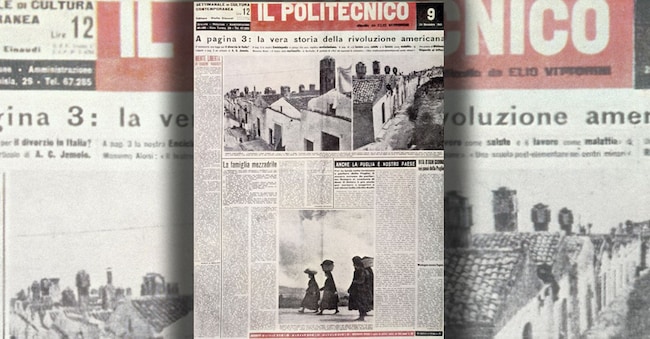
Eighty years ago, on 29 September, the first issue of Elio Vittorini's 'Politecnico' was published by Einaudi, a weekly newspaper format with a strong vocation for storytelling through images without becoming a magazine. The graphic layout, entrusted to Albe Steiner, was already a sign of a political choice. Each page was made up of red inserts that slipped into the black of the typefaces and had long, narrow columns, signifying an idea of verticality, an upward tension, as was in the architectural prerogatives of the Milan in which the magazine was printed and which inevitably recalled the skyline of New York, Vittorini's favourite city, almost as if it were possible, thanks to this organisation of space, to breathe in an air still afflicted by the offences of dictatorship, but already projected into the dreams of a civilisation far beyond the scandals of history, beyond the world conflict, racial hatred, social and economic injustice, and the vengeance of the civil war.
The 20th century would not have been the same as we know it if it had not been for this publishing venture to act as a watershed, to intrude into the heart of the century like the line of a frontier. In fact, it matters little if by a twist of fate the magazine would have ended a couple of years later, in December 1947, much earlier than we would have expected and due to the ideological misunderstandings that arose between its editor and Palmiro Togliatti, then secretary of the PCI. Frontier was for real, starting with the editorial with which Vittorini undertook a personal discourse on the 'new culture' - this was the title - that he himself was waiting to see realised. "Whose is the most serious defeat in all that has happened?" he asked in the incipit, turning his concern towards the defeated, not just the armies, but civilians, children, the elderly, women, the ordinary, the victims who have no names to remember and who always fall, yesterday as today, into the enormous storehouse of forgetfulness and error. But Vittorini was aiming higher. To fall, to lose oneself, according to him, was not only human beings.
At stake was something more vital, more profound, and it consisted in ascertaining the causes of the failure of the old culture in the face of which he called for a new one, more urgent, perhaps decisive, and with the credentials to answer the other question: whose fault is it? Certainly it would have been certain to pronounce the names Benito Mussolini or Adolf Hitler. And in the time that followed, the list would have even lengthened: Stalin, Franco, Pinochet, Videla, Papodopoulos, right up to the events of recent months. But such an answer would have implied a misunderstanding of the question. Which, precisely, was not looking for proximate faults, but for remote responsibilities, the shortcomings that lay at the origins.
Vittorini, in other words, wondered how it was possible for Wagner's music to be played in the camps while human bodies were incinerated a few dozen metres from the orchestras. And these were remote responsibilities. If the encounter with the imagination fails to change the human soul one iota, it means that the premises are wrong. This is what Vittorini meant when he wrote his article giving it the physiognomy of an indictment: 'Man has suffered in society, man suffers. And what does culture do for the man who suffers? It tries to console him." We find ourselves at the turning point of another twentieth century, of another era that could have been opened up by these words. As difficult as it is to understand and accept, there is one mistake that has been made since the dawn of time and that is to believe in the consoling role of culture. But it must not and cannot only heal the pain of life, medicate wounds, alleviate suffering. It would be too narrow in its scope, perhaps even trivially useless because it is subject to episodic and temporary fruition. There would be no point in reading a book, visiting an exhibition, listening to a symphony, attending a dance, watching a film, without the assumption (and the hope) that all this would protect against suffering. To liberate man, not to be his consolation: this is what Vittorini asked of culture in the middle of a century that, alongside genocides and dictatorships, promised a secure future between well-being and technological progress, trust in human intelligence. He did not obtain it in his time, we have not obtained it either, eighty years on.


