Digital Economy

The Ai agent economy: the new automation is already worth trillions

From Salesforce to Amazon Web Services, platforms are evolving to delegate complex tasks and operational decisions to software. A revolution that according to McKinsey may be worth USD 4.4 trillion.

3' min read

3' min read

From assistants we can talk to to autonomous systems capable of making decisions for us, in the company, interacting with tools, data, other agents. As well as ourselves, of course, although in this evolution, one wonders whether these systems will not soon turn up their noses at us poor flesh-and-blood creatures. Humans 'ancient race', destined to become extinct, would say the famous director Sergio Leone (Once Upon a Time in the West).

Who knows: for now, the trend is clear, moving towards platforms to manage autonomous or semi-autonomous AI. 'Agents', as they are called: a term that has been used in the industry for decades, but now, thanks to 'generative' AI technologies, has become a common or almost common reality.

Loading...

What until a few months ago was only the unchallenged realm of chatbots talking to us and advising us, is increasingly being populated by systems that can also make decisions for us. For companies, the implications are interesting. McKinsey estimates that generative agents could bring $2.6 to $4.4 trillion in added value per year worldwide.
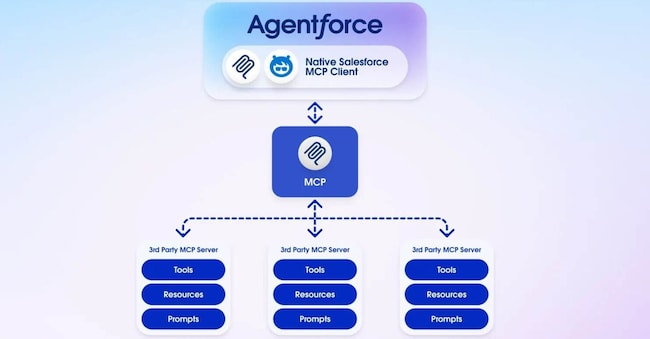
The latest evolutionary step was taken in June by Salesforce with Agentforce 3, a platform designed to bring generative artificial intelligence into business processes in a secure, scalable and measurable way. A complete, end-to-end approach.

Agentforce 3 enables companies to delegate complex tasks such as generating quotes, onboarding customers, analysing complaints or managing IT tickets to digital agents. These agents can make decisions based on business rules, integrate with legacy systems (crm, erp, database) and adapt to data in real time. The command centre allows managers to control everything the agents do, preventing errors, monitoring kpi and meeting compliance standards.

Compared to the AI agents we have seen with OpenAI (Gpts) and Anthropic (Claude Agents), the difference is clear. These perform on cognitive tasks: writing, document analysis, writing code, reasoning on complex texts; they can interact via api with other systems, but are less structured to orchestrate distributed business tasks or to act on databases and complex software solutions. Agentforce 3, on the other hand, is designed to integrate itself into the corporate environment and in this way can also make more autonomous decisions, while other more consumer (or prosumer) agents are still more tied to a human assistant role. The same applies to the 'AI Agents' that Microsoft is beginning to integrate into Copilot Studio.

We are at an early, immature stage of the market, so there is no homogeneous category of solutions yet. Amazon Web Services (Aws) perhaps has the solution most comparable with Agentforce, Bedrock Agents, a modular architecture that allows complex flows to be orchestrated thanks to a 'supervisor + sub-agent' model. The emphasis here is on automated task execution in cloud environments, with the possibility of integrating persistent storage, databases and IT automation tools.

Companies already operating on Aws can create agents that autonomously manage tasks such as compiling reports, processing documents, creating dashboards or sending alerts in case of anomalies. The model replicates real operational dynamics, such as a project manager coordinating technical teams.

Google, with its Vertex AI Agent Builder, has instead introduced a flexible framework for developers, focusing on the orchestration of multiple agents via languages such as Python and standard protocols. Compared to Vertex, Claude Agents and its Workbench is more experimental, allowing the configuration of intelligent agents capable of performing analyses, writing code and interacting with enterprise data via api. The focus, however, remains on cognitive enhancement rather than actual operational automation.

The choice depends very much on the scale of the company.

For many SMEs, the most common choice now is OpenAi's GPTs with Assistants Api: an easy gateway to agents, which can be used to manage customer care, faq, internal support on company policies, or to customise experiences on sites and apps. These tools are quick to adopt and inexpensive. Large companies should probably look more closely at Salesforce and Aws.

Copyright reserved ©

Brand connect

Loading...

Newsletter

Notizie e approfondimenti sugli avvenimenti politici, economici e finanziari.

Iscriviti