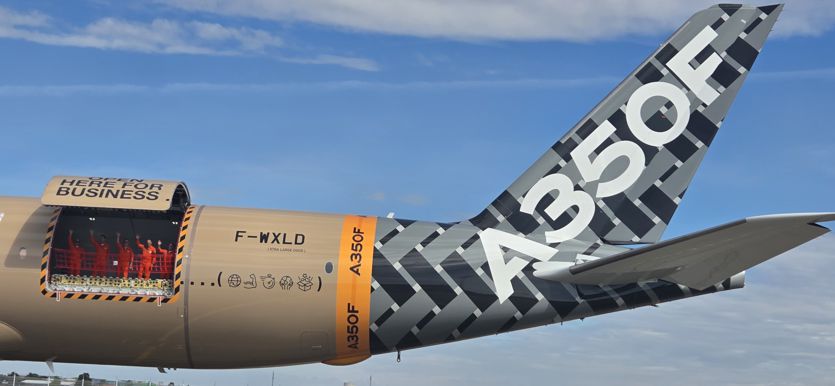
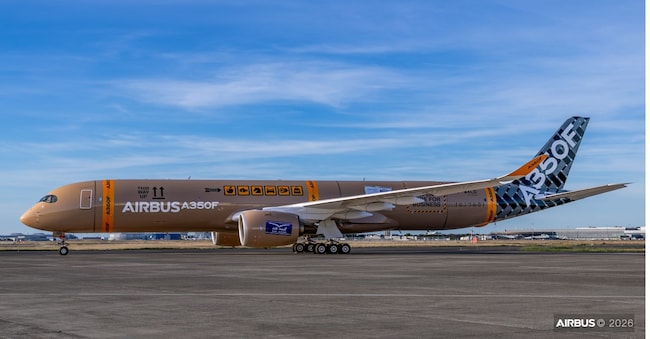
The Airbus cargo aircraft has taken off to compete with Boeing
Even before it went on sale, the A350F had already secured 115 orders from 14 customers, accounting for 60 per cent of the market. The first delivery is scheduled for the end of 2027.
by Mara Monti (Toulouse)
 Aggiungi Il Sole 24 Ore
ai preferiti su Google
Key points
The A350F, Airbus’s new cargo aircraft, took off on its maiden flight at 10.30 am from runway 14R at Toulouse Airport. There were five pilots on board. After four hours flying over France at 25,000 feet, the aircraft returned to the Airbus hangar, where it will undergo the final stage before entering service: the certification programme, which will last around nine months. “This aircraft is a game-changer for the cargo sector: the technology will enhance its benefits and performance, representing a real breakthrough. It is a momentous change for the target market; we are entering a new phase,” commented Lars Wagner, CEO of Airbus Commercial Aircraft, on the sidelines. The CEO confirmed that the first delivery is scheduled for the second half of 2027. “We haven’t yet decided who the launch customer will be,” specified Julien Poyou, Head of the A350F project, during a briefing in Toulouse. “There are two names on the list: Singapore Airlines and CMA CGM.”
Market trends
The first flight is arriving some two years behind the schedule set out in 2021, immediately after the pandemic. During those years, the boom in demand for cargo transport had helped to shore up the airlines’ finances, partly offsetting the slump in passenger traffic. Demand for cargo continues to show a degree of resilience even during the current crisis, despite the impact of the war and the resulting rise in jet fuel prices: in the first six months of the year, demand in the cargo sector rose by 4.7 per cent, despite a 9.6 per cent slump in traffic in the Middle East. Europe stood out during this period, with growth of 5.8 per cent, followed by Africa at 10.9 per cent and Asia at 8.6 per cent.
Airline orders
The A350F is entering the market with an already substantial order book. Airbus has secured 115 firm orders from 14 customers (KLM, Air France, Etihad, Turkish Cargo, Cathay Cargo, Singapore Cargo, Silk Way, Korean Air, Martinair, MNG Airlines, Air China Cargo, Avilease and the latest order from the American airline Atlas Air for 20 aircraft), as well as one unidentified customer. The A350F has thus achieved a market share of 60 per cent, ahead of the Boeing 777-8F.
“Despite these difficult times, the sector is holding up well,” explained Crawford Hamilton, head of cargo marketing. “Demand remains strong, buoyed by e-commerce and the boom in artificial intelligence. Both of these trends are helping to cushion the impact of the crisis.”
The launch of a new aircraft is now a rare occurrence in the industry, particularly at a time when manufacturers are grappling with delivery delays and significant pressure on production capacity. Airbus plans to increase production of the A350 – in both its passenger and cargo versions – to 12 aircraft per month from 2028. For the A350F, the use of the same platform as the passenger A350 is one of the main advantages for airlines. The commonality between the two versions allows for greater flexibility in crew management and maintenance operations. The cargo version, however, is not simply a passenger A350 adapted for freight transport. The A350F incorporates numerous modifications, including the main deck loading system, tail anti-tilt systems, the drainage system, air distribution and other systems.