Online shopping

The intention algorithm: how AI predicts our desires and what we will buy

Emma McFerran, CEO of Lyst – an aggregator of 27,000 brands and shops worldwide – explains how, in the age of artificial intelligence, ten million everyday actions can be transformed into an assessment of tastes and trends.


Un ritratto di Emma McFerran, ceo di Lyst. ©Hannah Dace

7' min read

Translated by AI
Versione italiana

7' min read

Translated by AI
Versione italiana

At the height of Facebook’s popularity, experts claimed that the algorithm would be capable of sensing a user’s intention to change their life even before they were aware of it themselves, by picking up on moods and subtle shifts in language. Today, some are delving even deeper, mapping contemporary desire through ten million daily actions. A search, a saved item, a purchase: it is this mass of signals that Lyst works with – a search engine and global aggregator that brings together 27,000 brands and shops and uses artificial intelligence to guide and personalise the multi-brand shopping experience. But what it observes goes beyond purchases: it traces the journey through which taste is formed, fragmented and changes direction.

Lyst Index con gli oggetti più cercati dell’estate appena trascorsa. Il prossimo sarà pubblicato a fine ottobre.

Emma McFerran, aged 40, CEO since 2022 and with the company since its inception, emphasises that, to achieve this, it is necessary to combine the research aspect with the emotional one. At Lyst, they describe themselves as fashion architects, because the project stems from the intersection of art and science. ‘Users’ activity is constantly visible on the platform. We can see what people love and search for, what they add to their wishlists, and what they interact with,’ she explains. And she concludes with an almost programmatic definition of what they have built: “I’d call it a ‘platform of desire’. Lyst does not directly own the stock, which remains in the hands of retailers and brands: it organises choice and discovery through data.” The aggregator was founded in London in 2010, born of an insight that other sectors – from travel to music – had already experimented with: bringing together a vast range of offerings in one place and relying on data to make it accessible and personalised. McFerran joined when the company had just over ten people working out of a warehouse in East London – early enough for its founder, Chris Morton, to end up regarding her almost as a co-founder. Soon, observations of user behaviour gave rise to the Lyst Index, the quarterly ranking of the hottest fashion brands and products, fuelled by every search, save and purchase made by customers. The inspiration came not from the catwalks, but from music charts. ‘We took our cue from Billboard, applying to fashion the idea that there could be a sort of neutral benchmark capable of showing, in real time, where customers’ interest was concentrated and how it changed over time.’
Loading...

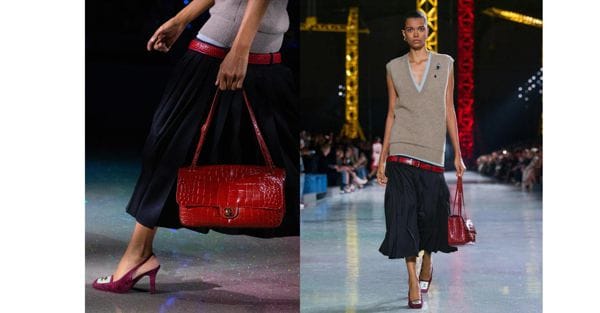
Alcuni scatti suggeriti dalle tendenze che Lyst ha dato in anteprima ad HTSI. Varie sfumature di rosso per borsa, cintura e slingback dalla sfilata CHANEL A/I 26 e il look completo in passerella.

Turning desire into data, however, means reaching the point where data alone is no longer enough. At Lyst, they call them silent criteria, the silent criteria: everything that influences a choice without ever being explicitly stated or typed into the search bar, such as the occasion, the social context or insecurity. McFerran gives the example of an invitation to a work cocktail party hosted by one’s partner: ‘A situation where you don’t know anyone, but you want to make a good impression and get the dress code right. You want to be comfortable yet chic; to stand out, but not too much. These nuances linger in your mind when you simply type in ‘black cocktail dress’, losing sight of all that crucial context,’ she explains.

It is in the space between those three words and what precedes them in the mind that artificial intelligence opens up a new field of research, attempting to get closer to the unspoken part of a question. It is more difficult to capture the opposite: “‘I hate it’, ‘I don’t like it’, ‘I’d never wear it’: in fashion, these reactions can be very visceral, but it’s tricky to pick up on them,’ he admits. Whilst the system is learning an ever-changing aesthetic vocabulary, the context is also shifting. ‘In the past, aspirations were much more top-down and uniform. Today, they have become complex and fragmented,’ he explains. Knowledge has also become more widely accessible: you can follow an entire creative team, track down an archive piece from the other side of the world, or get lost in online discussions about the texture of a fabric, the cut, or the quality. ‘The range of what we consider to be luxury, or what we can dream of, has expanded enormously,’ notes McFerran.
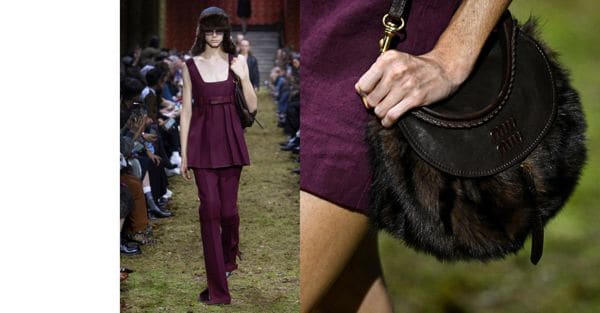
Nuance color vino per la collezione MIU MIU stemperate anche nella borsa in dettaglio.

Of course, the big brands continue to attract a huge amount of attention, but they are no longer the only guiding principle. “We’re seeing that aesthetics, rather than the brand, are becoming the organising principle behind building a wardrobe. The questions now are: ‘What is the aesthetic? What is my style tribe? How do I put it together? What look am I going for?’ The old search formula of ‘brand plus keyword’ is being replaced by detailed descriptions of a visual world to be reconstructed. This attitude is particularly evident among Gen Z, for whom fashion and culture seem to move at almost the same pace. In the second quarter of 2026, the hottest item on the Lyst Index was the New York Knicks cap: searches rose by 4,276 per cent compared with the previous period. An item that becomes the symbol of a collective moment; McFerran interprets this as “the connection between a real-life moment – perhaps even a physical event they didn’t attend – and the demand for the fashion surrounding it”.

However, engineers alone are not enough to make sense of a subject that is so difficult to reduce to numbers. At Lyst, data scientists and developers work alongside stylists, editors and fashion experts: ‘These are new, cutting-edge issues, and for that very reason they cannot be resolved within silos,’ he emphasises. From this blend of cultures and skills emerges one of the company’s most evocative phrases: engineering serendipity, designing serendipity. Because personalisation carries a risk: if an algorithm returns only what it recognises as consistent with the searcher’s taste, precision ends up equating to predictability. ‘A poorly designed algorithm flattens everything into a homogeneous mediocrity. And that’s terribly boring. We don’t want people to all dress the same or be exactly alike.’

Il cappotto tagliato come una mantella di MASSIMO DUTTI.

The challenge is to digitally capture something that is part of the physical experience of discovery: walking into an unfamiliar boutique on a whim and finding something we wouldn’t have known to look for. The question then becomes how to make a person feel that their tastes have been understood, whilst at the same time giving them the thrill of wandering. Hence the oxymoron: ‘Can serendipity be designed? I believe so, because we must continue to offer novelty and surprise.’ The very things that McFerran herself cultivates when shopping in boutiques: ‘Because of my job, I can’t separate the context from the object: lines, style, materials, collections. I look on with envy at my mother, my sisters and my friends who don’t work in the industry. They simply see something they love and buy it,’ she notes. So, especially when travelling, she forces herself to practise a little freedom. She walks into a boutique and, if she likes something, avoids immediately turning the item into a system of references and meanings: ‘I buy it because I think it’s beautiful,’ she laughs. Even amidst the ocean of data collected and analysed, there remains a fundamental distinction between behaviour and taste. The algorithm can recognise a pattern and identify early on something destined to become relevant. But it is not necessarily the source of it. The radar works, however, and can do so months in advance: ‘chocolate brown’, for example, appeared in Lyst’s data long before it filled the shop windows (including) this season. Not all trends are quite so clear-cut: the return of maximalism seemed to spell the end of ‘quiet luxury’, but ‘I wouldn’t say we can claim today: “Minimalism is dead, long live feathers”’, admits McFerran.

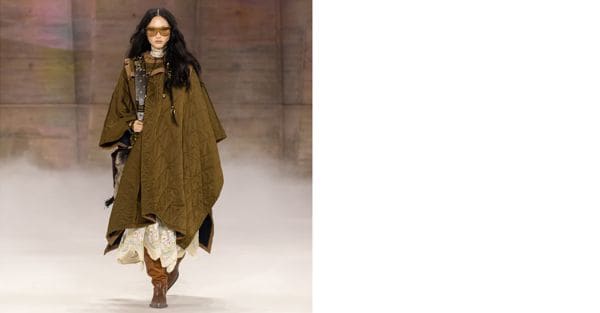
Verde sottobosco per l’ampia cappa effetto matelassé di CHLOÉ.

Furthermore, observing does not mean remaining neutral. The Lyst Index has gained such authority that singling out a brand or product as hottest in turn generates attention. The line between measuring a trend and helping to create it is becoming increasingly blurred. ‘I believe we are increasingly helping to shape it. And we’re proud of that, because it means the Index is sparking conversation.’ Once published, this ranking “exists independently of us: it belongs to the brands and creatives, but also to journalists and those who comment on it on social media”, he adds. It is this circularity – desire produces data, data produces narrative, and narrative in turn influences desire – that makes the Index a portrait of the present as well. If preserved in a time capsule and opened a century from now, according to McFerran, it would reveal ‘a multifaceted society’. In the same quarter, a Chanel Flap Bag and a Trader Joe’s tote can coexist, the aspiration for high luxury and the desire to be a quiet tastemaker, the desire to belong and the desire to stand out. There are so many different voices. Taken together, they end up revealing a great deal about the way we live.’ Second-hand and archive pieces also contribute to this diversity, combining sustainability, the quest for uniqueness and nostalgia. And you don’t need to have lived through an era to long for it: ‘I used to steal my dad’s pink flared trousers that he wore in the 1970s!’ recalls McFerran. Today, Gen Z looks at the 1990s in the same way – and even at the recent year of 2016 – as a past to be reconstructed through objects.

McFerran comes from a legal background and her leadership style is based on the ability to listen, whilst still staying the course. ‘I gather input, take it seriously, we discuss things at length and then make decisions. It’s essential to establish a very clear vision and strategy and to remain steadfast, because the problem is losing your way, straying from your guiding principles.’ It’s a balance for which she is grateful to the place where she seeks calm and beauty: McFerran, mother of six-year-old twins, has been living just outside London for about a year, on the edge of an ancient woodland. Whenever she can, she walks amongst the trees on her own, without her mobile phone. “I listen to the birds, watch nature change, and enjoy the silence – which lasts until my children catch up with me,” she laughs. “Technology moves at breakneck speed, as do fashion and culture. This slowness, and the simple fact of being surrounded by nature, are a gift to me.”

Ten million gestures a day can reveal a great deal about desire, and artificial intelligence can learn to get close even to what remains unspoken. But there remains a boundary that McFerran does not seem willing to erase: ‘There is always a human element to taste.’ The machine can recognise the signal. First, however, someone must have looked at something in a different way. And decided that it was beautiful.

Loading...


Copyright reserved ©
Loading...
Loading...

Newsletter

Notizie e approfondimenti sugli avvenimenti politici, economici e finanziari.

Iscriviti