
The American reflection of the Italian dream

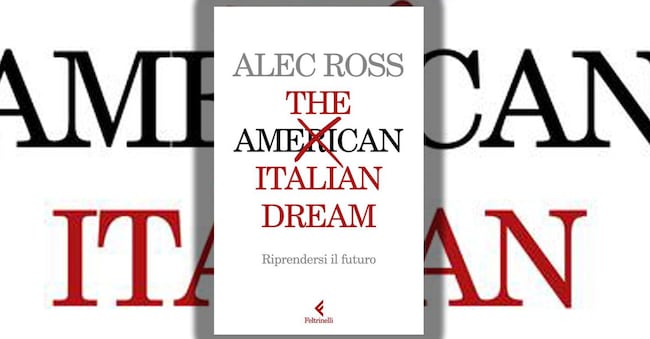
Italia could finally return to growth. To achieve this, it would need to capitalise on its strengths and tackle its shortcomings with greater determination. This is the argument put forward in *The Italian Dream*, Alec Ross’s latest book. The author holds up a rather unusual mirror to us: that of an American who has chosen to live in Italia. Ross knows our country well, yet maintains just enough distance to view what we consider normal with a critical eye. It is a perspective which, through its use of personal narrative, is reminiscent of Tim Parks’ *Italian Neighbours* (1992), whilst in terms of content it takes us back to the very recent warnings contained in the closing remarks of the Governor of the Bank of Italy and, before him, Mario Draghi.
The quality of the analysis also depends on the author’s background. The Ross family’s Italian roots are complemented by extensive experience in innovation and positions held right up to the White House. This is another reason why the book rejects two common stereotypes: that of a country in decline or a museum to be preserved. Instead, what emerges is a portrait of a society that could grow significantly, if only it learnt to combine creativity with discipline, to preserve ‘elegance and attention to detail’, and finally to develop the confidence and ability to work as a team. The scourge of parochialism is illustrated with an amusing and emblematic example: the rivalry between Modena and Bologna.
The Renaissance, the author points out, did not simply preserve the past: it reinvented it. Even today, cultural heritage drives development when it better supports research, artificial intelligence and advanced manufacturing. The sections devoted to the relationship between craftsmanship and technology are particularly compelling. Ross sees physical AI as a tangible opportunity for Italia. The point is not to copy Silicon Valley, but rather to imbue emerging technologies with an Italian character: attention to detail, quality, aesthetic sensibility and adaptability. The important thing is not to end up like the European Community, which acts almost exclusively as a referee with its many rules, but does not play the game itself; and, as Ross writes, ‘the referee never wins’.
Equally effective is the reflection on time. Italia continues to prioritise what is urgent over what is important. Ross observes how much our politicians favour the urgent but unimportant – which flatters the ego but ‘starves the Republic’ – and that the adrenaline on which Italians thrive may win a sprint, but not a marathon. Digital infrastructure, research, education and administrative modernisation, on the other hand, require patience and determination over the long term. On the other hand, the book offers some consolation regarding our relationship with the passage of time in life – age: for Italians, it is not a matter of numbers, but rather ‘a state of mind’.
Trust is also one of the book’s central themes. Paolo Baratta used to say: ‘Trust is currency.’ Ross observes that, in our country, because trust is low, this leads to an increase in unnecessary checks and red tape, and bureaucracy becomes an invisible tax on development. Anyone who has worked in public institutions is well aware of this mechanism whereby excessive energy is wasted on mutual scrutiny amongst peers.

