
The animal world in design: how shapes, movements and images enter interiors
From Martinelli Luce's iconic pieces to contemporary armchairs, from carpets inspired by endangered species to naïve and visionary illustrations: fauna, exotic and otherwise, returns as a protagonist in furniture, wallpaper and lamps

Key points
We love them, we fear them, we sometimes forget their existence. Animals are our double: in the relationship we establish with them - and each era expresses a specific one - we reflect ourselves. The design, which absorbs and restores the feeling of time, is inspired by the animal world even in an era like the present one - which tries to silence the wild side of nature - and highlights how involving, and perhaps even salvific, it is to bring the instinctive and free traits of the animal world back into the four walls, whether translated into formal inspirations or transferred into descriptive images.
The Icons of Martinelli Luce
The forms of the animal world were a great inspiration for Martinelli Luce, which in the mid-1960s produced three famous lamps that never left the catalogue: Gae Aulenti's Pipistrello (1965), Cobra (1968) and Serpente (1965) by Elio Martinelli. Of the latter, the company is celebrating its 60th anniversary with a special edition with base and arm finished in orange, a pop, cheerful and energetic colour that characterised those years and is now back in vogue. It is instructive to note how Elio Martinelli translated the observation of movement into function: like the body of a reptile, the sinuous arm of the Serpente lamp rotates 360° thanks to a central joint, bringing the light from the white hemispherical diffuser to the most favourable position for the user. In addition to fulfilling its purpose, the curved line is an element of character that gives the lamp beauty and charm.
Freedom and dynamism in the Softy armchair
The dynamism of the animal world also inspired young Ukrainian designer Vladimir Tolochko for the new Softy armchair by Potocco: "It is a story of freedom, movement and uniqueness," says Tolochko, "brought to life by a design that combines aesthetics and comfort. Inspired by the image of wild animals running freely through boundless meadows, the armchair reflects their grace, individuality and strength'. The trait of movement is recognisable in the cylindrical legs, particularly in the back legs, which are inclined as if for a running lunge, as well as in the slightly reclined backrest: but the idea of movement is only suggested, while the solid conformation and the integral upholstery invite one to sit.
Furniture as an ecological manifesto
That design captures the spirit of the times is proven by the series of benches signed by Bahia-based artist and designer Danilo Freitas and disseminated in Europe by Tropicalistic, a digital platform founded in Milan to spread the potential of Brazilian design. Freitas uses wood, stone and plastic scraps to create his furniture, grafting into them a message of concern for nature. His series of benches is inspired by endangered South American animals, capturing some of their unmistakable formal traits: Tatu bola, inspired by the armadillo, Queixada al pecari (a species of wild boar) and Tamandua, which reproduces the silhouette of the giant anteater. Each piece is unique, composed like a mosaic with solid wood tesserae made from scraps.
Irony and design against the trophy myth
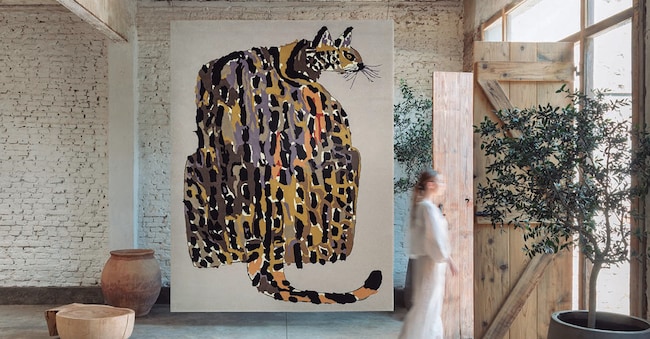
The dismantling of the colonial and post-colonial myth of the hunting trophy took place in the Seventies with irony and design: the protagonist was Gabetti&Isola, the Turin studio led by Roberto Gabetti and Aimaro Isola, which realised the Olivetti West Residential Centre in Ivrea. The architects also designed the furnishings for the flats, intended for the company's employees, including a series of Tapizoo carpets that reproduced the skins of wild or fantastic animals: they were Tapileo, Tapiorso, Tapipardo and Tapidrago, which Amini put back into production, fifty years later, in full continuity with the original design. The careful choice of wools, the fine hand knotting and the multi-layered chiselling of the fleece restore the quality of the design and the surreal and playful suggestion that was the basis of the series.
Brand connect


Newsletter RealEstate+
La newsletter premium dedicata al mondo del mercato immobiliare con inchieste esclusive, notizie, analisi ed approfondimenti
Abbonati