
The antidote not to condemn Europe to irrelevance
Mario Draghi's powerful speech removed all illusions from those who believe that postponing decisions is a winning strategy

3' min read
3' min read
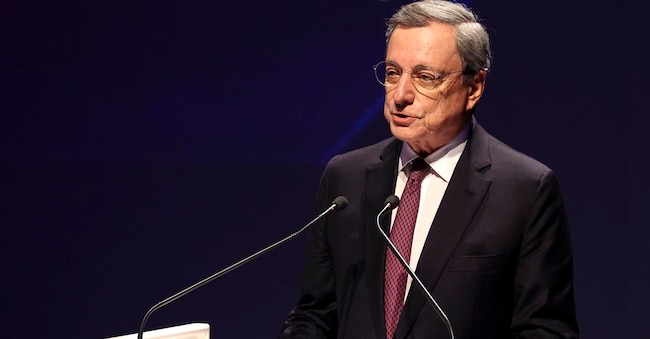
Mario Draghi's powerful speech in front of the attentive audience of bankers and entrepreneurs gathered at the Cotec Forum in Coimbra removed all illusions from those who still believe that postponing any decision is the winning strategy for this fragmented and quarrelsome Europe. In full agreement with President Mattarella, Draghi made it very clear that there is no going back from this situation, created by Trump's willingness to abandon all multilateralism to go it alone along the path of generalised conflict. This is therefore the moment for decisions: in the face of these, no one can be found asleep - as our Head of State emphasised - and no one can keep their feet in two or more stirrups.
It is no coincidence that Draghi and Mattarella chose the Cotec stage to send such a clear message: COoperacion TECnologica is the foundation launched in Spain 30 years ago by the then King of Spain Juan Carlos - later replicated in Italy and Portugal - to accelerate innovation and cooperation between banks, companies and public institutions in the lagging areas of Southern Europe. Today, as the pact between France, Germany and Poland tightens, the space for Southern European countries risks closing. Italy, Spain and Portugal find themselves squeezed on the one hand by Trump's choice to erect import duties - which affects above all those who have staked their growth on exports - and on the other by the risk that Northern European countries will decide to play their own strategic weight, thus outside the EU context.
Draghi's speech is even more compelling here. From the mid-1990s to the crisis of 2008, the European Union experienced higher annual growth rates than the rest of the world, thanks to the courageous choice of the single currency and the enlargement to the East, two policies that declared the structure that had emerged from World War II finished. With the 2008 crisis, however, each country sought its own way out of the crisis, chasing extinct sovereignisms and thus condemning itself to act on the scraps of the world market.
There is no more time to play each one on his own,' Draghi says, 'but it is time to achieve a new leap of integration together. The Monetary Fund predicts an internal recession in the US, so European companies will have to find an alternative for their products to the rich American consumer market. In order to maintain the growth of the European economy, Draghi thus sees an increase in domestic consumption as the only solution, which implies an increase in wages and thus a reorientation of the competitiveness of EU companies. Equally, it is necessary to support an increase in private and public investment, especially in skills and technology - and thus in technological cooperation, to borrow precisely Cotec's mandate - towards those areas of digitalisation, decarbonisation and communications, in which Europe is most dependent on the United States.
This certainly includes the issue, which Draghi and Mattarella addressed head-on, of common defence, which has been at the very origin of European cooperation since the early 1950s. Today, however, the first voice of European defence is to regain full autonomy in our network and satellite communications, which are today dominated by American companies, starting with Google - which has over 90 per cent of the global search engine sector - and Starlink, which, with over eight thousand satellites placed in orbit, controls the global satellite broadband internet sector. These are the areas on which common decisions must be taken today and which we could stylise in the principle that 'to decrease Europe's dependence, we must increase interdependence among Europeans'. This is the narrow path that Draghi and Mattarella are pointing out to us, both pointing out that the risk for all of us lies in falling back into economic and political irrelevance, as is demonstrated in these days when Europe, which has given half of the total aid to Ukraine, is not even called to the table in negotiations that will affect our very future.

