
The architect who teaches how to misalign the gaze: from Bolzano to Brianza
It takes little to disrupt the status quo and succeed in surprising. Hannes Peer does this by turning invention into verrückt, an act of creative madness and inventing new ways of living.
by Sara Deganello
4' min read
4' min read
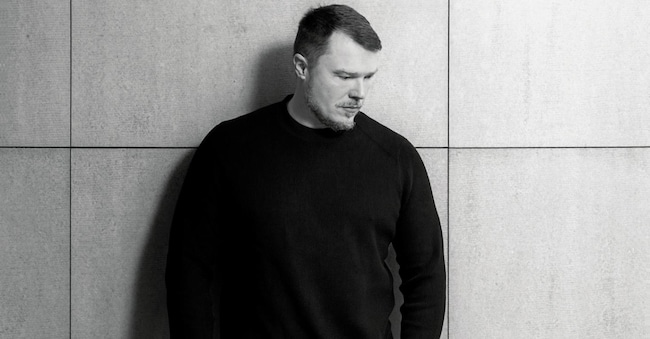
For me it is very important to read the context: understand, study, do a lot of research. And then on this basis, to allow a misalignment. It takes very little to unhinge, to create a contrast: all it takes is an element that puts a certain linearity, rigidity or way of doing things out of place". Hannes Peer talks about the heart of his way of designing, also drawing on his South Tyrolean roots to find a synthesis: 'There is a word, verrücken, which means "to move", and then at the same time verrückt means "crazy". There is an act of madness in not always being aligned. How boring it would be if we all were'.
It is a thought with which the architect born in Bolzano in 1976, with a studio in Milan since 2009 after graduating from the Politecnico, seems to move away from the fuck the context of Rem Koolhaas, with whom he worked early in his career. "I learnt disrespect from him, and yet what Koolhaas did with the Fondazione Prada in Milan is one of the excellent examples of work with the context," explains Peer, who from those beginnings has developed a design philosophy that spans architecture, interior and product design. "From the spoon to the skyscraper, under the sign of Gio Ponti," he recalls. An eclecticism that embraces history and new technologies, craftsmanship and industrial production, and which led him to a collaboration with Minotti: "So many pieces, almost a whole house. Each one very reasoned, very authorial. I added a certain softness to upholstery and shapes, without it being a deconstruction. Minotti has to maintain its DNA'.
It is back to the verrücken, grafted onto a solid Brianza base. 'It's an intense collaboration: on Mondays the appointment is at the factory. I discovered a world of production, a professionalism, a meticulousness reminiscent of the haute couture of fashion. We were working on prototypes in fabric, and they were already thinking in leather, which has a maximum size that can be used, which is fascinating to me: we made a merit of it, with the stitching arriving at a precise point, like a Mondrian painting'.
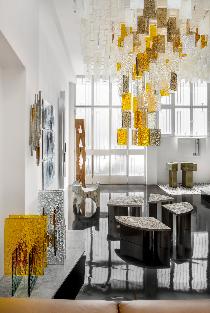
At the Salone del Mobile 2024, Hannes Peer also presented a collaboration with Baxter and some projects with smaller companies such as 6:AM Glassworks by Francesco Palù and Edoardo Pandolfo, the new generation of Murano glass: 'They came to me five years ago. They did not know that I have a very intense relationship with glass: my mother, the artist Ursula Huber, used to take me to Murano furnaces and to North Carolina as a child to learn from Harvey Littleton of the Studio Glass movement. I needed a very large piece, 4 by 4 metres, because for my interior projects I make what I need, and our collaboration began'.
During Design Week, Peer's studio hosted The Clearing installation with the Belgian stone company Van Den Weghe: a forest of travertine marble monoliths that leads the visitor into a path of spatial deconstruction inspired by Peter Eisenman's House IV. A partnership that re-proposes the artisanal vein of Peer, occasionally also a carpenter, and his commitment to collectible design. One example: the Sole coffee table he designed for the Blend gallery in Rome is made by an almost 80-year-old mosaicist from Ravenna, Paolo Racagni.

