The automotive industry and its leaders demand attention for an industry in crisis
Global industry leaders discussed future challenges and necessary innovations. Keynotes by Oliver Zipse ceo of Bmw, Luca de Meo at the head of the Renault group and Carlos Tavares for Stellantis

4' min read
Key points
- Brussels technocrats imposed electric
- The 100% electric solution alone is not sustainable
- One of the alternatives to electric will be hydrogen
- The biggest challenge is regulations
- There's no turning back on electrics.
- For the mobility of the future, stability is needed
- This is no time for debate but for action
4' min read
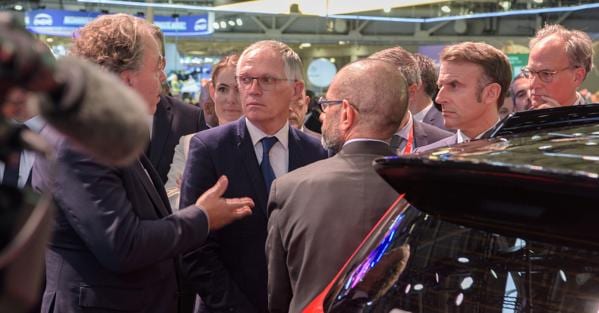
PARIS - After the many new products presented on the day dedicated to the media and industry insiders, it was the turn of the Paris Automotive Summit, which brought together a number of top managers from the automotive industry to take stock of a sector that needs to address and possibly resolve as soon as possible the many critical issues in view of the mobility of the future. Attended by more than 3,000 guests, the Paris Automotive Summit was an opportunity to listen to three top managers from the automotive industry. Oliver Zipse ceo of Bmw, Luca de Meo at the head of the Renault group and Carlos Tavares for Stellantis.
The technocrats in Brussels have imposed the electric
.Highlighting the many critical issues in the automotive sector was Luc Chatel, president of PFA (Platefoprme Automobile), who bluntly framed the theme of the Summit. "The technocrats in Brussels who have imposed on us a single technological solution for the future, that of the electric car, have forgotten the real problem, the customer who decides and who does not believe in solutions imposed from above, and therefore had to be listened to".
The 100% electric solution alone is not sustainable
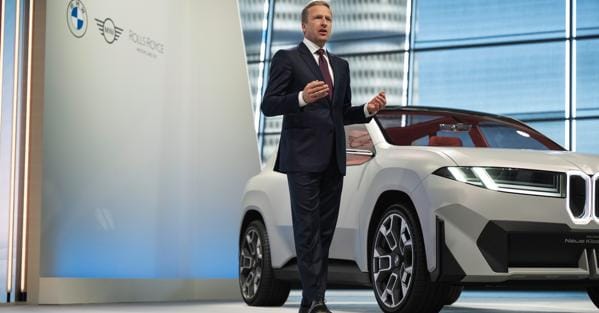
.Entering more into the matter was Bmw CEO Oliver Zipse, who explained that 100% electric will not do everything and above all that there are other solutions as an alternative. 'Europe must maintain its technological leadership,' explained Zipse, 'and consequently it must be demonstrated that to achieve technological neutrality, all technologies that can help reduce CO2 must be considered. Including,' continued Zipse, 'efficient combustion engines, plug-in hybrids and electricity. But that is not all. Considering that there are around 250 million vehicles circulating in Europe, it would be more efficient to power them with synthetic fuels such as e-fuels, according to the Bmw CEO, also pointing to hydrogen as one of the emerging technologies in the future.
One of the alternatives to electric will be hydrogen
.It should also be mentioned that BMW exhibited the iX5 Hydrogen at the Paris show and is working together with Toyota on a new fuel cell to democratise the technology by 2028. Zipse went on to emphasise that it is necessary to support both the production of hydrogen and the construction of infrastructure for recharging vehicles. According to the Bmw CEO, Europe should react with more aggressive long-term strategies than China and the US, adding that the goal of 100 per cent electric and base is to be considered impossible.
The biggest challenge is regulations
.'I can't comment on what other car CEOs do, they know what they do and what happens in their companies. However, I can say that Renault is solid and there are many products on the launch pad'. This was explained by Luca de Meo, CEO of Renault, responding to a questioner asking for comment on the fact that several automotive groups have issued profit warnings and revised forecasts for the current year. "I am worried about 2025, the biggest challenge is related to the regulations that will come into force. That is why we are asking the authorities to make decisions, to set a clear direction. We have to start the year with a situation that is already clear and that has to be addressed in the most pragmatic way," he added. Speaking generally about industry consolidation, Luca de Meo went on to emphasise that 'the automotive industry will always be linked to the size of companies. Now you have to work with different scenarios, play games that are very different from the past and you have to be able to adapt. For our part, we aim to be fast and to work in the most agile way'.