Music

The Beatles are more popular than Jesus (for 60 years now)

On 4 March 1966, John Lennon uttered the famous phrase that scandalised the world. History and geography of the first global pop controversy

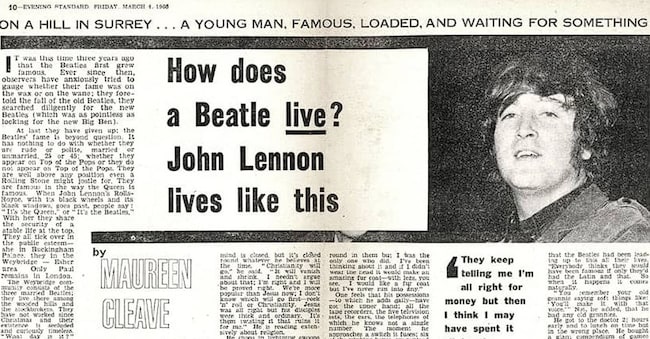
by Francesco Prisco

L’intervista dell’Evening Standard a John Lennon in cui l’artista pronunciò l’affermazione che sconvolse l’opinione pubblica Usa

5' min read

Translated by AI
Versione italiana

5' min read

Translated by AI
Versione italiana

Needless to get around it: the Beatles invented practically everything. In popular music and beyond. And, in their inventing everything, they reached unimaginable levels of popularity for anyone, let alone four twenty-something British working class guys. No one, before them, had ever started a band in which everyone sings because everyone matters, no one had occupied the top five positions of the Billboard Hot 100 at the same time, no one had achieved a lofty title thanks to their recording success. And no one, before them, had ever triggered a worldwide controversy, capable of simultaneously scandalising the American religious right and the Vatican, Mexico and Spain. And make the London Stock Exchange fluctuate.

Continuing around this concept: no one had ever realised before how much a pop star's words could influence everyone's life, because no one had ever realised that entertainers - singers, actors, various artists that they were - are also 'influencers', a now abused term that nevertheless no one used before the invention of social networks.

Loading...

The story was pushed forward by John Lennon, the 25-year-old founder of the Liverpool band, despite himself: on 4 March 1966, exactly 60 years ago, the first of a series of interviews by Maureen Cleave entitled How does a Beatle live? was published in the British newspaper Evening Standard. It all started from an idea of the Fab Four's manager Brian Epstein, whose intention was to make it clear out there that in the case of his assistants, besides the veneer of unprecedented success, there was also a lot of substance. Artistic, intellectual and human.

It was indeed not a trivial phase in the Beatles' history: in December 1965 a masterpiece entitled Rubber Soul had been released. August 1966 would see the release of another masterpiece, Revolver. Two seminal records that helped define the canon of contemporary popular music.

Since, having achieved worldwide success, the Beatles can do whatever they want, why not let them express themselves on the highest systems? Here's John, Paul, George and Ringo discussing youth culture, politics, drugs, sex and... religion. It fits, as the four boys from Liverpool were always effective in their meetings with the press.
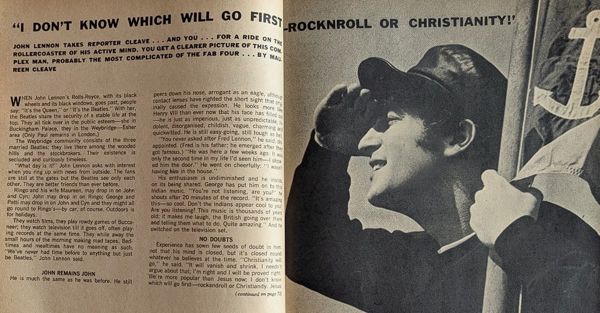
In his interview, however, Lennon indulges in some such assessment: 'Christianity will disappear. It will become obsolete and die out. I do not need to discuss this, I am certain of it and the facts will prove me right. We are now more popular than Jesus. I don't know what will disappear first, rock 'n' roll or Christianity. Jesus was OK, but his disciples were limited and mediocre. They are the ones who distorted him and ruined him in my eyes'. Strong words set in the more general context of a discourse around the relationship between the youth of the 1960s and religion. Statements that were not even mentioned in the headline of the Evening Standard.

Il cristianesimo scomparirà. Diverrà obsoleto e si estinguerà. Non ho bisogno di discuterne, ne sono certo e i fatti mi daranno ragione. Noi adesso siamo più popolari di Gesù. Non so cosa scomparirà prima, il rock ’n’ roll o il cristianesimo. Gesù era a posto, ma i suoi discepoli erano limitati e mediocri. Sono loro che lo distorcono e lo rovinano ai miei occhi

John Lennon, Marzo 1966

There and then nothing happens. Social networks, on the other hand, did not yet exist and a controversy would take weeks, even months, before it took hold. Shortly afterwards, however, in preparation for the American tour in the summer of 1966, The Beatles' press officer Tony Barrow had the ingenious idea of granting a number of US newspapers the possibility of reusing the texts of the interviews in question. Among the selected newspapers was the teenage magazine Datebook, edited by Art Unger, a liberal, pro-racial integration journalist critical of the Vietnam War.

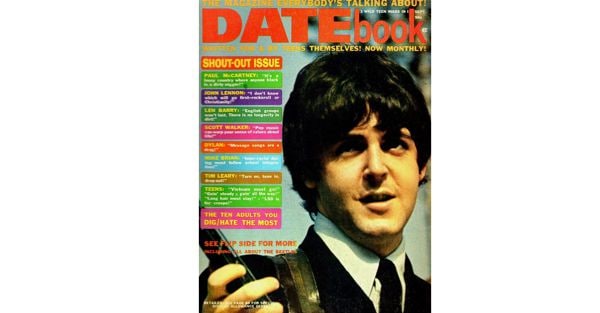
La copertina di Datebook di settembre 1966 che riprendeva l’intervista a Lennon con la celebre frase

But at the same time a lover of headlines: here's the front page with the big face ofPaul McCartney and some shouted declarations. Macca talking about America and saying, "It's a lousy country where anyone who's black is a dirty nigger!" John saying, "I don't know what will disappear first: rock 'n' roll or Christianity!" The editor of Datebook bets everything on the racial issue and in July sends out several advance copies of the September issue of the magazine to radio stations in the Southern States, with the intention of causing discussion. But he is wrong in his prediction: it is not Paul's words, but rather John's that will create debate.

And what a debate: disc jockey Tommy Charles, of the radio station Waqy in Birmingham, Alabama, says live: 'That's enough for me. I won't play the Beatles any more'. A campaign ensues in which the network asks listeners to get rid of Beatles records and merchandise. A second, then a third anti-Beatles campaign was born in the southern States. Not even theNew York Times, the most important American newspaper, stood by and wrote a highly critical article on Lennon's statements.

Even the Vatican, while grappling with the innovations of the Council that had ended three months earlier, stigmatises those words and popular anti-Beatles demonstrations are recorded in Mexico, Spain and South Africa. The Ku Klux Klan goes on the warpath. Beatles record burnings begin, about which Epstein initially downplays: 'If the kids are burning our records, it means they bought them first'. At the same time the Northern Songs, the company that owns the rights to Lennon and McCartney's songs, has a nasty debacle on the London Stock Exchange.

L’intervista a Lennon ripresa su Datebook

How do you get out of it? At first there were even thoughts of releasing a 45 rpm with an apology message from Lennon. But John wants no part of it. So here is Lennon who, having landed in Chicago in August for the start of the US tour, spreads his head in ashes at a press conference: 'I suppose if I had said that television was more popular than Jesus, I would have got away with it. I am sorry I opened my mouth. I am not against God, against Christ or against religion. I wasn't criticising anything. I wasn't saying that we are bigger or better than them."

They ask him what his idea of God is. He replies: "I don't see him as an old man in heaven. I think what people call God is something that is in all of us'. As for his statements of a few months earlier, 'if you want me to apologise, if that will make you happy, then fine, I'm sorry'.

Loading...

Back to the way it was? More or less. The record burning planned for the following day comes to a halt, but the Ku Klux Klan doesn't give up on a few more anti-Beatles demonstrations already organised. The Roman Observer accepts an apology on behalf of the Papal throne and the Datebook editor is asked to hand over a press pass for the tour. He refuses and John, someone who loves to sail against the tide, agrees with him. The controversy, however, had done Unger good: the magazine sold a stratospheric one million copies with that issue.

Immagino che se avessi detto che la televisione era più popolare di Gesù, me la sarei cavata. Mi dispiace di aver aperto bocca. Non sono contro Dio, contro Cristo o contro la religione. Non stavo criticando nulla. Non stavo dicendo che noi siamo più grandi o migliori di loro. Se volete che mi scusi, lo faccio

John Lennon, Agosto 1966

The tour ends and, at the last press conferences, Epstein's team applies pressure: journalists are asked the 'courtesy' of not asking any more questions on the matter. But the Beatles once again overtake their management to the left: John expresses solidarity with young Americans burning military postcards and refusing to leave for Vietnam, the band explicitly condemns the war as unjust.

And above all, they realise one thing: if you have to compromise to play live around the world, better to quit. The one on 29 August 1966 in Candlestick Park, San Francisco, would be their last concert open to the public. After that only studio recordings, experimentation, music as art, a flurry of memorable records in which Sgt. Pepper, the White Album and Abbey Road stand out. And a new awareness: unprecedented success brings unprecedented responsibility. To the public, certainly, but even more so to one's own art, one's own values, one's own worldview. A lesson we should all brush up on today. World leaders included.

Copyright reserved ©
Loading...

Brand connect

Loading...

Newsletter

Notizie e approfondimenti sugli avvenimenti politici, economici e finanziari.

Iscriviti