Dynasties

The beauty gene: in Venice, at the home of Cristiana and Coco Brandolini d'Adda

Between group photos and personal portraits, exotic papiers peints and the genius of Mongiardino, a tale of family and passions: handmade, flea markets, antique shops, vintage.

by Maria Shollenbarger

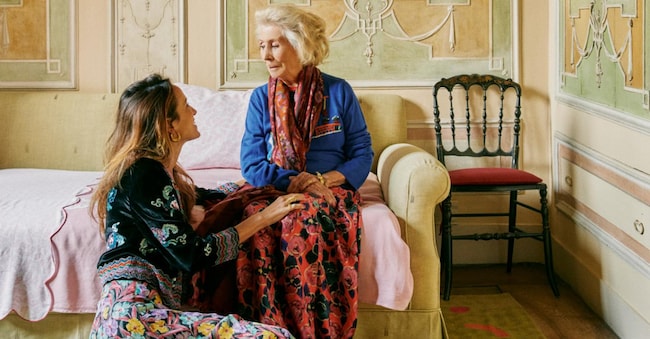
Coco Brandolini d’Adda e la nonna, la contessa Cristiana Brandolini d’Adda, nella residenza di famiglia, Palazzo Giustinian Brandolini, a Venezia. Tutti i capi del servizio sono del brand fondato da Coco, D’ADDA. Tutte le foto Stefan Giftthaler

7' min read

7' min read

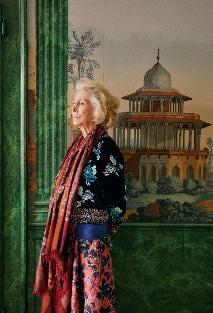
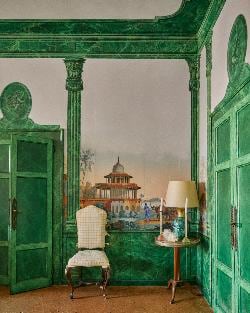
A winter afternoon in Venice, crystalline light floods the sky. It filters through the tall windows of Palazzo Giustinian Brandolini, on the Grand Canal, illuminating the exotic scenes of the papiers peints covering the walls of the dining room. The garden, in the courtyard below, is frozen, the flowerbeds are flowerless and the climbing ivy leafless, but in here banana trees grow on the banks of rivers and huge ficus trees stretch their shade over golden temples, and every scene is enclosed between mock columns and frames of bright malachite green.

Colour and pageantry are an integral part of the Venetian atmosphere, in basilicas, piazzas and also in this palace, where different branches of the same family cohabit. The matriarch, the ultranovantenne Countess Cristiana Brandolini d'Adda, is technically not Venetian - she is from Turin, born Cristiana Agnelli, sister of the Avvocato - and her flat is an emanation of her extraordinary personality, with portraits by Cecil Beaton and snapshots taken at Truman Capote's Black and White Ball attesting to her years of intense social life. In the house upstairs lives Brandino, one of his four sons, whose late wife, Marie, founded the glassware brand Laguna~B (now run by his son Marcantonio, 32, who comes to lunch with his grandmother more or less every week). On the piano nobile is the flat of Diane von Fürstenberg, the ex-wife of Cristiana's grandson, Prince Egon von Fürstenberg, and therefore also part of the family.
Loading...

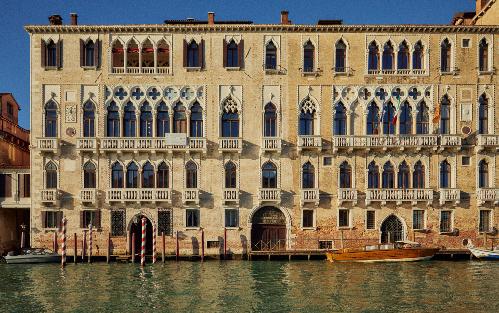
Gli esterni del palazzo, sul Canal Grande.

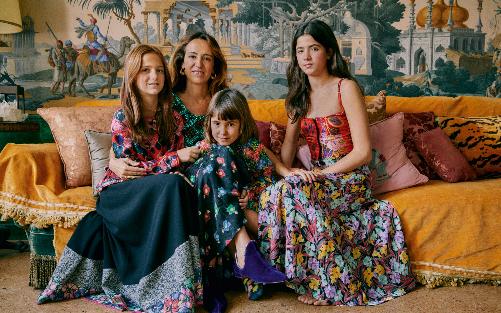
Today, the upper floors of the palace resound with the voices of the fourth generation: Coco, Cristiana's granddaughter, is here with her three daughters, Nina, 13, Lea, 10, and Cora, 6. Like her grandmother, Coco is not entirely Venetian: born and raised in Paris, she studied philosophy and political science there, and then design at Central Saint Martins in London. She spent the first years of her adult life in New York and for the last ten years has lived in Milan with her husband, Matteo Colombo.

What ties her to this town is her relationship with Cristiana, a relationship they both describe as the strongest family bond ever. They talk to each other often, she was the grandmother who took her granddaughter on trips when she was still a child (together with her parents) and they spent entire summers together in Vistorta, the family farm in Pordenone. "We are close," says Cristiana simply. "I watched her grow up and realised that there was great potential in her, but she needed encouragement to express herself. She was a very shy girl'.
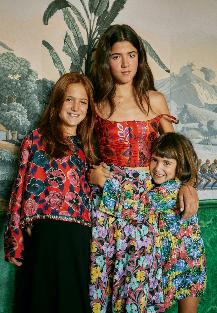
Le figlie di Coco: Lea, Nina e Cora Colombo.

It was Cristiana who convinced Coco to move to New York on her own in her early twenties. A three-month internship at Oscar de la Renta (where she worked with Adam Lippes) stretched over five years; then Coco moved on to Alberta Ferretti and Bottega Veneta (with Tomas Maier). She returned to Milan in 2012 to join the Haute Couture team at Dolce & Gabbana, where she remained for about ten years.
All the time she spent observing and absorbing her grandmother's taste - not only for fashion (in 1975 Cristiana was inducted into the International Best Dressed Hall of Fame) and interior design, but also for art, literature, travel, people - had already trained Coco's eyes.

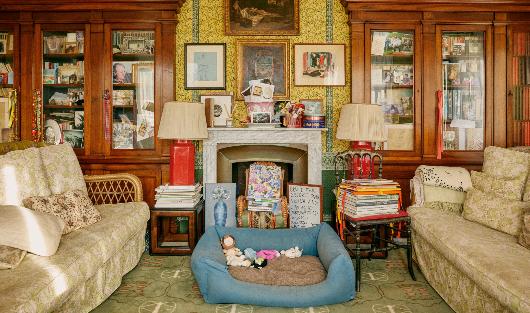
Il salotto al quarto piano: la carta da paratie le librerie sono di Renzo Mongiardino.

Haute Couture allowed her to hone her skills in a professional context. The decision to launch d'AddA, her clothing and accessories line, stemmed from a desire to combine the skills she had acquired in couture with her love of trouvés pieces. The first collection, which came out at the end of 2022, consisted of seventy-five pieces made from vintage offcuts - fabrics sourced from antique markets, tracked down by word of mouth from collectors or purchased from colleagues - or from reclaimed preloved garments. Garments such as an impalpable silk skirt (from €1,400) or a brocade bustier with wing sleeves (€990) are reproduced in small numbers - ten at most - but each has original details that make it unique. Coco has a small atelier in Milan, where she meets clients by appointment. Otherwise, the project consists of a series of trunk shows and an Instagram profile from which it is possible to buy: no sales outlets, e-commerce sites or wholesalers.

La sala da pranzo principale al terzo piano del palazzo, con i pannelli di carta da parati della serie “Hindoustan” di Zuber & Cie (1807), installati nel 1960 circa.

Working with Dolce & Gabbana was the best of gyms. "Coco and I shared creativity, taste, emotions, vision," says Domenico Dolce. "We created magnificent garments together. I remember the first time I met her, we talked a lot about fashion and all of a sudden I asked her: "Do you really like her? Because fashion is serious'. She said yes and I said: 'Then you have to work with us'". Coco recalls those years of total creative freedom: 'From fabrics to production, we had no limits: we could do anything'. The subsequent launch of d'AddA was 'a matter of trust. I had worked for big brands, always feeling very protected, it took me some time to feel that I could dare on my own'. She therefore credits Domenico Dolce with encouraging her: 'He was a super mentor. He suggested everything to me, from how to structure the company to how to promote my idea'. At first, for example, Coco would not have thought of wearing d'AddA's clothes and posting them on Instagram. She would have preferred to present them on a model or to friends. But it was Domenico Dolce who pushed her to focus on personal photos, of herself and her family: 'He pointed out to me that not many people have a story like mine. The relationship with my grandmother, who is really a character, her influence on me: it's all special. 'Use it', he advised me." The trunk shows, so far organised in New York and Paris - in spring they will come to London - are restricted, intimate presentations. But Coco also has several, loyal, foreign buyers who have met her on Instagram: 'They don't care who I am, or to talk to me; they care about my product and the fact that they won't see it on anyone else. They find it, they fall in love with it, they click 'buy', I ship it, stop," she says, smiling. "I love them because they recognise the value of my work."

Cristiana Brandolini d’Adda nella sala da pranzo del palazzo: la vernice verde malachite è un’idea dell’architetto Renzo Mongiardino, del 1960 circa.

She shows me the buttons on the Viola skirt (€1,850), a floral pattern printed on a heavy black silk. 'A vintage print that I replicated on this fabric,' she explains. "It renders very well, better than the original. All the buttons I use are vintage. It's a huge job: I find them in haberdashers - and there are very few left - or from private collectors. At a flea market in Tuscany, a seller from whom I always buy my enamel necklaces, told me about someone who lives outside Rome and has a kind of obsession, she is a serial accumulator of buttons. I went to see her: she had boxes upon boxes of buttons, tens of thousands of them, and she pulled out some wonderful ones,' including the large, hand-blown glass ones we are looking at right now. This special treasure hunt and the resulting encounters are for Coco the most interesting aspect of his business: 'Working with niche artisans, who have been producing the same items for a lifetime and carrying on the manufacturing tradition, is an enriching experience on a human level as well. The appreciation today is mutual. "In the beginning it was not easy to convince some factories to produce, for example, only ten articles, when an order normally arrives for a thousand. There is one supplier who, as soon as he sees me coming, laughs and says: 'I already feel I am going to lose money'. Many of them have known me for years and have understood and appreciated my project'.

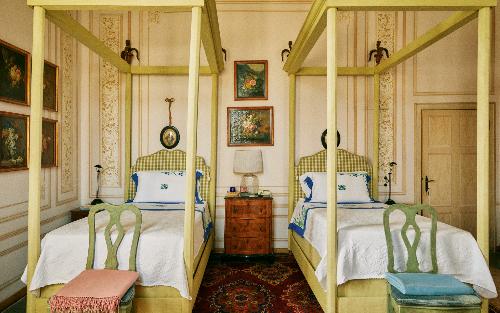
La camera degli ospiti principale, affacciata sul Canal Grande: i letti gemelli sono stati disegnati da Mongiardino, i quadri con i fiori sono stati aggiunti inseguito da Cristiana.

The AddA aesthetic is not for everyone. Those who love minimalism may have already moved on. But while Coco superimposes one d'AddA garment on top of the other, with a result that is quintessentially Venetian opulence, it is not difficult to imagine each piece juxtaposed individually with a pair of jeans, a camisole or a little black dress. For example, the precious short black velvet jacket, embroidered and edged with multi-coloured beads that Coco first tries on herself and then makes Cristiana wear, or the floral blouse (€ 1,250) that six-year-old Cora wears as a dress. The atmosphere probably also plays a role. If the house in which you wear a dress is designed by Renzo Mongiardino, all parameters jump. Cristiana and her late husband Brando were among the first and most frequent clients of the Genoese architect, who was commissioned to furnish the house in Vistorta and the flat in Palazzo Brandolini. Mongiardino's predilection for dramatic effect - he designed both stage sets and grand residences - is evident everywhere, not only in the dining room with its exotic papiers peints.

Coco con le figlie nella sala da pranzo. Il divano è rivestito da tende originariamente appese nella sala da pranzo invernale del secondo piano del palazzo.

On the walls of the living room and entrance hall, paint creates the effect of stone and fabric finishes. In the cinema room - a small lounge bathed in shades of red, with an enormous television and a row of upholstered armchairs upholstered in a khaki fabric by Bennison with an ivy design - there are trompe-l'œil effect columns and gilded medallions. Upstairs, on the fourth floor, is a smaller, low-ceilinged living room known as Grandma's room: two rattan sofas are placed opposite each other and in the middle is a doghouse (Cristiana's three dwarf dachshunds never stray too far from her), on the tables and chairs are piled books and magazines. Everywhere, framed or not, spread out on coffee tables or mantelpieces, tucked into the corners of a mirror, are family photos. "She was my first granddaughter, and in a way my first daughter, since I had four boys," says Cristiana of Coco. "Maybe that's why I devoted more time to her." The photo shoot is over and the two protagonists, grandmother and granddaughter, are sitting in the living room, hand in hand. Coco's daughters, who have left the scene to go to lunch, are upstairs.

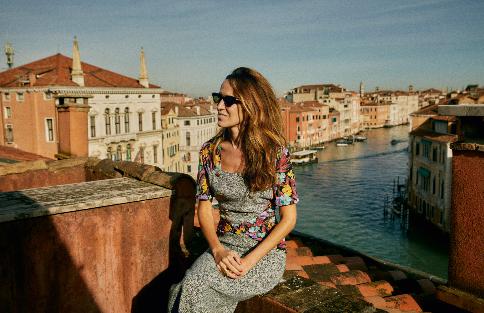
Coco sulla terrazza al quarto piano, vista Canal Grande.

Cristiana still wears the short velvet jacket that Coco slung over her shoulders in the dining room for the last shot. Vivid turquoise beads reverberate the blue of her simple jumper and light blue eyes. So the fashion gene has been passed down through the grapevine, I suggest to Cristiana. Not of fashion, she corrects me sharply. "Of beauty." Coco nods. 'As a child, I was fascinated by grandmother's world. Maybe not every child would have been, but I was. All those little artisans she would go out to find to have special cushions or sheets made.... It is thanks to her that today I am able to spend hours and hours selecting fabrics'. The laughter softens into a smile. "It is thanks to her that I see beauty in the details.

Copyright reserved ©
Loading...
Loading...

Newsletter

Notizie e approfondimenti sugli avvenimenti politici, economici e finanziari.

Iscriviti