The unreleased

The Bee and the Mulberry Tree

We publish an unpublished text by Fiammetta Palpati, winner of the Campiello Opera prima prize, with her novel La casa delle orfane bianche .

by Fiammetta Palpati

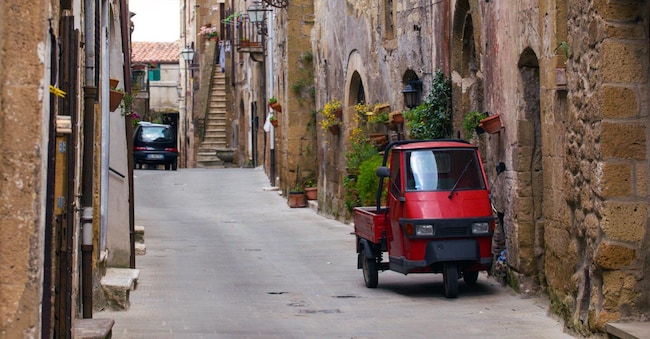
Ape Piaggio (Adobe Stock)

7' min read

7' min read

The text that follows - here entitled The Bee and the Mulberry Tree - was excerpted at the editing stage from the novel 'La casa delle orfane bianche' (Laurana editore, 2024), for reasons of story balance. The episode refers to the moment when, in the second act, the protagonists - the three White Orphans - resolve to tackle the issue of the rubbish they have accumulated in the house and of which, for a sort of reasonable and, at the same time, mysterious enchantment, they are unable to get rid.

Since the 1950s, the Ape has replaced the mule. Let's just say it is a pick-up de noantri. But much more agile, manoeuvrable. There is no uneven ground, no ditch, no quagmire, from which it does not come out (perhaps by pushing); no bottleneck into which it does not slip (leaving the rear-view mirrors behind), no bend that it cannot tighten (rolling over), no staircase that it cannot climb down (falling back, alternately, left and right, on the front or rear wheels). Not to mention the versatility and capacity of the body, which can take the most diverse weights and encumbrances. The passenger compartment is wide enough for two - driver and passenger, who end up as one body against the door when steering - but shallow. The seat is cramped and hard, so that bouncing around on the too-rigid, or unloaded, shock absorbers can result in one's stomach being stabbed by the handlebars. Or banging your chest on the dashboard, when not your forehead on the windscreen. On the other hand, the Ape allows children - who generally ride on the side or on their grandfather's lap - one of the first exhilarating experiences of the physics of gravity, and the elderly to continue driving even with those defects of sight and reflexes that would discourage the use of a real car but which, in the case of the Ape, are tolerated. Replaced by long experience. By prudence. One's own or that of the other drivers who usually take care to steer clear of the bees. In sum, a merry-go-round.

Loading...

A loud thump, like a fart; the clutch engages; a blackish smoke; and then - out of the curve, with the headlight rounded upwards - comes Mr Primo's yellow Ape: Natàlia is driving it with a smug expression - her head brushing against the roof every time the vehicle hits a stone, a pothole, a step. In front of the front door she dismounts: engine running, air drawn - the spark plug is dirty and the engine has started by a miracle - red cheeks and bright eyes. Crackling and the smell of farm diesel all the way into the room.

Absent mothers and nuns, locked in the bedroom, watching over each other.

Germana and Lucia ready, next to the rubbish.

The orphans load the caisson.

Natàlia: 'I'm going'.

Lucia: 'I'm coming too'.

Germana: 'Me too.

A look at the house, at the old ones.

"What if they kill each other?"

"If they kill themselves, they don't do a penny of damage".

"...".

"Then, however, there's Primo... downstairs."

"Right.

"...".

"You left him the phone?"

'Of course'.

They iron and bind everything - scrap metal, furniture, black sacks - shrouded in exhaust smoke. Natàlia in first position. Germana mounts the side - metallic clangour of the door. Lucia is missing. She is left - last - in the hall. She takes a big breath, plugs her nose and activates, one after the other, the three self-emptying canisters of insecticide, enough for the disinfestation of ninety cubic metres. He runs outside. He slams the door behind him. With the urge to flee, he climbs up onto the caisson, crouches down among the rubbish.

Knock knock, on the glass.

Off we go.

The ramp downhill.

The mumbling of the shaky muffler.

The rumble under the dark vault of Madonnella.

A cheerful march.

A mischievous breeze.

***

So. We are alone.

The venomous haze is dissipating and this room looks ghostly empty without all the junk we had, by now, grown accustomed to. Yes, we are indeed alone, my dear Damian.

Come, come closer... don't be afraid.

Keep me company.

Let us face it.

Careful leaning out. Give me your hand.

The courtyard - the farmyard - seen from up here appear to be just what they are: a terrace. You can sense their not being part of a field, but of a rocky coast, enclosed upstream by this house and on the sides by small walls and rustic buildings that mark the property, or the passage, with the communicating vegetable gardens; made of the same stone on which they rest, some tufa and brick waste at the corners, and covered, if need be, with sheets of Onduline. But opposite, on the outer side of this handkerchief, the emptiness beyond the parapet is complete. One is seized with dismay, until the intellect becomes accustomed, after so much anguish, to the faculty. One's gaze plummets - oh ohh - but immediately rises again!

It was a soft fall, on grassy bushes. Rolls. Rollings. The millenary hills have stretched out, comfortable surfaces: eroded the roughness, widened the sides, filled the valleys, they let themselves be climbed over without excessive fatigue. Neither jolts nor jolts or surprises. The rhythm is that of a wide, regular stride: a little momentum and, from summit to summit, you find yourself at the level. A river - a Tiber not yet blond.

Hot. Dishevelled. You catch your breath.

Elbows on the ground, lift your back a little. Dazzling light. We squint around. The shadow, the dark silhouette of the Cimini Mountains, dark and distant, only touches our feet. Between us and these specimens of the Antiappennino laziale runs too much space, too many leagues. On the gentle Amerino hills the sun rises and sets.

Primo - the honest neighbour - bustles by the old tree. For a good hour he has been working around it, with hacksaw and scissors. He cleans the tree from the thicket of lignified shoots. Without haste.

For the third time he moves the ladder, searches for support on the ground - among the prunings and weeds - he puts the last rung on the trunk, shakes it, checks the firmness of the support, puts the visor on his forehead. And up he goes. One last peg is missing, then the trunk will be completely shaved. He saws the largest branches flush: half from one direction, half from the opposite. One hand supports the fall. The blade cleans the wound of those that have given way, shaken by their own weight. Then he puts his hand to the scissors, for the thinner ones. They are very numerous. They fall at the first blow, one after the other to the monotonous, reassuring rhythm of the spring.

Tac. Tac. Tac. The tree is naked.

What remained was a dulled plank, whose lumpy shadow, in the middle of the courtyard, shifted like the rod of a sundial. Arthrotic. Disproportionate: wide at the base and top - little or no tapering in the middle; and folded in on itself, full of scars, and open wounds.

It no longer supports anything but the memory of the weight borne. The memory of the body.

"Naked female kneeling, bent, crushed on herself and totally moulded by the hand of weight, whose load sinks into all her limbs like a never-ending fall (...) And she holds as one holds the improbable in a dream, with no possibility of release. And its bending and yielding is still a bearing, and as soon as it is overcome by the near exhaustion that will force the body to lie down, this lying down will also be a bearing, an endless bearing. Thus is Caryatis'.

Thus Rilke on Rodin.

So this mulberry tree, this house, these women.

Primo finished, put the ladder away. I put away the scissors. With the scythe he now clears the biggest branches. He cuts them to size. For chimney and stove. Stacked dry, under the cellar roof. Of the remainder he has prepared bundles: sorted by each size of wood. Tied with string. Side by side. Ready for every kind of fire: lighting, roasting, heating.

He is sweating on his forehead, on his cheeks. He wipes with his back. He puts his cap back on - a checked cap. He looks around.

At the drinking fountain. Move the net. The chicks cluster around the trousers, pecking at the fabric, the work boots. It has been three days since they have been in the house, and apart from the two losses we have already sadly reported on, the remaining ten seem to have doubled in volume. There is a stubbornness, a fury, in the way they claim to be fed, fattened.

First: one hand under the plastic cinnamon, on the face, on the neck, on the hardened folds. Handkerchief. Cotton.

Some chickens take a leap: the golden plumage is already no more; the first feathers - more tenacious, more dull - have replaced it.

A pinch on the knee.

"Ajo!"

In the container at the base of the hopper there is only a remnant of floury feed.

The man goes through the small door of the stall - his cap touches the moth-eaten beam - he comes out with a bucket. Wheat, corn, soya, sorghum, peas. Sprinkled, abundant, with his hand.

The chickens seem to have gone mad. The fragments, the broken ones, disappear at a glance. Then follow the barely larger grains. Some end up in the beak and are then spat out, far away.

Half an hour later there was nothing left but some whole corn; stubborn.

Copyright reserved ©
Loading...

Brand connect

Loading...

Newsletter

Notizie e approfondimenti sugli avvenimenti politici, economici e finanziari.

Iscriviti